Bridging Visa C (BVC) which is also popularly known as the subclass 030, is a safety net for you in this complex migration system of the Australian government. If you are in a situation where you find yourself “unlawful” but are actively seeking to regularize your current status in Australia. Unlike more flexible visas available in the Australia Migration Programs, the Bridging Visa C is a specifically designed visa that is targeted to individuals who lodge a substantive visa application after their previous visa has already expired.
In this meticulously drafted guide by BJay education & Visa Services, we have complied information and data regarding the Bridging Visa C that is verified against the Department of Home Affairs (DHA). This guide seeks to help you navigate through the BVC with ease and secure a positive Bridging Visa C result.
Bridging Visa C
Bridging Visa C (BVC) or the Subclass 030 is a visa amongst the various bridging visa programs that are available in the Australian Migration landscape. This specific visa is a temporary visa that is granted to you if you are already in Australia but aren’t currently holding a valid visa to apply for a substantive visa program (e.g. Partner Visa 820 or 190 visa). The BVC is a non-travel visa which basically means that the Bridging Visa C doesn’t provide you with a travel permission and you can’t leave the turf of Australia in this specific visa.
How Does Bridging Visa C work?
If you are someone who has overstayed in Australia with your prior visa and have lodged an authorized application for a new one, there is a transitional visa known as the Bridging Visa C (Subclass 030). As soon as it is granted, it is active, guaranteeing you with continued legal status in Australia. With BVC, your Travel rights is prohibited, and you cannot return back to Australia. Additionally, it usually entails a work restriction (Condition 8101), which can only be removed in the event that the applicant can prove financial hardship. Until the substantive visa is decided, the BVC is still in effect. If the substantive visa is denied, there is a 35-day window for an appeal or departure.
At BJay Education, we frequently encounter the presumption that a Bridging Visa C can be upgraded to a BVA. But the harsh truth is that it can’t. The BVC is a lower tier bridging visa since it is triggered by an illegal status. To completely avoid the BVC travel lock, we here at BJay suggest that you lodge your substantive application just before your existing visa expires.
Difference between Bridging Visa C and B and A
The current Australian migration system provides you with multiple bridging visas and people have confusion on the differences between bridging visa C and B and A. The different bridging visas serve specific purposes according to their design. The comparison table below helps to clarify the question better:
| Feature | Bridging Visa A (BVA) | Bridging Visa B (BVB) | Bridging Visa C (BVC) |
|---|---|---|---|
| Eligibility | Valid visa at the time of visa lodgment. | Individuals holding a BVA or BVB. | No valid visa at the time of visa lodgment. |
| Travel Rights | None (Visa ends on exit). | Permitted (Re-entry). | Strictly Prohibited. |
| DHA Cost | AUD $0 (Free) | AUD $190 | AUD $0 (Free) |
| BVB Pathway | Eligible to apply to BVB | Already holds BVB. | Strictly Ineligible to apply for the BVB |
| Work Rights | Often automatic | Inherited from the BVA or previous visa. | Usually 'No Work' (condition 8101). |
| Granted Time | Onshore substantive application while visa valid | Apply when there is a travel need on BVA | Apply after visa expiry |
Bridging Visa C Conditions & 2026 Restrictions
If you are someone who is looking to know about the BVC then you must understand that by holding a Bridging Visa C in 2026, you have to abide with a certain set of legal rules and conditions. As this visa is typically granted to those who were unlawful at the time of their application, the DHA tends to impose stricter limitations on this visa as compared to Bridging Visa A. Here are some Visa restrictions that you have to know:
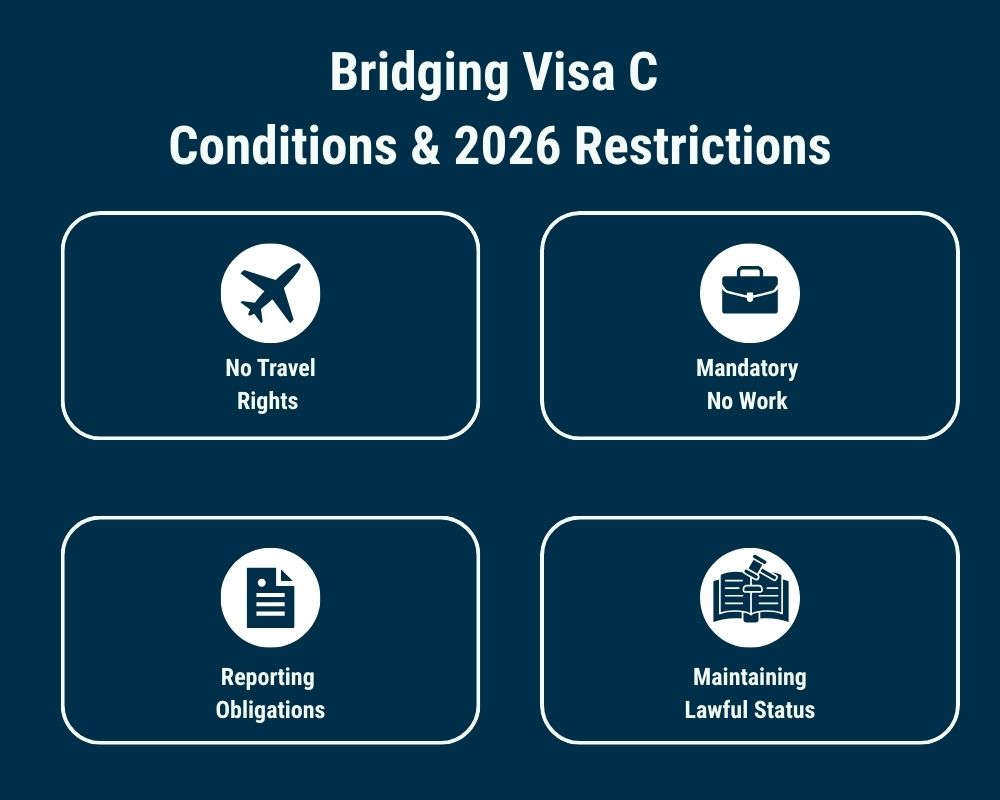
No Travel Rights (Condition 8001)
In the current context of the Australian migration scene, the BVC has a strict and absolute lack of travel rights which basically means that you are not allowed to leave the turf of Australia and if you choose to do so you can’t return back to Australia. While various Bridging Visa like the BVA enjoy the ability to apply for a BVB and travel, the BVC is a visa program that strictly prohibits travel and you can’t apply for the BVB to travel outside the turf of Australia
Mandatory “No Work” (Condition 8101)
With the Bridging Visa C, it usually comes with the Condition 8101 which basically means that if you are holding a BVC then you are not allowed to work in Australia. You are usually prohibited from working but you may be provided with an exception and can be granted with automatic work rights if you have applied for specific SkillSelect Visas like Subclass 189, 190 or 186. If your visa doesn’t fall under these specific visa programs, you must remain unemployed unless you successfully apply for a new BVC by proving “Compelling Need to Work” due to severe financial hardship.
Reporting Obligations
Under the “Integrity-First” protocol used by the DHA in 2026, some BVC holders, particularly if you have complex immigration histories in the past, may be subject to reporting conditions like:
- You may be required to check in with the DHA at specified intervals.
- If you have made any changes to your residential address, phone number, or passport information, then it must be reported to the DHA within the time span of 14 days.
Maintaining Lawful Status
If you are someone who has successfully secured the Bridging Visa C then you must know that the BVC is only valid for the time being until your substantive visa is active. In case that your main visa is refused by the DHA, your BVC is ceased within 35 days after getting the refusal notice. If you are not able to lodge an appeal within the strict timeframe given by the DHA, you will become an unlawful non-citizen again, risking detention and a 3-year re-entry ban (PIC 4014).
Conditions table:
| Condition Code | Restriction Type | 2026 Rule Details |
|---|---|---|
| 8001 | Travel | No re-entry. Visa ends if you leave Australia. |
| 8101 | Work | Prohibited unless "Financial Hardship" is proven or Skilled Visa applied. |
| 8506 | Address | Must notify DHA of address changes within 14 days. |
| 8501 | Health Insurance | Must maintain adequate health cover if required by the main visa path. |
Bridging Visa C Work Rights Application
With the major changes happening around the globe and with the Australian migration scene to be specific, the bridging visa c work rights application has been a hot topic that has been widely discussed. Usually, most BVC Visa are granted with Condition 8101 (No Work). However, you can apply to have this condition removed and work in Australia.
How to Apply for Work Rights
If you are on a BVC and need financial support to support yourself, you must lodge a request for a new BVC with “nil conditions.” In 2026, this is done via your ImmiAccount or by uploading Form 1005. You must provide Evidence for Financial Hardship by providing the following:
- Bank Statements: You are required to provide at least 3 months of bank account history for all accounts.
- Expense Audit: You need to provide evidence that shows your rent, utilities, and essential grocery costs and need work to support the expense.
- Income Proof: You will need to provide evidence that your current savings are insufficient for survival in Australia, and you require work rights to survive in Australia.
- Job Offer: While it is not a mandatory condition, a letter from a potential employer showing the employment details can strengthen the claim so that the concerned authorities can further access the application with ease.
Processing Time
In 2026, the DHA streamlined various digital processes, but the bridging visa c work rights application processing time remains variable because each case is manually assessed for “Financial Hardship.” As the DHA doesn’t provide a standard bridging visa c work rights application processing time, we can only predict the time with the data trends from successful applicants show the following ranges:
| Case Type | Estimated Processing Time | Outcome Probability |
|---|---|---|
| Standard Online Lodgment | 7 to 14 Business Days | High (if evidence is complete) |
| Complex/Manual Review | 3 to 4 Weeks | Moderate (may require more info) |
| Urgent | 2 to 5 Business Days | Case-by-case (requires escalation) |
Bridging Visa C Eligibility
If you are someone who is currently looking to apply for the BVC then you must meet the strict requirements provided by the DHA. As the BVC is a visa program specifically designed for certain circumstances, you must follow the given eligibility criteria to be eligible:
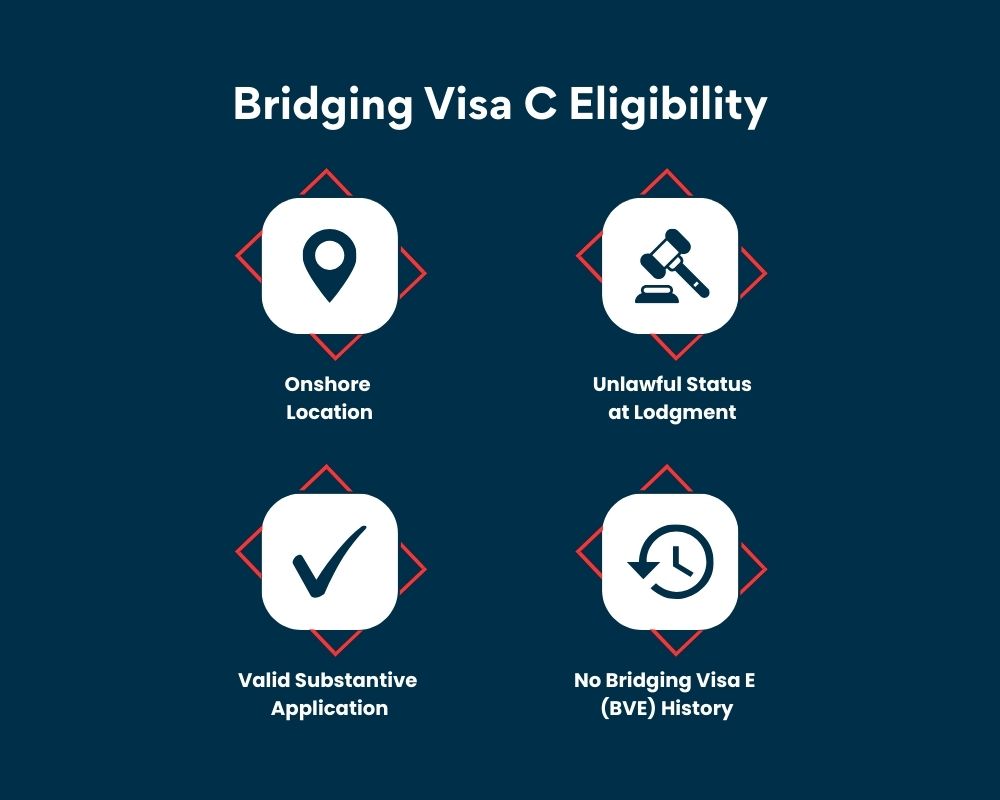
- Onshore Location: If you are looking to apply for the BVC then you must know that you are required to be in the turf of Australia while you apply for it as well as the BVC is granted to you.
- Unlawful Status at Lodgment: If you are trying to apply for the BVC then first and foremost you must be in an unlawful status in Australia at the time you submit your new application, which means that you either have a Bridging Visa A or B or that your previous visa has expired.
- Valid Substantive Application: You must have submitted an acceptable application for a substantive visa, such as a Protection, Skilled, or Partner visa, that can be granted while you are in Australia.
- No Bridging Visa E (BVE) History: If you want to apply for the BVC then you must not have had the BVE visa currently or even in the past is not accepted.
Bridging Visa C Application Process
While 90% of Bridging Visa C applications receive the automatic grant where if you lodge a valid substantive visa, the system detects that you currently don’t hold a valid visa and triggers the BVC automatically. However, if your substantive application is still pending and you want to waive Condition 8101 (No Work) due to financial difficulty or because your previous bridging visa has expired, you can apply for waiver of the condition.
Step-by-Step Process:
| Step | Action | Platform/Tool |
|---|---|---|
| Step 1 | Check Status | To make sure you don't already have a BVC, use VEVO. |
| Step 2 | Prepare Form 1005 | Even for online uploads, download and fill out Form 1005. |
| Step 3 | Access ImmiAccount | Log in to the account used for your substantive visa. |
| Step 4 | Submit Webform | Use the "Bridging Visa A, B, C Application" online webform if your main visa was paper-based or is under review. |
| Step 5 | Attach Evidence | Upload passport scans and, if applying for work, Financial Hardship proof. |
Common Pitfalls And Solution of Bridging Visa C
In 2026, understanding the Bridging Visa C and its pitfalls and their professional solutions is key to protecting your residency path in Australia. With major changes happening in 2026 with the Australian migration system, DHA has made the application process stricter making it easier to fall into status traps.
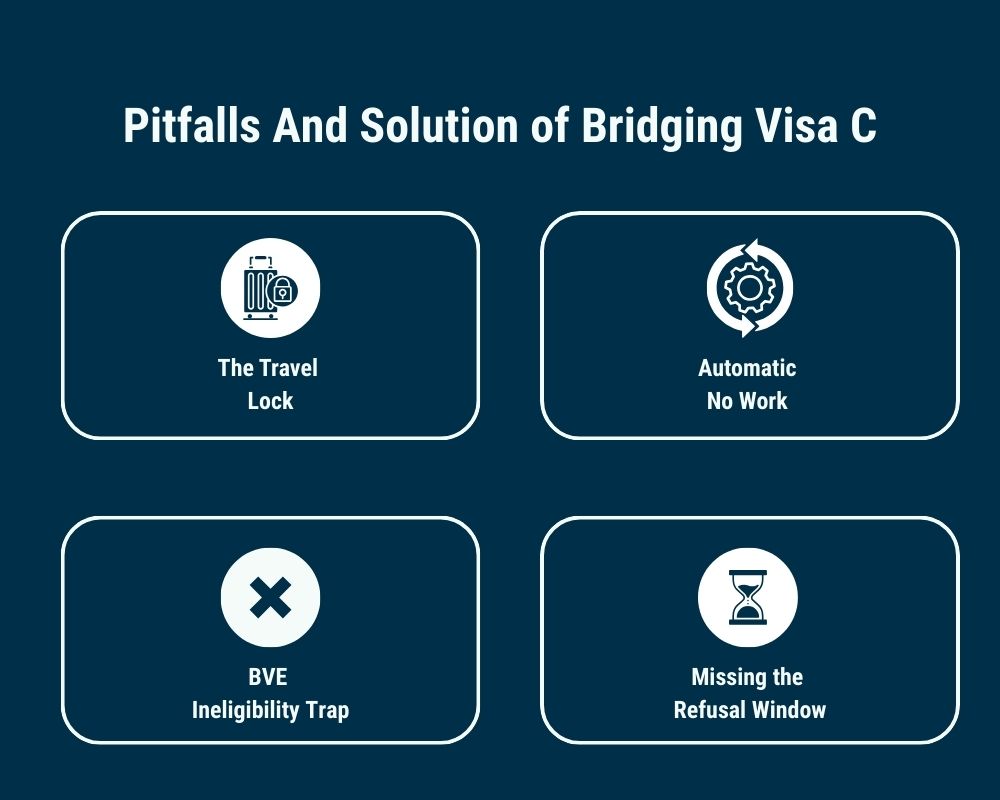
Pitfall 1: The Travel Lock
The Issue: Unlike Bridging Visa A, the BVC has no re-entry facility. You cannot apply for a Bridging Visa B (BVB) while holding a BVC. If you leave Australia, your BVC ceases immediately, and you will be stranded offshore while your substantive visa is processed which can make you wait years.
The Solution: Do not book travel. If an extreme emergency occurs, you must consult a migration expert immediately. Your only “solution” is to remain in Australia until your substantive visa (like a Partner or Skilled visa) is granted, giving you full travel rights.
Pitfall 2: Automatic “No Work” (Condition 8101)
The Issue: Working even for one hour while Condition 8101 is active is a criminal breach of visa conditions. In 2026, the DHA’s real-time data sharing with the Australian Taxation Office (ATO) means illegal work is detected almost instantly.
The Solution: Proactively apply for a Work Rights Variation using Form 1005. You must provide “Decision-Ready” evidence of financial hardship, such as bank statements showing your savings are depleted and a detailed budget of your weekly living expenses in Australia.
Pitfall 3: The BVE Ineligibility Trap
The Issue: You cannot get a BVC if you have held a Bridging Visa E (BVE) since your last substantive visa. Many people unknowingly move to a BVE to resolve a status issue, not realizing it “poisons” their eligibility for a BVC later.
The Solution: Before moving between bridging visas, check your Movement Records. If you have a BVE history, your strategy must change. At BJay Education, we review your full visa history to ensure you don’t accidentally lock yourself out of the BVC pathway.
Pitfall 4: Missing the 35-Day Refusal Window
The Issue: If your main visa application is refused, your BVC doesn’t last forever. It typically expires 35 calendar days after the refusal.
The Solution: You have 35 days to file an appeal with the Administrative Review Tribunal (ART) or apply for an alternative visa. You become an “unlawful non-citizen” and risk a three-year re-entry ban if you miss the deadline by even one day.
FAQs on BVC

No. With the BVC, you are not allowed to travel outside of Australia. If you still choose to travel outside of Australia while being on a BVC, you will have no legal way to return to Australia until your substantive visa is granted, which could take months or years.
Yes. While BVC generally comes with no work (Condition 8101), you can apply for a new BVC showing evidence that you have financial hardship and without work you can’t survive in Australia. For this you need to fill out Form 1005 and provide the required evidence that proves your hardship.
No. While being on a BVC visa, you aren’t allowed to travel and cannot transition from a BVC to BVB. While being on a BVC you will have no way to return back to Australia if you choose to travel as BVB pathway is not available.
No. A bridging visa C cannot be transitioned to a bridging visa A. Your status at the time you apply for your substantive visa determines the sort of bridging visa you need. You cannot “upgrade” to a BVA since a BVC is given because you were “unlawful” (had no valid visa) at the time of filing.
If your BVC is rejected, you will have 35 calendar days to lodge for review or you must leave the turf of Australia.
If your BVC was granted, it ends the moment your substantive visa application is granted.
While on a BVC, you are generally subject to Section 48 Bar if you have had a visa refused or cancelled. However, you can still apply for:
- Partner Visas (Subclass 820/801)
- Protection Visas (Subclass 866).
- Child Visas.
- Medical Treatment Visas.
- BVC (for work rights variations).

With the recent changes in the Australian Migration scenes, Bridging Visa C requires more than just filling out forms. It requires a strategic defense to ensure that your long-term residency isn’t compromised.
Why BJay?
- Decades of Proven Success: Led by Jaya Prakash Oli (MARN: 1570827), our team has successfully managed over 10,000+ cases across 20+ countries since 2011.
- Complex Case Specialists: We excel in rectifying “unlawful” status. Whether you’ve overstayed by a day or a year, we provide the legal pathway to regularize your stay.
- Strategic Work Rights Variation: We don’t just submit Form 1005; we build a comprehensive Financial Hardship Portfolio. Our team helps you compile bank audits, statutory declarations, and expense reports that meet the DHA’s strict “compelling need” threshold.
- Global Presence, Local Support: With flagship offices in Sydney, Kathmandu, and Birtamod, we offer 24/7 support for students and professionals moving between Nepal and Australia.
Having Trouble with Bridging Visa C applications? Book a Free Non-obligatory Consultation with BJay!