
Skills Assessment is the first step if want to pursue your studies, work, or migrate to Australia. A skills assessment in Australia is one of the key parts of your visa journey. Under the Australia’s General Skilled Migration (GSM) and employer sponsor visa schemes, acquiring a positive skills assessment is a requirement for skilled migration. For a positive migration process, you must provide the required proof that the skills you have are suitable and that your abilities are appropriate for the position you have been nominated for.
This guide provided by BJay Education and Visa services strives to help you know about the Skilled Assessment in Australia and help you to understand and guide you to work, study or migrate in Australia without any hassles.
What Is a Skills Assessment in Australia?
A skills assessment is an evaluation conducted by an authorized assessing body to confirm that your education, your work experience, your skills, qualification are on par to Australian equivalency and standards.
Skills assessments ensures that your profession meets the standards required in Australia. They are compulsory for every skilled visa, including:
- General Skilled Migration (GSM) Visas:
- Skilled Independent Visa (subclass 189)
- Skilled Nominated Visa (subclass 190)
- Skilled Work Regional (Provisional) Visa (subclass 491)
- Employer Sponsored Visas:
- Employer Nomination Scheme Visa (subclass 186) (Required for Direct Entry stream)
- Temporary Skill Shortage Visa (subclass 482) (Often required for certain occupations)
- Temporary Graduate Visa (subclass 485)
Key Assessing Authorities in Australia
To increase authority, it is important to mention the specific organizations that carry out these key works:
Do You Need a Skill Assessment?
The answer to that question is probably a yes, as most of international students and skilled workers planning to live in Australia for a longer period, it will require a skills assessment, as it is usually the first step while applying for a skilled visa, including subclasses 189, 190, and 491.
For certified trades like electrician or plumbers, a skills assessment is requirement that should be fulfilled before getting their state license. Additionally, if you are trying for a 485-graduate visa, you must note the distinction: an assessment is only required if you apply for the Graduate Work stream (GWS). If you are applying for permanent residency (189, 190, 491), a provisional skills assessment is not suitable; you will need a full assessment. In conclusion, if you are looking to study, work or migrate to Australia, getting a skills assessment is an essential step that ensures your qualifications and experience are of Australian Standards.

How to Choose the Right ANZSCO Code for your Skills Assessment?
Probably the biggest mistake migrants make in the process is selecting their ANZSCO code based on their job title and not their actual job duties. Assessors in 2025 are focusing so much on the “70% Rule”, which basically means you have to satisfy at least 70% of the official ANZSCO daily tasks, descriptions, and requirements. You must be able to choose the correct ANZSCO code which would meet the conditions set before it.
The 4-Tier Priority System
There was a ranking system designed into the invitations offered under the ANZSCO schemes, and this was made public by the Australian government towards the latter part of 2025:
- Tier 1: This is the highest priority job on the ANZSCO list, which includes the healthcare sector (doctors, nurses, midwives).
- Tier 2: Education (Early Childhood, Secondary, Special Ed) – This is categorized in the High Priority Occupation List of the ANZSCO.
- Tiers 3 & 4: This category of professionals, including engineers, ICT professionals, and tradesmen, ranks lowest on the ANZSCO categories.
Skills Assessment Requirements
Even though the skill assessment varies from occupation to occupation and the requirements also different significantly from one to other, the basic requirement you must provide are:
- Proper identification documents like passport, photos, CV that can be used for authentication process.
- Relevant Work Experience depending on the nature of the work and the daily task provided by the ANZSCO codes
- Relevant Qualifications according to the nature of the work
- English Proficiency test certificates (IELTS, PTE, or TOEFL)
Step-by-Step Skills Assessment Process in Australia
Successfully navigating a Skills Assessment requires a surgical approach to documentation and timing. In 2025, authorities have transitioned to “Decision-Ready” digital models, meaning your initial submission must be flawless to avoid being sidelined by lengthy administrative requests. This four-stage roadmap outlines the critical path from occupation mapping to receiving your formal outcome letter.
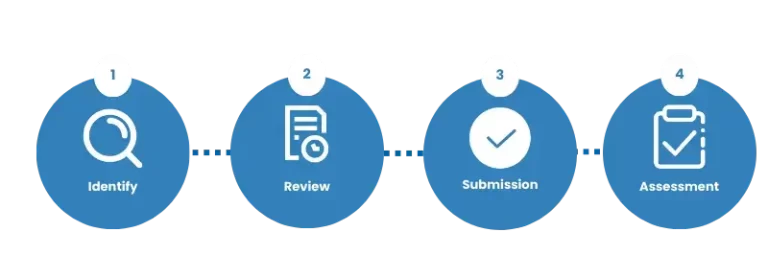
Step 1: Occupation Identification
Identify your 6-digit ANZSCO code. Don’t just look at the title; download the full task list from the Australian Bureau of Statistics (ABS) or the assessing authority’s website.
Step 2: The “Post-Qualification” Experience Check and review
Most authorities, especially VETASSESS and ACS, deduct years of experience. For example, if you have 5 years of experience, ACS may “deem” 2 of those years as your “qualifying period,” leaving you with only 3 years to claim for points. BJay Education & Migration helps you calculate your “Deemed Skilled Date” accurately to avoid EOI errors.
Step 3: Gathering “Decision-Ready” Evidence and submission
In 2025, “generic” HR letters are no longer sufficient. You need:
- Detailed Reference Letters: you must include start/end dates, specific duties, salary, and supervisor contacts to show authenticity.
- Verifiable Pay Evidence: You should provide certain financial documents like payslips, tax records, or bank statements for every year of claimed experience.
- English Proficiency: While it is not always required for the assessment process (except for some medical roles), it is required for the visa. Aim for IELTS 8.0+ or PTE 79+ to maximize points.
Step 4: Assessment of the Submission
Once your “Decision Ready” portfolio has been submitted, it will then be assessed against Australia’s standards by the assessing body, and in some cases, you may be asked to undertake an interview and have your documents verified to send you your final letter of outcome.
Common Reasons for a Negative Skilled Assessment Outcome
With migration scrutiny reaching record highs in late 2025, the margin for error in a Skills Assessment application has never been smaller. The first step in building a resilient application is to understand the main triggers for rejection, which range from technical “ANZSCO mismatches” to “post-qualification” evidence that is not good enough. Identifying such pitfalls early allows you to implement proactive strategies with a view to securing a positive result at the first attempt.
| Reason for Rejection | Description | How to Avoid |
|---|---|---|
|
ANZSCO Mismatch |
Your job title and actual duties do not match with the main tasks listed for your ANZSCO code. |
Do not rely on your job title; make your reference letters to match at least 60-70% of the ANZSCO duties. |
|
Insufficient Work Evidence |
Failed to prove employment through different verifiable third-party evidence |
Provide consistent, verifiable documentation throughout claimed employment period. |
|
Experience Gaps |
Claiming experience that is not considered “post-qualification” or “at a skilled level” by the related body. |
Understand the rules—the experience required to meet the minimum threshold is deducted and cannot be claimed for points. |
|
Unverifiable References |
The concerned authority is unable to contact your former employer, or the reference information that mismatches your application. |
Ensure all contact details are current and the referee is aware they may be contacted for verification. |
Cost and time of the Skilled Assessment
Strategic and appropriate planning related to finances and timelines is a highly necessary factor when it comes to any move in 2025, as the fees of the prominent bodies, such as VETASSESS and ACS, change every year in accordance with the Consumer Price Index (CPI).
There is a normal processing period of 6 to 20 weeks, but it is necessary to identify the correct point to apply for “Priority Processing” in order to turn the tables in favor of the applicant, in cases of expiration of visas and decreasing points in relation to age.
| Assessing Authority | Average Processing Time (Standard) | Estimated Cost Range (AUD) |
|---|---|---|
|
VETASSESS |
7-12 weeks |
AUD $1,000 – $2,000 (Non-refundable) |
|
ACS |
4-6 weeks |
AUD $530 – $560 (Non-refundable) |
|
TRA |
Highly variable (Documentary stage 6-8 weeks; full assessment with interview is longer) |
AUD $1,000 – $2,500 (Varies by program) |
Source: The Fees and all the processing times are compiled from the publicly available official fee schedules and processing guidance published by the respective assessing authorities (VETASSESS, Australian Computer Society (ACS), and Trades Recognition Australia (TRA)). These figures are subject to change and the applicants must confirm the current fees directly on the authority’s website before applying.
FAQ on Skills Assessment Australia
No, you can’t as most assessing bodies, such as VETASSESS and ACS, generally allow only one active application per applicant at a time. However, the option for application for a second occupation is possible when an unsuccessful outcome is issued in your first application or when you have formally withdrawn from your first application. It is very important that your applications described duties are not in conflict with one another, lest there will be an outcome based on “integrity concerns.
A negative outcome is not always the end of the road but could be the start of something new. In 2025, most authorities offer a Review or Appeal process.
Review: A superior assessor re-examines your original documents; various authorities allow fresh evidence at this stage.
Appeal: A formal procedure where you contest the ruling on the grounds that you believe the evaluation was flawed. You can ask to be evaluated for a “closely related” job or reapply after a year if you have more experience.
This could be one of the most complicated parts in the process. Normally, VETASSESS and ACS “deduct” certain years of experience to meet the “entry-level” requirement for an occupation. For example, if you have 5 years of experience, the authority might deem you “skilled” only after the first 2 years. Only the remaining 3 years can be claimed as points on your EOI. Engineers Australia, on the other hand, often recognizes the experience that is gained even before formal graduation in specific circumstances.
The Skills Assessment result letter is usually valid for a total of three years from the date that the letter is issued. However, the Department of Home Affairs has provided a condition that the assessment is no more than a certain number of years old when the visa application is made for certain types of visas, for instance, visa 485 (Graduate Work Stream).
Yes, they are different as a Provisional Skills Assessment (PSA) is typically used by international graduates for the 485 Graduate Visa. It confirms you have the qualification and some basic placement/work experience. A full skills assessment is far more rigorous and is mandatory in PR visa subclasses including 189, 190, and 491
The most common mistake that causes failure in your application is choosing the wrong ANZSCO code. Even if you are a manager and if your daily tasks match the description of a technician code, the assessor will issue a negative result. A mismatch here also prevents you from claiming points for the correct occupation later.
Yes, provided each role meets the minimum requirement (usually 20 hours per week of paid work) and is “closely related” to your nominated occupation. You must provide a separate, verifiable evidence trail (payslips and references) for every role.
Why BJay in Skills Assessment?
The journey to work, study, or migrate can be exhausting and full of hassles. With more than 13+ years of experience, BJAY Education & Migration stands out as a bridge for helping international students and skilled migrants and helps you throughout the whole process from choosing the right occupation and course to gathering documents, meeting visa eligibility criteria, and maximizing points of applications.
BJay helps you with:
- Reviewing your documents like your education, professional and English proficiency for positive skill assessment.
- Evaluating your work experience on comparison to ANZSCO standards
- Identification of the potential gaps that may affect the outcome of the skill assessment
- Organize and verify all the required documents like qualification, transcripts, employe evidence, CV, English test for smoother and hassle-free process
- Professionally drafting the ANZSCO aligned letters
- Submission and Regular Follow-up of the process with the concerned authorities
By managing these important steps, BJay helps you in making sure the application is correct, compliant to the standard, and maximizes the outcome and helps as the bridge for your brighter future.

Starting your journey in Australia can be hard and overwhelming, when it comes to knowing the requirements of the skill assessment, visa eligibility and the documents required for the process. That’s why we BJay Education & Migration offer you a completely free, no-obligation consultation service so you can get all the support you need and boost the chances of studying or working in Australia.
Why take the Free Consultation?
- No Cost or Obligations: You may gain valuable information before committing free of cost.
- Personalized guidance and mentorship: We provide you with guidance tailored to your personal needs and goals.
- Expert Advice: We help you maximize your chances of a positive skill assessment
- Roadmap: We provide you with a proper and crystal-clear roadmap for your future studies, work, and migration plan in Australia.
This free consultation provides you with an opportunity to clarify your existing questions, understand the rules and regulations better and help in understanding the career and migration option leading to a successful path in Australia.
Take the Free Consultation Today: Book your free consultation with BJay and let us guide you through every hurdle that comes in the path of you and a positive skill assessment in Australia.