

ROL (Regional Occupation List) is a list that is available in the current migration scene of Australia which offers pathways which provide you faster and have lower points requirements as compared to various metropolitan stream. If you are someone who is aiming to secure your Permanent Residency (PR) in Australia, then the ROL may be the strategic tool you need. With the migration scene of Australia moving towards the designated regions of Australia, the ROL has become a primary gateway for skilled migrants who are searching for opportunities in designated Regional Areas of Australia.
With over 13 years of experience in visa services, BJay Education & Visa Services has meticulously drafted this guide to help you with your ROL Australia. This guide has been drafted with the data against the standards of Department of Home Affairs (DHA) to provide you with the latest information as of early March 2026. As a migration partner, we here at BJay have drafted this guide to ensure that you are able to utilize the ROL to its full potential, bypassing the high-point competition of Sydney and Melbourne.
ROL (Regional Occupation List)
ROL stands for Regional Occupation List which is a specialized list of occupation that is provided by the government of Australia to target the critical shortage occupations available in designated regional areas of Australia. Unlike other occupations list like Medium and Long-term Strategic Skills List (MLTSSL) that applies all over the turf of Australia, the ROL is basically used to target the professionals into Designated Regional Areas of Australia.
In the year 2026, the ROL has become a primary list that is used for applying for the Subclass 491 (Skilled Work Regional) and the Subclass 494 (Skilled Employer Sponsored Regional) visa programs. In case that you choose a ROL then you are giving the sign to the government of Australia that you are someone who is willing to contribute to the development of regional parts of Australia like Perth, Adelaide, Hobart, and the Gold Coast.
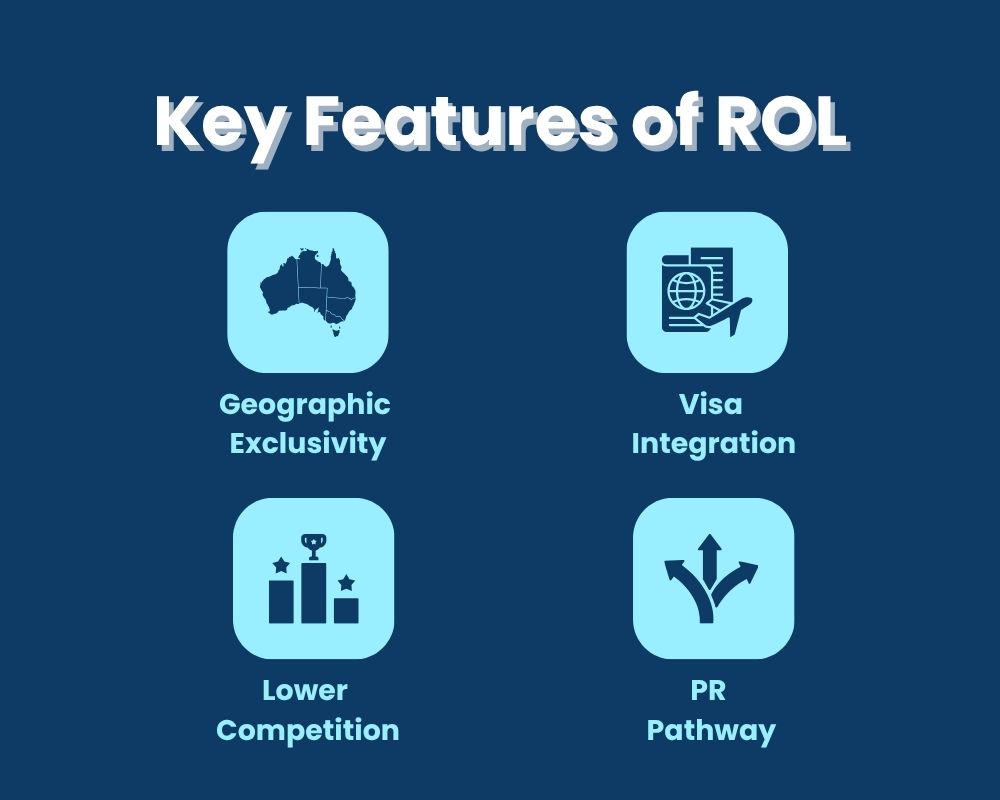
Key Features of ROL:
Geographic Exclusivity: The ROL is a list that is specifically designed to target the Designated Regional areas of Australia. With 2026 in effect, the regional occupation list target all cities of Australia except for the capital cities of Australia.
Visa Integration: The ROL is a mandatory list that should be used if you are someone who is applying for visa subclasses like subclass 491 and subclass 494.
Lower Competition: Due to the nature of the list being specific to a certain area, the competition seen in the occupations available on this list is lower comparatively. Being a list targeting the regional areas of Australia, you usually avoid the points race which is seen in major cities of Australia and tends to receive invitations at 75-80 points.
PR Pathway: The occupations that are available on the ROL are eligible for PR in Australia and provide a clear pathway to subclass 191 after 3 years of living and working in the regional areas of Australia.
Occupations in the ROL
The ROL (Regional Occupation List) is considered as a critical resource list that is used by skilled migrants who are targeting the designated regional parts of Australia. The ROL currently consists of 77 occupations that are highly demanded and are eligible for visa programs like Subclass 491 (Skilled Work Regional) and Subclass 494 (Skilled Employer Sponsored Regional) visas.
The table below consists of all the occupations that are available on the ROL as of the current legislative instrument in 2026 LIN 19/051 with their specific ANZSCO codes, Accessing Bodies like VETASSESS, TRA, AIMS, NAATI, EA, AMSA, etc. and their specific Skill level.
| S. N | Occupation | ANZSCO Code | Accessing Body | Skill Level |
|---|---|---|---|---|
| 1 | Real Estate Representative | 612115 | VETASSESS | 3 |
| 2 | Property Manager | 612112 | VETASSESS | 3 |
| 3 | Clinical Coder | 599915 | VETASSESS | 3 |
| 4 | Jockey | 452413 | TRA | 3 |
| 5 | First Aid Trainer | 451815 | VETASSESS | 3 |
| 6 | Flight Attendant | 451711 | VETASSESS | 3 |
| 7 | Funeral Workers nec | 451399 | VETASSESS | 3 |
| 8 | Driving Instructor | 451211 | VETASSESS | 3 |
| 9 | Emergency Service Worker | 441211 | VETASSESS | 3 |
| 10 | Gas or Petroleum Operator | 399212 | TRA | 3 |
| 11 | Nurseryperson | 362411 | TRA | 3 |
| 12 | Zookeeper | 361114 | VETASSESS | 3 |
| 13 | Electrical Linesworker / Electrical Line Mechanic | 342211 | TRA | 3 |
| 14 | Floor Finisher | 332111 | TRA | 3 |
| 15 | Vehicle Painter | 324311 | TRA | 3 |
| 16 | Pathology Collector / Phlebotomist | 311216 | AIMS | 3 |
| 17 | Operating Theatre Technician | 311214 | VETASSESS | 3 |
| 18 | Building and Engineering Technicians nec | 312999 | EA/VETASSESS | 2 |
| 19 | Maintenance Planner | 312911 | VETASSESS | 2 |
| 20 | Safety Inspector | 312611 | VETASSESS | 2 |
| 21 | Mechanical Engineering Draftsperson | 312511 | EA | 2 |
| 22 | Surveying or Spatial Science Technician | 312116 | VETASSESS | 2 |
| 23 | Construction Estimator | 312114 | VETASSESS | 2 |
| 24 | Agricultural Technician | 311111 | VETASSESS | 2 |
| 25 | Ship's Master | 231213 | AMSA | 2 |
| 26 | Financial Institution Branch Manager | 149914 | VETASSESS | 2 |
| 27 | Cinema or Theatre Manager | 149912 | VETASSESS | 2 |
| 28 | Sports Centre Manager | 149113 | VETASSESS | 2 |
| 29 | Fitness Centre Manager | 149112 | VETASSESS | 2 |
| 30 | Amusement Centre Manager | 149111 | VETASSESS | 2 |
| 31 | Post Office Manager | 142115 | VETASSESS | 2 |
| 32 | Caravan Park and Camping Ground Manager | 141211 | VETASSESS | 2 |
| 33 | Dental Therapist | 411214 | VETASSESS | 1 |
| 34 | Dental Hygienist | 411211 | VETASSESS | 1 |
| 35 | Community Arts Worker | 272611 | VETASSESS | 1 |
| 36 | Translator | 272413 | NAATI | 1 |
| 37 | Intellectual Property Lawyer | 271214 | VETASSESS | 1 |
| 38 | Anaesthetist | 253211 | MedBA | 1 |
| 39 | Dentist | 252312 | ADC | 1 |
| 40 | Environmental Health Officer | 251311 | VETASSESS | 1 |
| 41 | Vocational Education Teacher / Polytechnic Teacher | 242211 | VETASSESS/TRA | 1 |
| 42 | Exercise Physiologist | 234915 | VETASSESS | 1 |
| 43 | Conservation Officer | 234311 | VETASSESS | 1 |
| 44 | Wine Maker | 234213 | VETASSESS | 1 |
| 45 | Multimedia Designer | 232413 | VETASSESS | 1 |
| 46 | Helicopter Pilot | 231114 | CASA | 1 |
| 47 | Flying Instructor | 231113 | VETASSESS | 1 |
| 48 | Aeroplane Pilot | 231111 | CASA | 1 |
| 49 | Market Research Analyst | 225112 | VETASSESS | 1 |
| 50 | Liaison Officer | 224912 | VETASSESS | 1 |
| 51 | Policy Analyst | 224412 | VETASSESS | 1 |
| 52 | Workplace Relations Adviser | 223113 | VETASSESS | 1 |
| 53 | Human Resource Adviser | 223111 | VETASSESS | 1 |
| 54 | Sports Administrator | 139915 | VETASSESS | 1 |
| 55 | Regional Education Manager | 134412 | VETASSESS | 1 |
| 56 | Medical Administrator / Medical Superintendent | 134211 | VETASSESS | 1 |
| 57 | Procurement Manager | 133612 | IML | 1 |
| 58 | Project Builder | 133112 | VETASSESS | 1 |
| 59 | Policy and Planning Manager | 132411 | VETASSESS | 1 |
| 60 | Public Relations Manager | 131114 | IML | 1 |
| 61 | Mixed Crop and Livestock Farmer | 121411 | VETASSESS | 1 |
| 62 | Livestock Farmers nec | 121399 | VETASSESS | 1 |
| 63 | Sheep Farmer | 121322 | VETASSESS | 1 |
| 64 | Pig Farmer | 121318 | VETASSESS | 1 |
| 65 | Mixed Livestock Farmer | 121317 | VETASSESS | 1 |
| 66 | Horse Breeder | 121316 | VETASSESS | 1 |
| 67 | Goat Farmer | 121315 | VETASSESS | 1 |
| 68 | Deer Farmer | 121314 | VETASSESS | 1 |
| 69 | Dairy Cattle Farmer | 121313 | VETASSESS | 1 |
| 70 | Beef Cattle Farmer | 121312 | VETASSESS | 1 |
| 71 | Crop Farmers nec | 121299 | VETASSESS | 1 |
| 72 | Sugar Cane Grower | 121217 | VETASSESS | 1 |
| 73 | Mixed Crop Farmer | 121216 | VETASSESS | 1 |
| 74 | Grain, Oilseed or Pasture Grower / Field Crop Grower | 121214 | VETASSESS | 1 |
| 75 | Fruit or Nut Grower | 121213 | VETASSESS | 1 |
| 76 | Cotton Grower | 121211 | VETASSESS | 1 |
| 77 | Aquaculture Farmer | 121111 | VETASSESS | 1 |
ROL vs National Occupation Lists
While other national occupation lists like the Medium and Long-term Strategic Skills List (MLTSSL) & Short-term Skilled Occupation List (STSOL) is usually used to cater the labor needs of Australia as a whole, the ROL is a specific list that is designed to cater only the skilled migrants that are looking to migrate into the designated regional areas of Australia.
The major differences between the ROL and other National Occupation lists are as follows:
| Feature | ROL (Regional Occupation List) | MLTSSL (Medium/Long-Term) | STSOL (Short-Term) |
|---|---|---|---|
| Targeted Area | Targets only the designated regional areas of Australia excluding major capital cities like Sydney, Melbourne, Brisbane | Target all the areas inside the turf of Australia. | Targets State-Specific areas which is typically Based on the demand specific state has |
| Visa Subclasses | Subclass 491 & Subclass 494 | Subclass 189, Subclass 190, Subclass 491, Subclass 186 & Subclass 482 | Subclass 190, Subclass 491 & Subclass 482 |
| PR Pathway | Via Subclass 191 (After 3 years in region) | Direct PR (189, 190, 186) | Indirect PR (Requires state/regional nomination) |
| Point Bonus | +15 Points (State/Regional Nomination) | 0 Points (189) or +5 Points (190) | +5 Points (190) or +15 Points (491) |
| Competitiveness | Lowest | Highest | Moderate |
ROL Application Process
The Regional Occupation List (ROL) application process is a multi-staged process that requires you to have precise documentation and timings in order to succeed. With 2026 in effect, the migration scene of Australia has moved towards the “Targeted Selection” model where the nomination for various visa programs have been made tighter which makes it vital for you to have a decision ready application while applying.
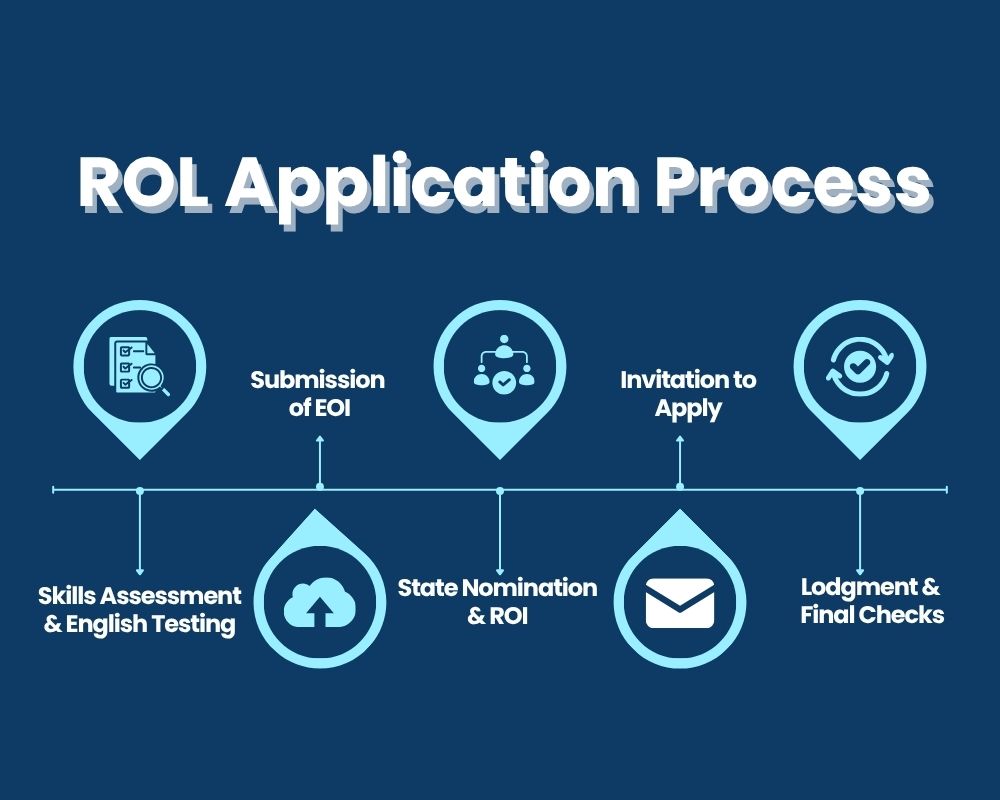
Step 1: Skills Assessment & English Testing
The first step in the ROL application process is that you are required to prove your professional eligibility to the government of Australia by providing the following:
Positive Skills Assessment: You need to provide a formal skills assessment from the authority concerned that is linked to the ANZSCO code that you are applying for (e.g. if you are applying for the ROL for the role of Property Manager then you need to get an assessment from its authority, that is VETASSES.
English Assessment: In this criterion, you need to provide proof that you have attended an English proficiency test approved by the DHA like IELTS, PTE, TOEFL. While for the ROL, it is generally required that you have competent English with scores that equivalent to IELTS 6.0, we highly recommend that you aim for the Superior English with IELTS score of 8.0. Securing a superior English will help you gain the 20 extra points which will ultimately help you to score higher in competitive rounds.
Step 2: Submission of Expression of Interest (EOI)
After you have successfully completed the skills and English Assessment, the next step is to Submit an Expression of Interest (EOI) through the SkillSelect portal. In this step, you are required to provide proofs about yourself that include your skills, age, English level etc. due to which you will then receive points. In the current scenario of Australia, if two candidates have the same points in an EOI then the individual who submitted their EOI first is prioritized and invited.
Step 3: State Nomination & ROI
If you are someone who is pursuing the subclass 491 visa, then you are required to be nominated by a state of Australia or Territory. For this you are required to submit a Registration of Interest (ROI).
Step 4: Invitation to Apply (ITA)
In case that your ROI is selected, the state will then nominate you which will trigger the DHA to issue an Invitation to Apply (ITA) for your application. After you have received the ITA notification from DHA, you have exactly 60 calendar days to lodge your visa application and make sure that every claim that has been made in the EOI is backed up will evidence as any discrepancies will ultimately lead to immediate visa refusals.
Step 5: Visa Lodgment & Final Checks
After you have received an ITA then you need to submit your visa application within the 60-day window. In this final stage of the process, you are required to submit all the supporting documents that act like evidence to the DHA. In this stage, you need to provide police clearance reports for all the countries that you have lived in for more than 12 months since you were 16. Additionally, you are required to attend a Health examination that is assessed by an authority concerned.
Common ROL Application Pitfalls & Solutions
If you are someone who is looking to apply for a role under the ROL, then you need to make sure that your application is “decision ready”. Even a small mistake in your application process and your EOI can cause visa refusals and long-term bans in Australia.
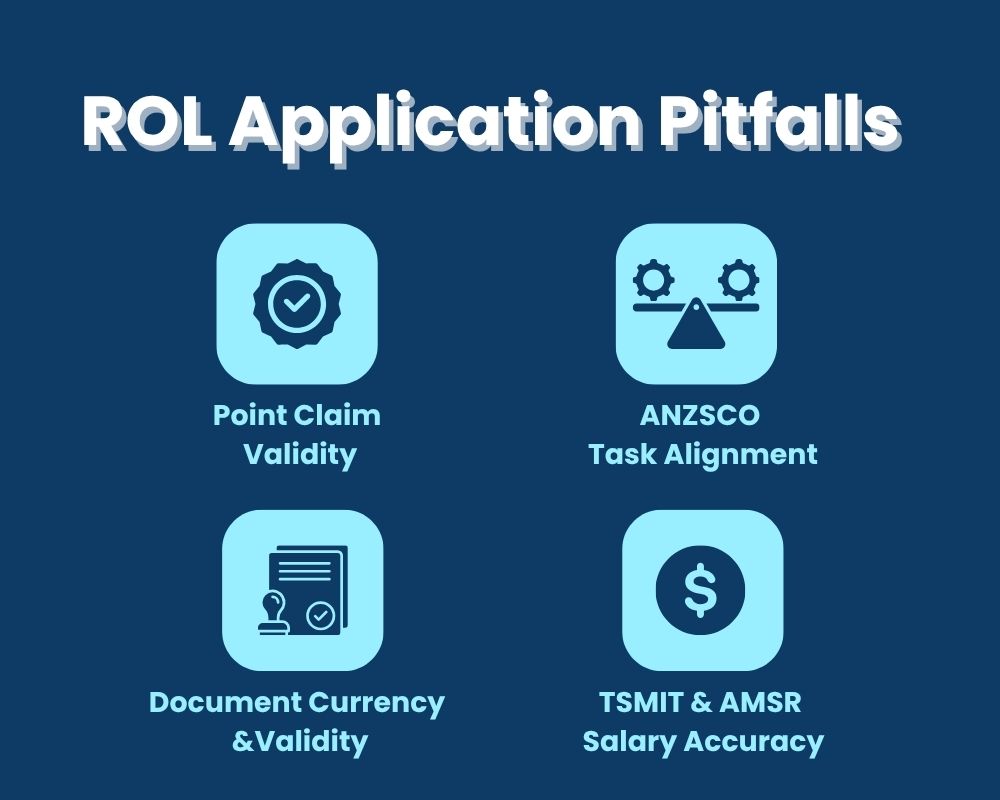
Point Claim Validity
Pitfall: Many applicants tend to claim points for the work experience that has incurred even before the date that they were considered as skilled individuals by the authorities concerned. They tend to include their initial internships or training years towards the total points calculation.
Solution: Make sure that you only include the work experience that has incurred after the Deemed Skilled Date in your formal Skills Assessment letter. This ensures that your points claim is 100% legally defensible during the visa stage.
ANZSCO Task Alignment
Pitfall: If you are someone you have applied for a role in the ROL, you need to make sure that the job description mentioned in the company’s requirements matches the nature of the work that you perform rather than just the job title. If the Daily tasks mentioned in the job description don’t match the 80% threshold of the ANZSCO unit group description, then your application can be rejected due to Inaccurate Nomination error.
Solution: Make sure that you map your tasks with the tasks mentioned in the job description against the ABS (Australian Bureau of Statistics) ANZSCO definitions. This makes sure that your work description and daily tasks align well and there are no disappearances in the application process.
Document Currency and Validity
Pitfall: This is one of the primary reasons that individuals face a refusal in their application. While lodging an EOI with a skills assessment and English test that is near its date of expiration, it is possible that the documents expire while EOI is in the waiting pool or during the 60 days window.
Solution: While applying for an EOI, you need to make sure that all your documents like the skills assessments and English assessments have at least 12 months of validity left at the time of lodgment.
TSMIT and AMSR Salary Accuracy
Pitfall: This is a pitfall where individuals fail to update their contracts to meet the indexed TSMIT of $79,499 in July 2026. Many applicants applying for ROL rely on outdated salary figures from previous years which will then lead to your visa being refused.
Solution: Make sure that you audit your employment agreement and ensure that your base salary excluding the superannuation reached the requirement of AUD $ 79,499. Additionally, you are required to provide an Annual Market Salary Rate (AMSR) report that indicates that you are being paid the same as an Australian worker who is working in the regional areas of Australia.
FAQs
The 482 skills in demand visa utilizes a subset of the ROL for employers that are located in the regional part of Australia. In the year 2026, the list is heavily focused on sectors like Agribusiness and Regional Management. The key occupations under this visa program are Aquaculture Farmer, Fruit or Nut Grower, Beef Cattle Farmer, and Dairy Cattle Farmer. Additionally, specialized management roles like Caravan Park and Camping Ground Manager, Post Office Manager, and Fitness Centre Manager are also preferred in the ROL.
The 491 Skilled Work Regional Visa is the visa program that has the most expansive occupation available. As the 491 visa is a state-nominated visa program, it includes all the occupations that are included in MTSSL, STSOL and ROL. The highly sought occupation under this visa program are Community Worker, Family Support Worker, Youth Worker, Horse Trainer, and Library Technician.
No. The ROL is not same as the MLTSSL as the MLTSSL is a national visa list that is used by applicants who are applying for the subclass 189 and have a higher competition whereas the ROL is a regional occupation list that is specifically used by applicants of subclass 491 and 494.
You are automatically eligible to receive 15 points toward your final score if a State or Territory government nominates you for a Subclass 491 visa and your occupation appears on the ROL. One of the biggest benefits of the ROL is the Regional Bonus, which frequently raises applicants’ scores from a non-competitive 65 to a very competitive 80.

If you are someone who is looking to apply for the ROL in 2026 then you need to understand that the current migration scenes of Australia than just filling forms. The process requires you to have precision and a “decision ready” application to make sure that your application doesn’t receive any refusals and has a smooth sailing experience.
Why BJay?
13+ Years of Proven Excellence: With over a decade long experience working with visa services in Australia, BJay Education & Visa Services has provided support to numerous clients around the world.
Global Presence, Local Support: With dedicated office available in Nepal (Putalisadak and Birtamode) and head office in Sydney, BJay Education & Visa Services provide you with the support you require in your preferred time.
Precision ROL Strategy: At BJay, we don’t just find a job for you, but we make sure that the job that you seek is aligned to your requirements and we make sure that you are able to maximize your points.
Documents Auditing: We make sure that every document that you have is “decision-ready” so that your application doesn’t face any problem in the migration scene of Australia.
Still Confused on your ROL application and job? Join BJay for a Free Nonobligatory Consultation!