Child Visa 101 Australia in 2026 is considered as a primary pathway for Australian citizens and Permanent Residence (PR) of Australia to reunite and sponsor their biological, adopted, or stepchildren living abroad for the purpose of reuniting your family. The Child visa 101 is an offshore permanent residency visa that grants the visa holder the full right to live, study and work in the turf of Australia. For adult children who must demonstrate continuous full-time education and financial dependence on their sponsoring parent, navigating the child visa 101 landscape demands a thorough awareness of the most recent dependency regulations.
With an expertise team and more than 13 years of experience in providing visa services to countless clients, we here at BJay Education & Visa services have meticulously drafted this guide to help you with the child visa 101 requirements, costs, and current processing trends. This guide has been drafted with the latest Department of Home Affairs (DHA) data to make sure the application is drafted with latest data.
Child Visa 101
The Child Visa 101 is a visa program that is provided by the Australian government that is designed for the children who are currently residing outside Australia. Unlike other temporary visa programs, the visa program offers a direct pathway to Permanent Residency in Australia. After being approved, the child is able to relocate to Australia and start receiving social benefits provided by the Australian government including Medicare and domestic schooling rates right away.
Core Rights and Benefits of Child Visa 101
The child visa 101 is one of the most preferred pathways that is used to have a PR in Australia that is offered by the government of Australia. The child’s “rights” are equal to those of any other Australian permanent resident since it is a permanent visa from the date of grant, giving them a solid foundation for the future.
The Core Rights and Benefits of Child Visa 101 are as follows:
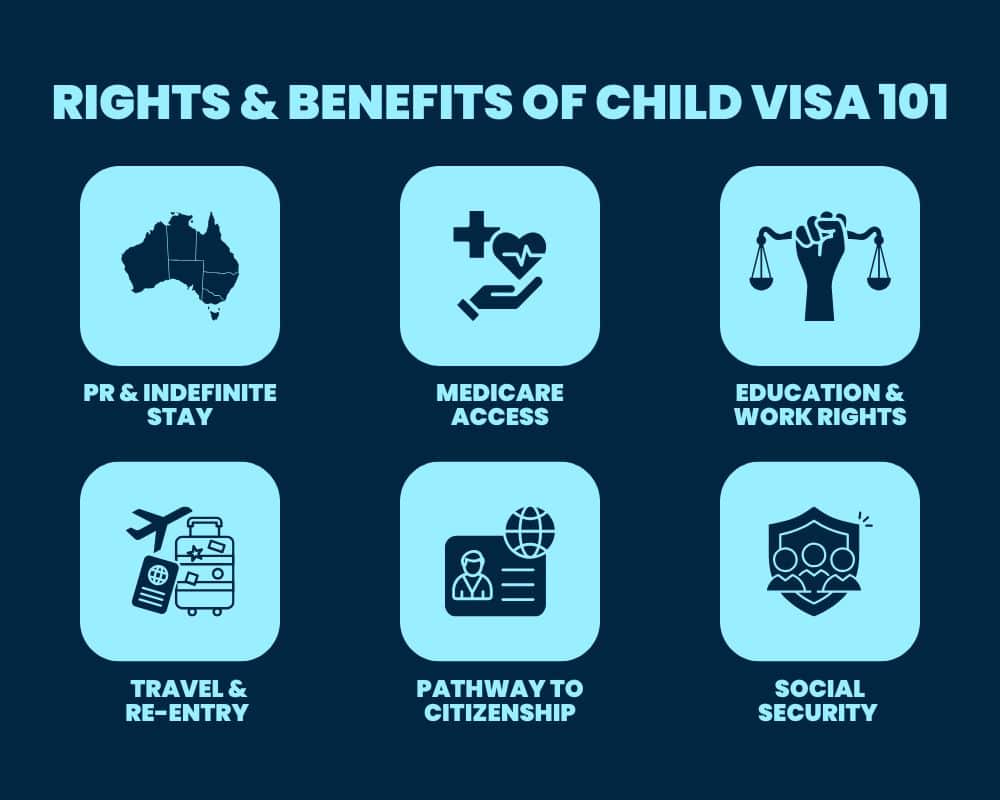
Permanent Residency and Indefinite Stay
The primary benefit of the Child visa 101 is that it provides your child the right to stay in Australia indefinitely. Unlike other temporary or provisional visa programs provided by the Australian government, this visa has no expiry date on the child’s rights to live in the turf of Australia. As a parent, this visa program provides you with a peace of mind ensuring that your family reunition is not compromised.
Full Medicare Access
With the Child Visa 101, your child is eligible to participate in the Medicare services provided by the Australian government. This service is provided to the child upon arrival (or upon grant if they are already ashore under certain circumstances). The Medicare services provide you with the following services under the Australia’s universal healthcare system.
- In public hospitals, this offers free or heavily discounted medical care.
- Subsidized medications are covered by the Pharmaceutical Benefits Scheme (PBS).
- It permits General Practitioners (GPs) to receive bulk billing for appointments.
Education and Work Rights
The Child visa 101 removes all the barriers to personal and professional development and provides unlimited educational and work rights in Australia. Your child with this visa is eligible for government funded primary and secondary education level at the same rates as of Australian citizens. If your child is above the working age of Australia, then they are eligible to have unrestricted rights to work for any employer.
Travel and Re-entry Rights
With the child visa 101, your child is provided with the facility of 5-year travel facility. This basically means that with the grant of this visa you are provided with 5 years travel facility of travelling in and out of Australia as many times as you want. After the 5 years duration has expired, the child will simply need a Resident Return Visa (RRV) to continue traveling, provided they maintain their residency.
Pathway to Australian Citizenship
Child visa 101 is a direct step toward obtaining Australian citizenship. When the child has lived in Australia for the required period of time (often 4 years overall, with at least 12 months as a permanent resident), they can request for full citizenship, which gives them to an Australian passport and the right to vote.
Social Security Benefits
After your child has met the standard newly arrived waiting periods, they are eligible to receive various social security payments through Centrelink, such as Youth Allowance or Study Assist, further supporting their integration into Australian society.
Child Visa 101 Eligibility
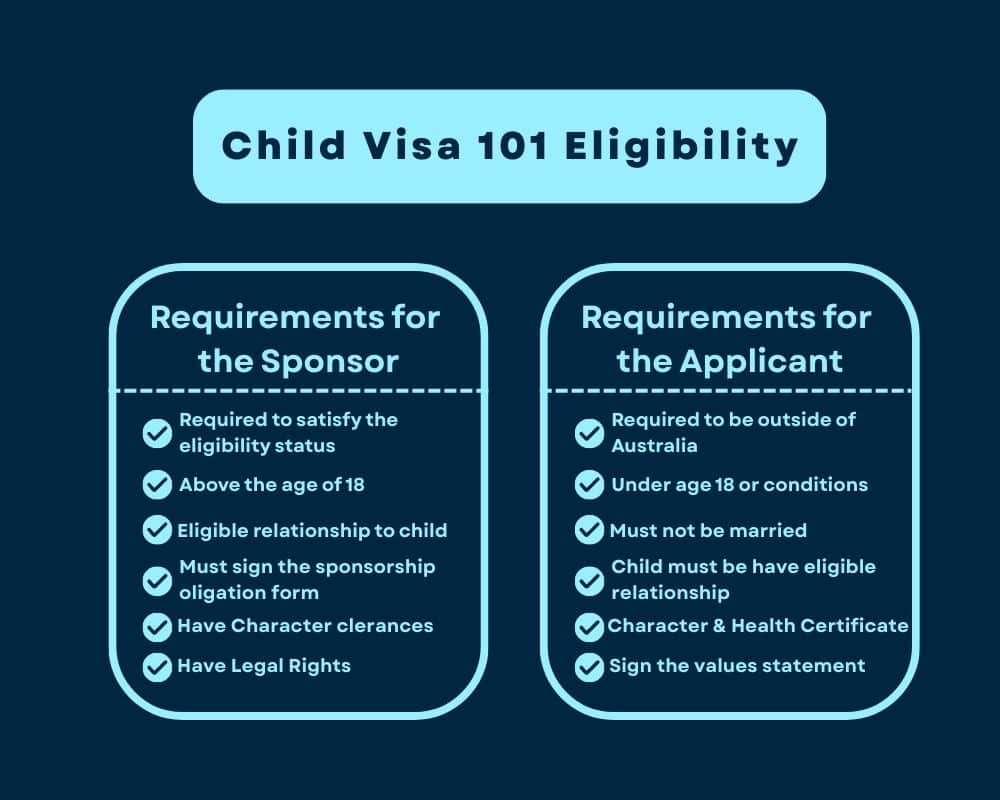
In order to secure a Child Visa 101 Australia in 2026, as a sponsor you are required to satisfy 2 different sets of eligibility criteria. One being the criteria that apply to your child and another being the requirements for you as a sponsor. Make sure these conditions are met because failing to do so may result in a visa being denied. The Department of Home Affairs’ (DHA) most recent eligibility requirements are described in detail below:
Requirement for the child (Applicant)
The requirements that are required to be satisfied by the child or the applicant are as follows:
Offshore: The child must be physically located outside of Australia at both events of lodgment and decision.
Relationship: The child must be the sponsoring parent’s biological child, adopted child, or eligible stepchild.
Age and Dependency: One of the following requirements must be met by the child:
- Under 18 years: Automatically eligible if the child is single and dependent.
- Aged Between 18-25: Must be a full-time student who is enrolled in a course that leads to a professional or a vocational qualification and must be dependent on the sponsoring parent.
- Above 18 and with a disability: If the child has a total or partial disability that prevents them from working.
Marital Status: For your child to be eligible for this visa program, they are required to be single and not married, engaged or in a de facto relationship.
Health and Character: For the child to be eligible, they must pass a medical examination by an approved physician from the panel. Additionally, if the child is above the age of 16 then they are required to provide police clearances from every country that they have lived in for 12 months or more for the past 10 years.
Values Statement: The child if above the age 18 then they are required to sign the Australian Values Statement, confirming they will respect the Australian way of life and obey its laws.
Requirements for the Sponsoring Parent
If you want to be considered as a sponsor for the Child Visa 101, you are required to meet a set of standards that proves your eligibility to provide full financial and legal responsibility for the child’s first two years in Australia.
Eligibility Status: For you to become an eligible candidate, you must be an eligible candidate who is either an Australian citizen, a holder of an Australian permanent residence visa, or a citizen of New Zealand in order to sponsor a child.
Age: For you to be an eligible sponsor, you must be at least 18 years old.
Relationship to the Child: As a sponsor, the child is required to be your biological, adopted, step or de facto partner’s child and have proper relations.
Sponsorship Obligations: As a sponsor, you are required to sign the sponsorship form which is the Form 40CH and by signing this you agree to provide adequate accommodation and provide financial support to the child.
Character Clearances: To be an eligible sponsor, you are required to provide police certificates showing your clearances that you are an eligible individual with no criminal background.
Legal Consent: If your child is under the age of 18, you are required to demonstrate that you have the legal right to remove the child from their home country.
Difference Between Child Visa 101 and 802
The difference between child visas 101 and Child Visa 802 is one of the most common areas of uncertainty for parents. Both offer permanent residency however the decision is solely based on the child’s actual location at the time of application.
| Feature | Child Visa 101 (Offshore) | Child Visa 802 (Onshore) |
|---|---|---|
| Location at Lodgment | Child is outside Australia. | Child is inside Australia. |
| Location at Grant | Child is outside Australia. | Child is inside Australia. |
| Bridging Visa | No Bridging Visa granted. | Bridging Visa A (BVA) granted. |
| Entry Requirements | Child waits abroad for grant. | Child must hold a valid visa to enter first. |
| Processing Time | Often slightly longer due to overseas checks. | It can be faster if identity is already verified. |
Child Visa 101 Cost
Planning for a Child Visa 101 requires you to have a clear understanding of the financial aspect of the visa. On July 1, 2025, the Australian government revised the Visa Application Cost (VAC). The verified costs for the 2026 migration year are as follows:
| Item | Fee (AUD) | Source |
|---|---|---|
| Base Application Charge | $3,235 | DHA 2026 Fee Schedule |
| Additional Applicant (18 or over) | $1,615 | DHA 2026 Fee Schedule |
| Additional Applicant (Under 18) | $810 | DHA 2026 Fee Schedule |
| Health Examination | $300 – $550 | Bupa Visa Medical Services |
| Police Clearances | $42 – $55 | AFP / International Authorities |
Source: DHA
Child Visa 101 Processing time
The Department of Home Affairs’ current emphasis on prioritizing family reunions while upholding strict checks on relationship validity and childcare is reflected in the child visa 101 processing time in 2026. The best strategy to reduce delays is to submit a “decision-ready” application, while deadlines may vary depending on the number of applications and the intricacy of specific situations.
| Percentage of Applications | Estimated Processing Time |
|---|---|
| 25% of Applications | 19 Months |
| 50% of Applications | 22 Months |
| 75% of Applications | 24 Months |
| 90% of Applications | 28 Months |
Source: DHA
Child Visa 101 Application Process
With 2026 the application process for the Child Visa 101 is a multi-step legal process that requires the child staying outside of Australia during both the filing and decision-making stages. You must carefully adhere to the Department of Home Affairs’ (DHA) sequential requirements in order to guarantee that your application is processed within the “fast-track” or regular 22-month window.
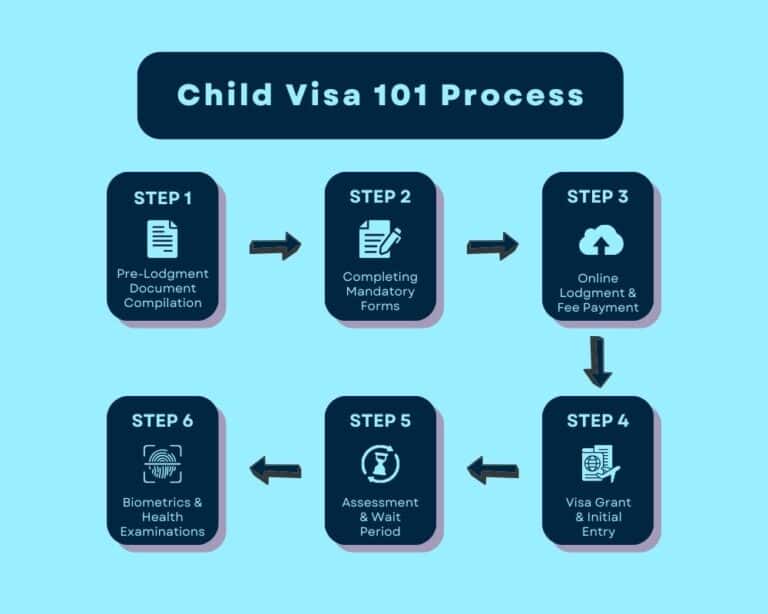
Step 1: Pre-Lodgment Document Compilation
Before you even think about applying for the Child Visa 101 Form, you are required to gather decision-ready evidence, and the DHA strictly penalizes incompetent applications with delays. You are required to provide the following documents:
- Relationship Evidence: Official adoption documents or certified color copies of the birth certificate that include both parents.
- Sponsor Status: Evidence (such as an Australian passport or citizenship certificate) that the parent is a citizen, permanent resident, or eligible citizen of New Zealand.
- Identity Documents: Recent passport-sized photos (45 x 35 mm) and the child’s valid passport.
- Consent (Form 1229): If the child is less than eighteen, you must present a signed copy of Form 1229 from any parent who is not migrating and has legal custody of the child, together with their identification.
Step 2: Completing Mandatory Forms (47CH & 40CH)
After you have complied all the documents that are required for the Child Visa 101, you are then required to fill out 2 mandatory Forms i.e. Form 47CH & Form 40CH.
Form 47CH: The primary application for the child to migrate. If the child is under 16, the parent signs on their behalf.
Form 40CH: The sponsorship form completed by the Australian parent, undertaking the financial and housing obligations for the child’s first two years.
Step 3: Online Lodgment and Fee Payment
After you complete the required and mandatory form 47CH and 40CH, you are then required to lodge the application digitally. As in 2026, paper applications have been uncommon. Due to this you are required to lodge the application through ImmiAccount portal and pay the AUD 3,235 base application charge via the portal. After the payment, you will then receive a Transaction Reference Number (TRN). After receiving this you are then required to upload these documents that are gathered previously in step 1.
Step 4: Biometrics and Health Examinations
After the application has been lodged successfully and the fees have been paid, the next step is where you will have been asked by the DHA to provide required biometrics and health Examinations.
- Biometrics: To obtain digital fingerprints and images, the child must go to an Australian Biometric Collection Centre (ABCC) or an AVAC in their home nation.
- Health: You need to schedule an examination with a panel physician who has been approved by the DHA. This usually costs between AUD $300 and AUD $550 in 2026 and is paid to the clinic directly.
Step 5: The Credibility Assessment & Wait Period
After all the data and documents have been successfully uploaded and the biometrics have been submitted, your application enters the processing queue. In this visa program roughly 15% cases, the child or the sponsor may receive a call from the Case officer. Every month, you need to verify your ImmiAccount. You typically only have 28 days to reply to a “Request for Information (RFI)” from the DHA before a decision is reached.
Step 6: Visa Grant and Initial Entry
After the wait period has ended, if the visa is successful, you will receive a Visa Grant Notice via email. Then the child must make their Initial Entry into Australia by the date specified in the grant (usually within 12 months). Upon that first entry, the child’s status as an Australian Permanent Resident is formally activated.
FAQs
As of early 2026, it usually takes 22 to 28 months to process a Child Visa 101. While more complicated cases involving custody battles or extensive character investigations may take up to 28 months, about 75% of applications are resolved in 22 months. Staying within the quicker processing window can be achieved by selecting a decision-ready lodgment method.
The primary difference between Child Visa 101 and 802 is the location of the child while the application is being lodged. Since the child must be outside of Australia at the time of application, the child visa 101 is an offshore visa. The Subclass 802 (Child Visa) is an onshore visa that permits a child who is already in Australia on a valid temporary visa (such as a visitor visa) to apply for and stay in the nation while their application is being processed.
The base application fee for the child visa 101 is AUD 3,235 in 2026. Fees for secondary applicants, police clearances, and required medical exams through approved Medical Services providers like Bupa (Approx. AUD $350–$500) are additional expenses.
Yes. DHA strongly promotes online filing with ImmiAccount in 2026. Compared to the previous paper-based application processes, applying online enables quicker document indexing and real-time tracking of your child’s visa 101 status.
One of the most important turning points in your migration journey is getting your family back together. At BJay Education and Visa Services, we think that not a child should be away from their parents because of complicated legal issues or avoidable administrative mistakes. The Australian migration scene is more data-driven than ever in 2026, so having a specialist who is familiar with the subtleties of Child Visa 101 processing is crucial.
Why BJay?
Proven Expertise: With 13 years of experience in Visa services in Australia, we here at BJay Education & Visa Services have been providing tailored services to help you navigate through the complex migration scenes of Australia.
Expertise Team: Led by Mr. Jay Oli (MARN: 1570827), we have an exceptional team that is there to solve any queries and help you with your application. The team is well trained to provide the services that you may require assistance with.
Global Presence & Local Support: With offices present in multiple locations throughout Nepal (Putalisadak and Birtamode) and a head office in Sydney, BJay provides you with seamless support you may require whether you are in your home country or already in the turf of Australia.
Transparent & Ethical Advocacy: We offer genuine evaluations of your eligibility. We use tried-and-true legal solutions to tackle any issues pertaining to adult student dependency or custodial consent (Form 1229).
Looking to reunite your family with Child Visa 101? Book a Free Consultancy with BJay for Expert Help!