S56 Request, also known as the Request for Further Information (RFI) in 2026, is considered an important aspect of your migration application. If you have received an s56 request from the Department of Home Affairs (DHA), you should not be worried or panic as it a common procedure in the visa processing scene of Australia. It is regarded as a signal indicating that your case officer assessing your visa application requires more details to proceed forward. It is a document that supports and backs up your visa application such as a partner visa requiring you to provide additional evidence.
With over 13 years of experience in migration services, BJay education & Visa Services has meticulously drafted this guide to help you with going forward with your s56 request. This guide is backed up with the data given by the DHA to make sure you are provided with the latest data to help you with your RFI submission.
S56 Request
Also known as the Request for Further Information (RFI), the s56 request is a formal document that is issued under the section 56 of the Migration Act 1958 of Australia. The DHA typically asks for a RFI when the case officer who is foreseeing your visa application needs more evidence or clarification to make a final decision for your visa application. In 2026, these requests are issued via your ImmiAccount, and they usually consist of 2 major documents:
- The s56 Request for More Information: This letter is the document that outlines the basis for which the RFI was issued and also contains the deadlines in it.
- The Request Checklist and Details: In this document it contains the bullet list of all the evidence such as updated medical records, police clearances, or bank statements, that are to be submitted to the DHA for confirmation.
Common Reasons for an s56 Request in 2026
As the migration scene of Australia has become increasingly more stringent, so has the DHA been about “decision-ready” documentation required for the latest set of practices. With such stringent rules being intact, getting a s56 is not something to be worried about. The common reason that you might receive an RFI are as follows:
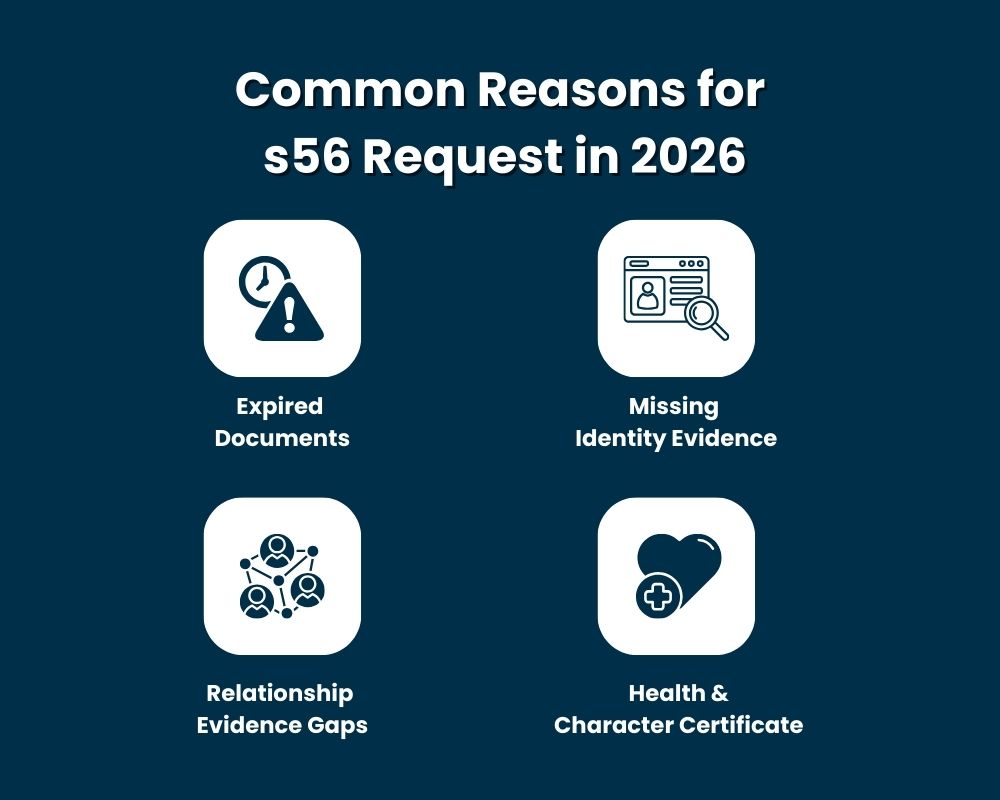
Expired Documents: One of the most common reasons why you might receive a s56 is that you might be providing the DHA with outdated documents. Many applicants lodge their visa prior to their requirement. Therefore, this causes the expiration as when the case officer is going through the documents, the required document has been expired. Documents like Police Checks and Health Checks could have been invalid in the time of the case officer assessing the document.
Missing Identity Evidence: Another reason that you could have got a s56 request letter is due to the missing identity evidence factor. If the document that you have previously submitted to the DHA was not high quality or was unclear (blurry) then it may cause the s56 request to trigger, ultimately leading the case officer to request further information.
Relationship Evidence Gaps: If you are someone who is applying for certain visa programs like the subclass 820, Subclass 801 or the subclass 309/100, then the case officer could have issued to s56 to request for the FORM 888s from a witness to cover the period between lodgment and decision.
Health And Character Certificate: If you have been issued a s56 request then it may be due to the fact that the assessor who is assessing your case currently requires extra evidence on health and character evidence that you have previously provided. In an RFI, you can be required to submit “re-medicals” or “Form 80” if the case officer is not satisfied with the evidence, you have provided previously.
Difference Between S56 Request and S57
If you want to protect your visa status in the current migration scene of Australia in 2026, you should understand the difference between s56 request and s57 as these notices represent a formal interaction that is initiated by the DHA. Both the request letters differ vastly from each other.
The difference between both s56 and s57 request can be seen with the help of the given table:
| Feature | S56 Request (RFI) | S57 Request (Natural Justice) |
|---|---|---|
| Legal Title | Request for Further Information | Invitation to Comment on Adverse Information |
| DHA Intent | Neutral: The s56 is usually a document that is sent because the case officer needs more evidence to finalize the visa result. | Warning: s57 is usually a warning sign that the accessor found a red flag in your application on why your visa should be refused. |
| Common Trigger | It can be sent to you in case of expired medicals, police checks, or missing bank statements. | It can be sent by the DHA due to Suspicion of bogus documents, undisclosed criminal record, or inconsistent claims. |
| Risk Level | Low to Moderate: A standard part of the process. | High: This is your final chance to prevent a visa refusal or 10-year ban. |
| Response Time | Typically, 28 days (can be 7 or 14 for specific visas). | Strictly 28 days (legislated under procedural fairness). |
| Vibe/Tone | Administrative and helpful. | Formal, legalistic, and cautionary. |
| Common Visas | Partner, 482, 491 | All, especially fraud-prone visa programs |
s56 Request Costs and Deadlines
In 2026, understanding the cost and deadlines related to the s56 is an essential part to maintain your visa status if you have recently received a s56 request from the DHA. The RFI requires strictly timed response to the requests made to avoid the automatic application refusal implemented by the DHA. The following table indicates the typical expense and approx. processing time for most s56 request in 2026.
| Action Item | Estimated Cost | Standard Deadline |
|---|---|---|
| AFP National Police Check | AUD $56.00 | 28 Days |
| Bupa Visa Medical (Standard) | AUD $382.89 (inc. GST) | 28 Days |
| Bupa Chest X-Ray Only (502) | AUD $144.10 | 28 Days |
| Specialist Medical Reports | AUD $250 - $600+ | 28 Days |
| Overseas Police Clearances | Varies by Country | 28 Days |
| s56 Response Submission | AUD $0 (Free) | 7 - 28 Days* |
How to Respond to an s56 Request in 2026
If you have recently received an s56 request from the DHA, then you must be wondering how you should respond to an s56 request in 2026. If you want to satisfy the request effectively you must follow the given verified steps carefully used by top migration specialists in BJay:
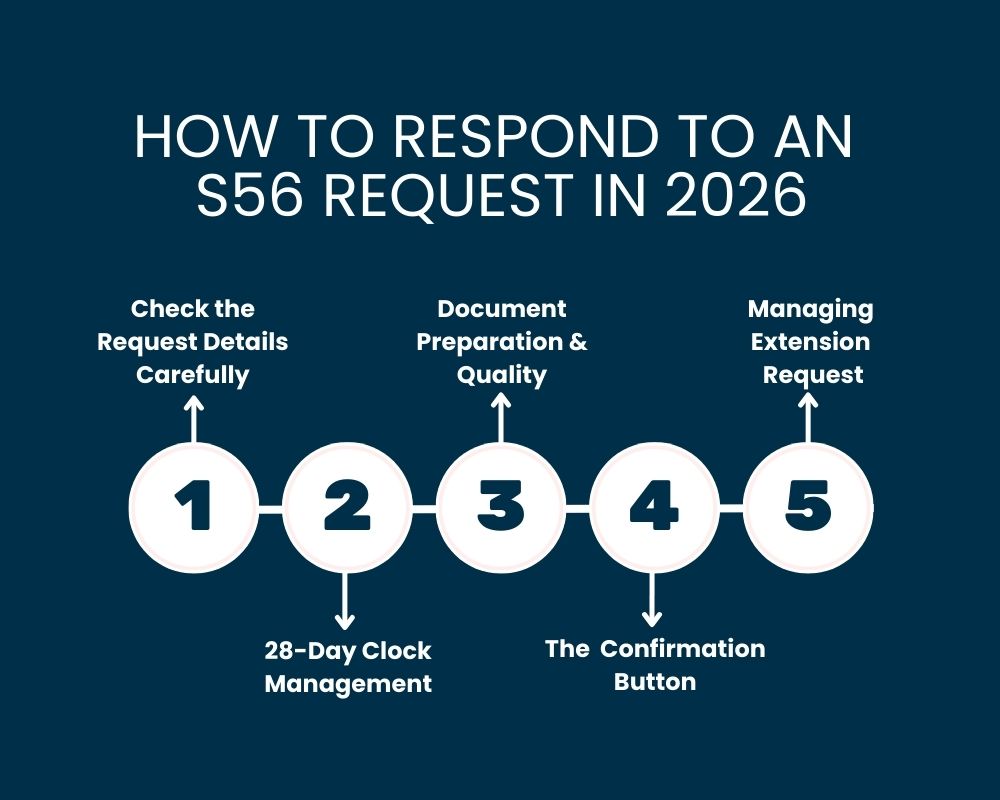
Step 1: Check the Request Details Carefully
If you have just received the s56 request, then the next step should be to carefully go through the requirement checklist provided by the DHA. Do not just look at the s56 form checklist but analyze and carefully read the specific instructions.
Step 2: The 28-Day Clock Management
After you have carefully analyzed the checklist given by the DHA, you need to make sure to provide the details within 28days from the date of the letter (though 7 or 14-day deadlines are common for medicals or certain student visa streams). In 2026, if you haven’t submitted your response or an extension request, you risk your visa being refused on Section 54 of the Act.
Step 3: Document Preparation & Quality
After you have managed your processing time, the next step is to prepare documents and make sure the documents are of high quality. You need to provide the documents in high quality color scans. By 2026, low-resolution or “photo-captured” documents will often be flagged for human inspection by AI-driven fraud detection systems, extending your wait time by months. And make sure that you use clear and specific filenames [LASTNAME_FIRSTNAME_APP_CHECK_2026.pdf] to ensure that the case officer can verify your documents against the s56 request checklist.
Step 4: The “I Have Provided” Confirmation Button
In 2026, providing the document solely doesn’t always notify the case officer but you are required to click the Confirmation button. Clicking the button is the formal legal trigger that moves your application to the further assessment queue.
Step 5: Managing Extension Request
If you are not able to secure the requested information such as an overseas police check with the given 28 days given by the DHA, you need to provide the following:
- Upload a Letter of Explanation before the deadline provided.
- Upload Evidence of Effort
Request Checklist for RFI
To make sure that you have smooth approval for your visa application after you have received a s56 request, make sure that you understand the Request Checklist for RFI that has been given below:
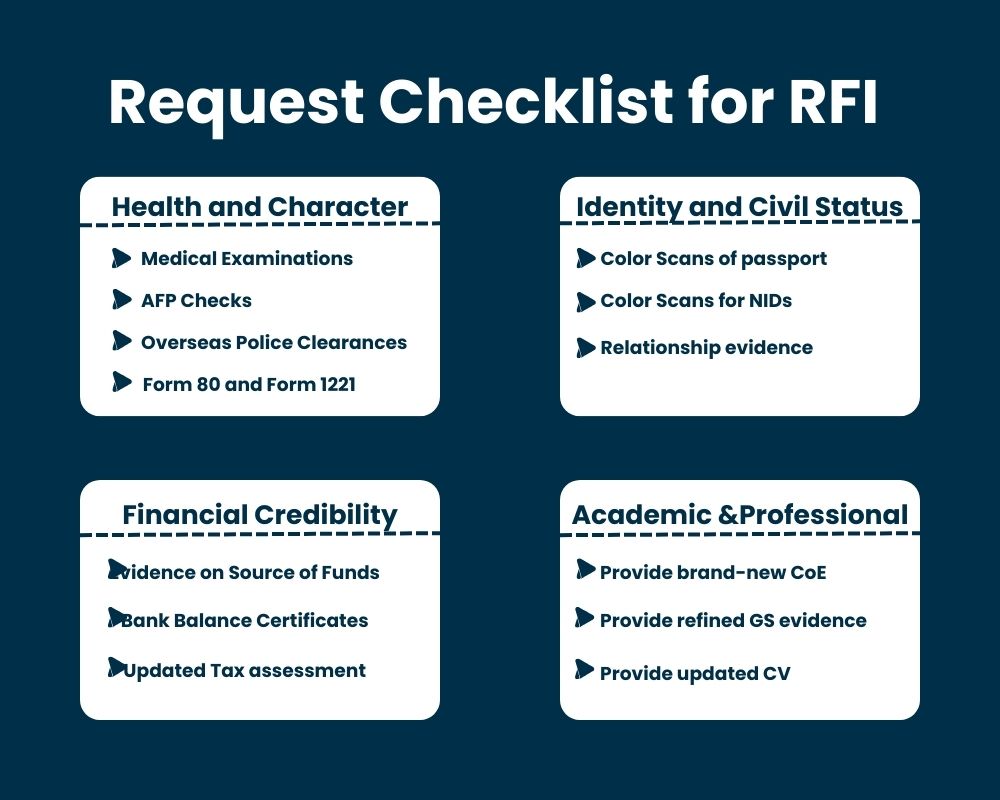
Health and Character
- Provide updated Medical Examinations if they are applicable.
- Provide the Australian Federal Police (AFP) Check if you are someone who has spent 12+ months in Australia.
- Provide the Overseas Police Clearances for every Country that you have lived for 12 months in the last 10 years’ time duration.
- Provide Form 80 and Form 1221
Identity and Civil Status
- Provide Certified and high-resolution color scans of your passport.
- Make sure to provide color scans for National ID cards.
- Provide evidence if there are any relationships that need to be updated.
Financial Credibility
- Provide evidence on the source of funds like property sale documents, tax returns, salary slips, etc.
- Provide recent bank balance certificates showing the ability to meet the requirements.
- Provide the Updated tax assessments or business registration certificates.
Academic and Professional
- Provide a brand-new Confirmation of Enrolment (CoE) if your course has changed or the start date has passed.
- Provide a refined Genuine Student (GS) Evidence.
- Provide an updated CV showing your timelines.
Pitfalls and Solutions of s56 Request
As the 2026 migration scene of Australia is very vast and requires a high level of precision, making a mistake in the s56 request letter can be a factor that can lead to your visa being refused. Hence, to make sure that you don’t go through the same mistakes and receive a negative outcome, go through the pitfalls and solutions given below:
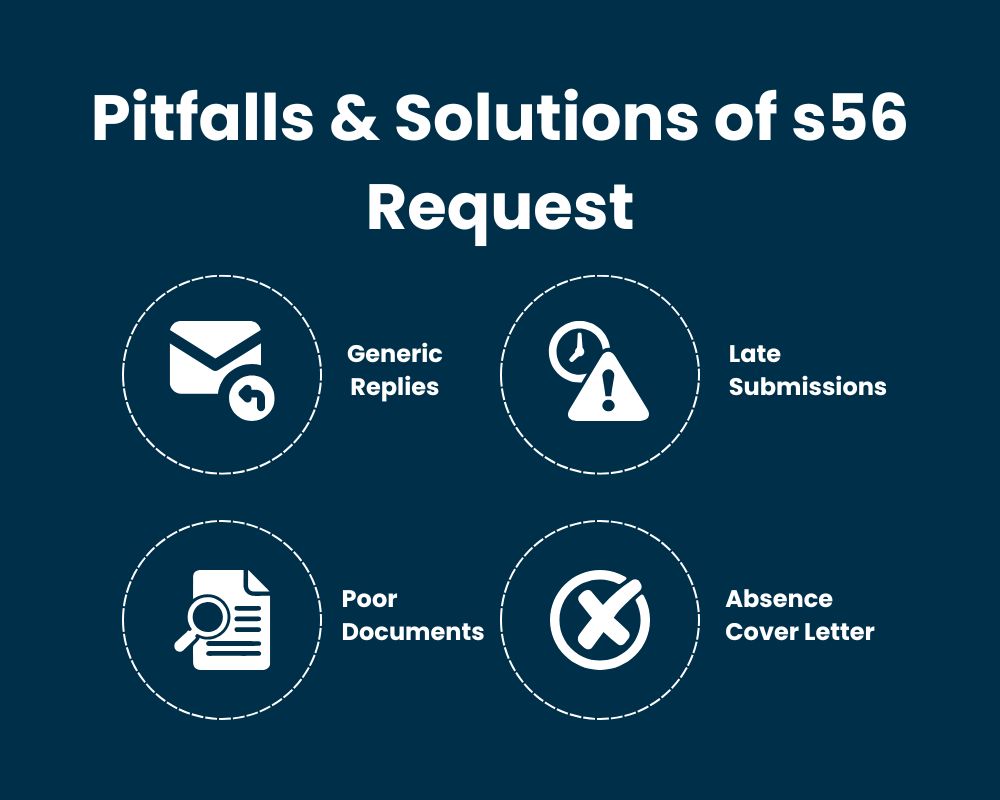
Generic Replies
Pitfall: Many individuals who have received the s56 request tend to provide generic evidence that does not address the concerns that have been mentioned in the letter. For example, if the case officer has requested evidence relating to financial capacity, then submitting a single bank statement without the source or a large transaction can lead to further doubts.
Solution: Provide the evidence and tailor it in such a way that it is requested in the letter. If the accessor expresses a certain sector that needs to be addressed, make sure you provide the exact documents that can back it up. For example, if the financial capacity evidence is addressed then make sure to include documents like tax returns or employment contracts that can help you win the claim.
Late Submissions and Auto-Decisions
Pitfall: In 2026, the DHA and the Australian government have gone through various technological developments and hence currently uses an auto-decision algorithm to make decisions for applications. Hence, if your s56 request response is not detected by 11:59 pm on the 28th day of the deadline (Unless you have got an extension), the system will automatically generate a refusal letter based on section 54 of the Migration Act 1958.
Solution: Make sure to submit the required evidence 24-48 prior to the deadline as there could be external factors like lag or errors in uploading that could affect the timing and hence provide a negative outcome.
Poor Quality Documents
Pitfall: As the implementation of advanced AI-driven fraud detection has been an advanced feature that is used by the DHA in 2026, poor quality documents or low-resolution scans can result in the rejection of your application. After you provide unclear and blurry documents in your s56 request, the case officer is not obliged to request a further version and can refuse your visa application,
Solution: Make sure to use a high-resolution flatbed scanner that has the capability to create 600 DPI pdfs. You need to make sure that all the corners of the document are visible and clear with security features like holograms or watermarks are clearly visible and the total file size doesn’t exceed the 5MB limit set by the ImmiAccount.
Absence of a Professional Cover Letter
Pitfalls: After receiving a s56 request from the DHA, individuals panic and upload a huge pile of documents without proper indexation or explanation for it. With such case, the case officer may miss critical links between the submitted documents which leads to them not being satisfied with the request letter.
Solution: Make sure that you include a Professional Cover letter. Make sure that the cover letter that you provide has successfully listed every item that is asked to be provided and make sure that you cross-reference the DHA request before submitting it.
FAQs

No, receiving a s56 request is not considered a bad sign for your application. It is basically a request letter that states that a case officer has been assigned to your application and in the process of finalization. The letter is basically a request letter that requests the missing pieces in the puzzle to grant a visa.
If you are certain that you are unable to meet the 28-day deadline due to certifications like overseas police checks, you are required to file a Request for Extension before the deadline for the application expires. In the request, you need to include that you tried and made efforts such as booking confirmation.
Yes, you can travel overseas while you are on a Bridging Visa B (BVB) while you are on a s56 request review but need to be caution throughout. You also need to be reachable. “I was traveling and missed the email” is no longer a legitimate legal justification for neglecting to reply to a s56 request in 2026, which could result in your visa being denied while you are abroad.
Even though there is no set timeframe for it, the 2026 standards show that decisions for simple requests in the s56 form (such as a medical update) often come back in two to six weeks. As the officer confirms the new information, complex investigations requiring business audits or employment verification may take longer compared to other requests.
Yes, you can add new documents that were not requested in the s56 letter. But it is advised that you don’t and stick with the s56 request checklist as overloading a case officer with information can lead to confusion. This could ultimately slow down the processing time for your grant. If there are relevant changes that are needed to be mentioned like new child or marriage, use the “Change in Circumstances” form instead.

In this fast paced and digitally driven migration scene of Australia in 2026, an s56 request is the final gate between you and you visa in Australia. While it is typically a last stretch before getting your visa, you need to know that the margin for an error in this letter is non-existent. With specialization in s56 request, BJay Education and Visa Services can be a strategic partner to turn complex RFI letters into successful grants.
Why BJay?
Global Presence: with offices in Kathmandu, Birtamode and Sydney, BJay education and Visa Services provides you with services that are uninterrupted and available for you at your convenience.
Proven Track Record: Since 2011, we have assisted more than 10,000 clients from more than 20 nations in obtaining Australian visas and enrolling in prestigious universities.
Decade long Experience: BJay Education and Visa Services has been in this field for over 13 years of services providing help to numerous clients around various countries of the world.
Registered & Regulated: We comply with the stringent code of conduct. Jaya Oli, our head agent, has firsthand knowledge of your path because he was an international student in Australia.
Document Auditing: With the stringent decision-ready documentation requirement of the DHA, it is crucial that your documents are all on point. We here at BJay, specialize in document auditing and preparation to help you process your request letter and lead to the visa being granted.
Received a s56 request recently? Join BJay and ace your letter for your visa grant.
Book a Free Non-Obligatory Consultation with BJay Now!