

Carpentry Course in Australia helps you equip the hands-on skills that is required to build structure. Various Trade courses in Australia including Carpentry Course is one of the most sought-after pathways in 2026. With the Australian construction industry expanding and changing, the demand for skilled workers has reached its peak in 2026, making Trade Courses in Australia a strategic career move and not just an educational choice.
With 13 years of experience in providing visa services, BJay Education & Visa Services has helped numerous clients in their trade course in Australia applications. Whether you are someone who is looking for a carpentry course in TAFE providers or a private college in Sydney or Melbourne, understanding the requirements, costs, and PR pathways is essential. This guide by BJay has been meticulously drafted in order to help you with Carpentry Course Australia. In this guide, it has been drafted with data from the Department of Home Affairs (DHA).
Carpentry Course
Carpentry Course under the Trade Course in Australia program is a structured program of vocational training intended to give students the practical and technical abilities needed to work in the residential and commercial construction industries. After the completion of this course, the primary qualification recognized across all over Australia is CPC30220 Certificate III in Carpentry. This course consists of a complex understanding of current construction technology, blueprint interpretation, and structural integrity. In order to prepare graduates for the industry’s future, the curriculum was revised in 2026 to include advanced flexible material handling and sustainable building methods.
Types of Carpentry Courses
The Vocational Education System (VET) in Australia offers you with a structure hierarchy of carpentry course options which are designed specifically to meet the different career needs. It caters for every career stage from complete beginners to experienced skilled migrants. In 2026, these courses are strictly regulated under the Australian Qualifications Framework (AQF) to ensure national consistency and high quality.
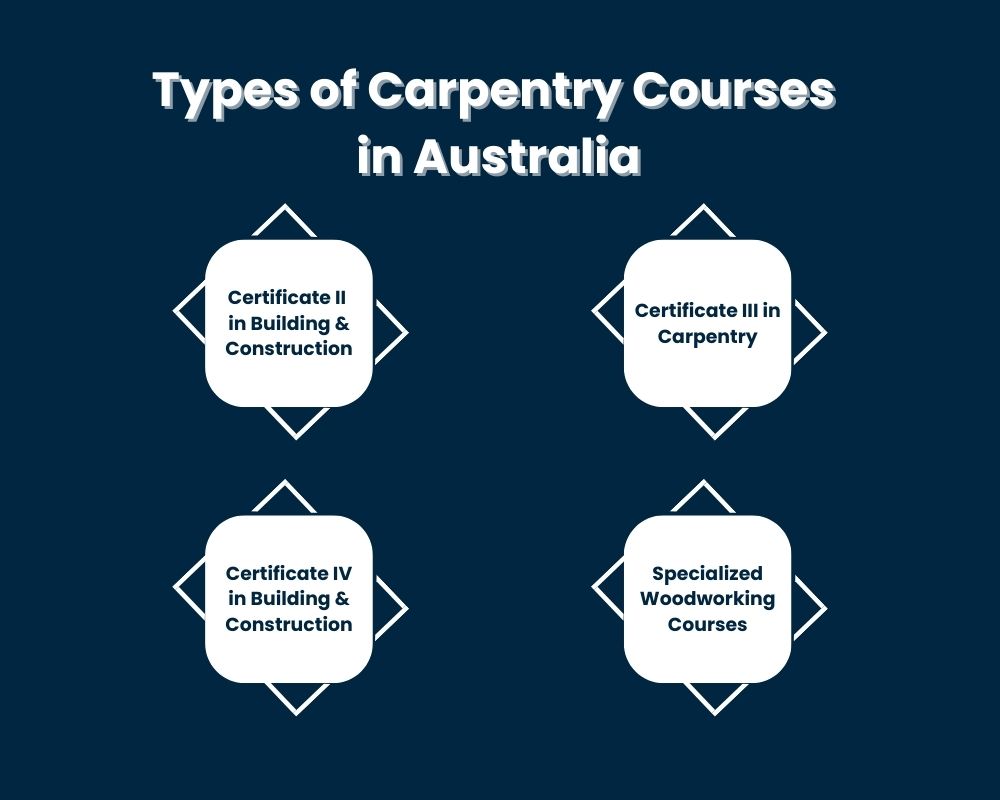
Certificate II in Building and Construction
This course is an entry level course which is often regarded as a pre-apprenticeship course. This course is specifically designed for school leavers or career changers to gain basic tool safety and site experience. After the completion of this course, it makes you an eligible candidate for an apprenticeship as this course provides you with your White Card which is also known as General Construction Induction.
Certificate III in Carpentry
The Certificate III in carpentry or CPC 30220 is the industry standard in the field. If you are someone who wants to become a qualified tradesperson in the field of carpentry, then this is the core carpentry course that is required. This course focuses on mastering structural work which includes wall framing, roof furnishing, eaves and flooring systems. This course is typically delivered over the duration of 4 years as an apprentice or 2 years as a full-time intensive course for international students. As a result after the course has been completed, you are provided with a Trade Certificate which is essential for most skilled visa pathways and trade licensing.
Certificate IV in Building and Construction
The Certificate IV in building and construction or the CPC 40120 is the course that is considered an advanced courses after you have completed your Certificate III. This course focuses on moving off the tools and provides you with knowledge into the management field. For many Australian states, this course is considered as the minimum educational requirement to apply for a Residential Builder’s License.
Specialized Woodworking Courses
While typical carpentry courses only focus on the structural skeleton of the building, several similar sister courses have their primary focus on finer and smaller details.
- Certificate III in Cabinet Making and Timber Technology (MSF30322): this course is specifically designed to focus on creating kitchens, bathrooms, and free-standing furniture.
- Certificate III in Shopfitting (CPC30120): This course is a course that specializes in the internal fit-out of retail stores and office spaces.
Entry Requirements for Carpentry Course 2026
If you want to successfully enroll in a carpentry course in 2026, international and domestic students are required to satisfy a specific set of requirements related to academics, language and physical criteria. These requirements are catered to students to make sure that both rigorous classroom and dynamic nature of Australian work site is maintained.
Therefore, the requirements for carpentry course in 2026 that ensure that they meet the DHA’s requirement criteria and individual RTOs are as follows:
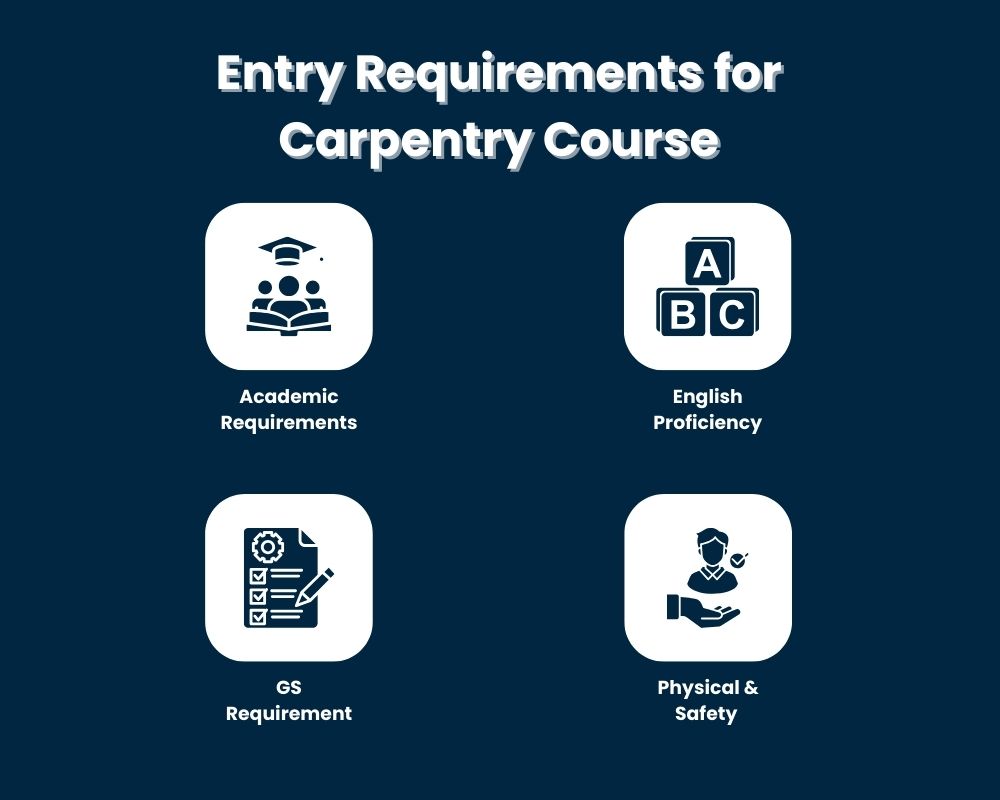
Academic Entry Requirements
The carpentry course in Australia under the available trade courses entry academic requirements makes it an ideal pathway for entry.
- Certificate III in Carpentry (CPC30220): If you want to satisfy the academic requirement for Certificate III in Carpentry, you need to make sure that you have completed an Australian Year 10 or 11 (or the international equivalent high school level).
- Certificate IV / Diploma Levels: To enroll for the Certificate IV you need to make sure that you have successfully completed a relevant Certificate III qualification or usually requires the completion of Australian Year 12.
- Mature Age Entry: If you are someone who is over the age of 21 and are not able to satisfy the academic requirements for the above courses, some providers allow entry for the Carpentry course based on Recognition of Prior Learning (RPL) or relevant work experience.
English Language Proficiency
If you want to enroll in the Carpentry course in 2026, you need to make sure that you satisfy the English test by scoring in the English Proficiency Test approved by the DHA. The requirements for English language for popular English test like IELTS, PTE, TOEFL are as follows along with the English Scores you need to have after ELICOS.
| English Test | Minimum Score Required (Direct Entry) | With ELICOS (English Package) |
|---|---|---|
| IELTS Academic | 6.0 Overall (Min. 5.5 in any band) | 5.0 – 5.5 |
| PTE Academic | 50 Overall (Min. 42 in any band) | 38 – 45 |
| TOEFL iBT | 60 – 67 Total | 46 – 51 |
Genuine Student (GS) Requirement
With the major changes in the migration scenes of Australia, the Genuine Student (GS) requirement has successfully replaced the traditional GTE system to ensure that you are a genuine student who is applying to study in Australia. If you want to satisfy this requirement, you need to make sure that the following are satisfied:
- You need to provide a logical and valid reasoning why a carpentry course in Australia is a preferred choice for you and aligns with the study and work history that you have.
- You are required to show that you have a clear understanding of the specific units that you will study throughout the Carpentry Course.
- You are required to satisfy the financial capacity requirement criteria by showing evidence that you are able to cover at least one year of tuition fees and living expenses which are currently indexed at Approx. AUD $29,710 as of 2026.
Physical & Safety Prerequisites
As carpentry course in Australia is a trade course which is physically demanding, these courses given by most TAFE and private providers require you to satisfy the following requirements:
- You need to show that you are physically fit and have the ability to stand for long periods of time, can lift heavy timber and are able to work at different weather conditions and heights.
- You are required to obtain a General Construction Induction Card which is regarded as a White Card before you set your foot into a live worksite for practical work.
- You are required to satisfy the PPE requirements by making sure that you have access to a standard safety kit which must include steel-capped boots, high-visibility vests, and protective eyewear.
Fast Track vs. Long Track Carpentry Course
If you are confused on choosing between the fast tracked and the long track pathways in the Carpentry Course in Australia in 2026 then you should know that choosing between two depends on your status of residency and how quickly do you aim to enter the professional workforce of Australia.
The key difference between fast tracked and long tracked pathways in Carpentry course in Australia are as follows:
| Feature | Fast Track | Long Track |
|---|---|---|
| Study Type | Intensive Study | Traditional Apprenticeship |
| Target Group | International Students & Career Changers | Domestic Students & School Leavers |
| Duration | 2 Years (approx. 92–104 weeks) | 3 to 4 Years |
| Learning Structure | 20 hours/week (Classroom + Workshop) | Full-time on-site work + Block study |
| Employment Status | Student Visa work rights (48 hrs/fortnight) | Full-time paid Apprenticeship contract |
| Practical Experience | Mandatory 360–400 hour placement | Continuous on-the-job training |
| Tuition Costs | Full international fees ($18k–$32k) | Often government-subsidized or "Free TAFE" |
| PR Eligibility | Direct route to 485 Graduate Visa | Standard route for Citizens/Residents |
Carpentry Courses Costs
As everything we need to be analyzed with a financial aspect in mind for the purpose of effectively budgeting the planning process, you are required to consider the cost related to the Carpentry course as well. In 2026, the cost related to the Carpentry course in Australia can be different according to your status in Australia (International or Domestic), the course you are choosing (Certificate III or Certificate IV), the region you are choosing (NSW or Victoria).
Cost of Carpentry Course by Status
According to the status that you have in the turf of Australia (Domestic Vs International), the cost related to the carpentry course in Australia varies with each other.
| Enrollment Status | Typical Payment Structure | Estimated Cost |
|---|---|---|
| Domestic (Subsidized) | Government-funded or Free TAFE | AUD $0 – AUD $4,500 |
| Domestic (Full Fee) | Upfront or VET Student Loan | AUD $18,000 – AUD $22,000 |
| International (Student Visa) | Installment plans per term/semester | AUD $18,000 – AUD $32,000 |
| International (Resource Fees) | Covers timber, PPE, and tools | AUD $1,500 – AUD $2,500 (Extra) |
Cost of Carpentry Course by Qualification Level
The price of a carpentry course in Australia is primarily determined by the total duration of the course and the complexity of it. According to the qualification level that you are applying for the cost varies significantly.
| Qualification Level | Average Duration | Average Total Cost |
|---|---|---|
| Certificate II in Construction | 3 - 6 Months | AUD $3,500 – AUD $6,000 |
| Certificate III in Carpentry | 2 Years | AUD $18,000 – AUD $32,000 |
| Certificate IV in Building & Construction | 1 Year | AUD $11,000 – AUD $16,500 |
| Diploma of Building & Construction | 1.5 Years | AUD $14,500 – AUD $25,500 |
Cost of Carpentry Course by Region
The cost of a carpentry course in Australia is varied significantly by the region that you choose. As geographic location plays a significant role in the tuition fees due to the varying state government subsidies and the competition that is existing in the local market.
| Australian Region | Certificate III (Avg. Total) | Certificate IV (Avg. Total) |
|---|---|---|
| New South Wales (Sydney) | AUD $17,500 – $22,000 | $12,500 – $14,500 |
| Victoria (Melbourne) | $16,800 – $20,000 | $11,000 – $14,000 |
| Queensland (Brisbane) | $13,900 – $27,800 | $10,000 – $13,500 |
| Western Australia (Perth) | $14,000 – $28,180 | $14,260 – $15,500 |
Carpentry Course Processing Timelines
If you are someone who is planning to enter in the Australian trade course through the Carpentry Course, then you need to understand the timelines involved in the course from the initial college application to the final visa grant. The processing time for carpentry course in Australia are heavily influenced by the DHA protocols like priority of trade skills and the Genuine Student (GS) assessment.
| Stage | Action Item | Estimated Timeframe |
|---|---|---|
| Admission | Application to Letter of Offer | 2 – 3 Weeks |
| Enrolment | Deposit Payment to CoE Issuance | 5 – 10 Business Days |
| Visa Prep | Health Exams & GS Documentation | 2 – 4 Weeks |
| Visa Assessment | Subclass 500 (VET Sector) | 4 – 10 Weeks |
| Total Prep Time | Initial Inquiry to Arrival | 4 – 6 Months |
Where Can I Do a Carpentry Course?
Selecting the right location for your carpentry course in Australia is an essential aspect that should be considered. This involves balancing the tuition fees, processing times and the potential migration benefits that can be achieved.
Provider Selection
TAFE Institutions
Technical and Further Education (TAFE) institutions are the government funded institutions that are considered as the backbone of Australia’s trade industry. This provider is the best option for students who value traditional campus experience, massive library resources availability and the prestige of government-based qualifications. These institutions are popular due to their massive scale, expansive workshops and real-world scenarios. The featured providers are TAFE NSW, TAFE Queensland, and Melbourne Polytechnic.
Private RTOs
Private Registered Training Organizations (RTOs) are the independent colleges that are often designed for building and construction. Due to the nature of these institutions acting like businesses, they are highly competitive on student support, specialized training, and modern learning models. This is the best option for you if you are international student who requires more frequent start dates, smaller one-to-one classes, and ability to balance work and study with the help of timetables being flexible. The Featured providers for this are Everthought, Skyline International, Lead College.
Designated Regions
The top study locations, the amount of money needed, and the anticipated waiting times for enrollment and visa processing in 2026 are all summarized in the table below.
| Region | Featured Providers (2026) | Avg. Total Tuition (Int'l) | Enrollment & Visa Timeline |
|---|---|---|---|
| NSW (Sydney) | TAFE NSW, Skyline College, Lead College | $17,500 – $32,000 | 4 – 5 Months |
| VIC (Melbourne) | Melbourne Poly, Holmesglen, Box Hill | $16,800 – $28,500 | 3 – 5 Months |
| QLD (Brisbane) | TAFE QLD, Macallan College, Everthought | $13,900 – $30,000 | 3 – 4 Months |
| WA (Perth) | TIWA (TAFE), SAI, Lead College | $14,000 – $32,000 | 5 – 6 Months |
| SA (Adelaide) | TAFE SA, Alliance College, Macallan | $10,000 – $34,600 | 4 – 5 Months |
PR Pathway with Carpentry Course in Australia
In the current migration scene of Australia, carpentry course in Australia still remains as one of the most stable and in demand trade course that has been favored by international and domestic students for Permanent Residency (PR) in Australia. Due to the course being available on the Medium and Long-term Strategic Skills List (MLTSSL), students who have graduated from this course have access to independent, state-nominated, and regional visa streams that are usually faster and more predictable as compared to various university pathways.
Step-by-step journey to PR
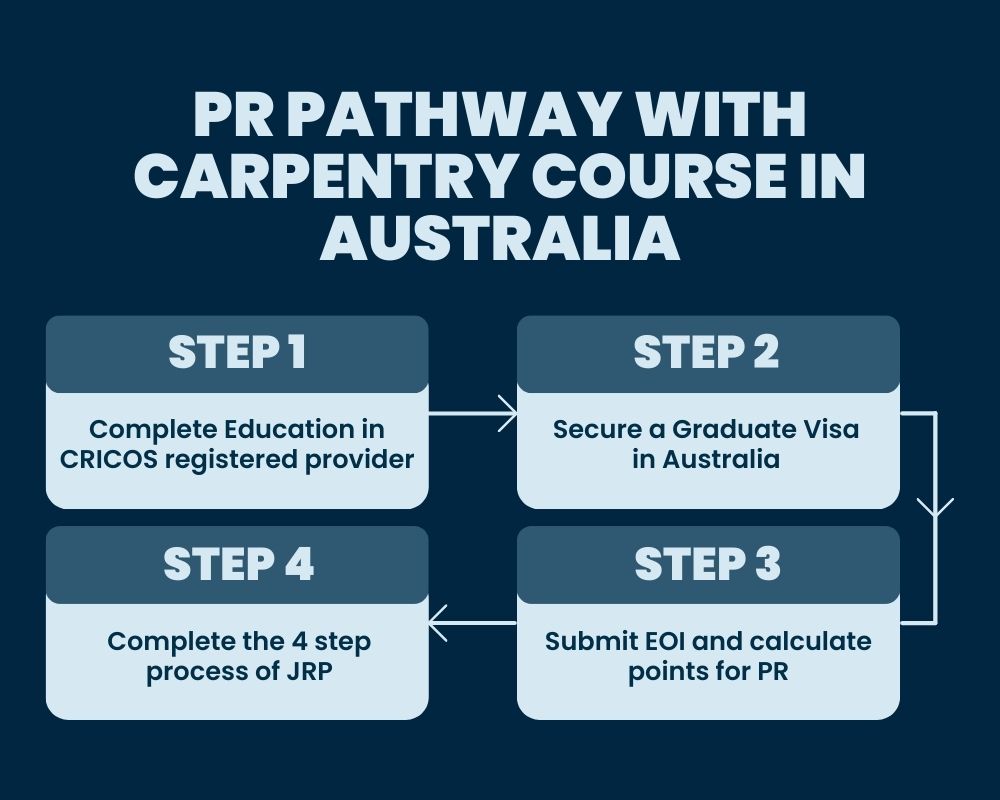
Step 1: Complete your Education
The first step in the PR pathway for carpentry course in Australia is that you are required to complete a 2-year Certificate III in Carpentry at a CRICOS registered provider where you will be provided with the education you require to know about the course and makes you job ready.
Step 2: Graduate Visa
The second step in this pathway is to secure a graduate visa (subclass 485) which grants you with 18-24 months of work visa which is required to gain the required 12 months of Australian work experience criteria.
Step 3: Job Ready Program
After you have secured your graduate visa the next step in the pathway to PR is that you need to complete the 4-stage assessment that is conducted by the Trade Recognition Australia (TRA) which is used to prove that you are eligible to perform at an Australian standard. The four stages of the Job Ready Program (JRP) include:
- Provisional Skills Assessment (PSA)
- Job Ready Employment (JRE)
- Job Ready Workplace Assessment (JRWA)
- Job Ready Final Assessment (JRFA)
If you want to know about the JRP in detail, make sure to visit the meticulously drafted guide on JRP by BJay Education & Visa Services.
Step 4: Points Test & EOI
After you have completed your JRP, then next step in the pathway to your PR in Australia is to submit an Expression of Interest (EOI) for visa subclasses like 189, 190, or 491. After this you are required to calculate your points.
PR Visa Options for Carpenters
| Visa Subclass | Pathway Type | Key Requirement | PR Potential |
|---|---|---|---|
| Subclass 189 | Skilled Independent | High points score (typically 75–85 in 2026) | Direct Permanent Residency |
| Subclass 190 | State Nominated | Requires nomination from a state (e.g., NSW, VIC) | Direct Permanent Residency |
| Subclass 491 | Skilled Regional | Must live/work in a regional area for 3 years | PR via Subclass 191 |
| Subclass 186 | Employer Sponsored | 3 years of experience + employer nomination | Direct Permanent Residency |
482 Pathway for Carpentry Course
Although there are many popular visa programs like subclass 189, 190, 491 are widely used, the subclass 482 or Skills in Demand visa which is formerly known as the Temporary Skill Shortage (TSS) visa is also regarded as a powerful alternative that is sought in 2026. This visa program has been preferred by graduates as this visa program offers a faster and more certain transition to PR through employer sponsorship.
As the role of a carpenter falls under the Core Skills Occupation List (CSOL), you need to make sure that certain criteria are satisfied that makes you an eligible individual to qualify for this visa program. The requirements for the 482 visa as of 2026 are as follows:
| Requirement Category | 2026 Mandatory Criteria |
|---|---|
| Employer Sponsorship | You are required to have a formal job offer letter from an Approved Standard Business Sponsor. |
| Work Experience | You need to have a minimum of 1 year of full-time relevant experience after you have graduated from the course. |
| Minimum Salary (TSMIT) | You are required to show that you are able to satisfy the minimum salary requirement of TSMIT which is $79,499 AUD per annum (plus 12% Superannuation). |
| English Proficiency | You need to satisfy the English requirements provided by the DHA by have scores that equivalent to IELTS 5.0 overall (or PTE 36) minimum. |
PR pathway with 482 visa
The primary reason that has made the 482 visa a preferred pathway in 2026 is that it has a clear pathway to PR in Australia. If you want to apply for PR with the 482 visa in Australia, then you are required to follow the process given below:
Step 1: Graduate & Work
In this step, you are required to graduate with a Certificate III in Carpentry and work for 1 year in related field on the 485 Graduate Visa. By completing the graduation from the Certificate III course and completing the work requirement, you will be eligible to apply for the 482 visa.
Step 2: Lodge your application
As the 482-visa program is an employer sponsored visa, you need to make sure that your employer successfully nominates you for the 482 visa and has the validity for up to 4 years.
Step 3: The “Two-Year Rule”
After you have successfully lodged your 482 applications after your graduation, you are required to work in relevant field for a total of 2 years on your 482 visa.
Step 4: Transition to 186
After all the above steps have been completed then you are required to apply for the PR visa which in this case scenario is the 186 visa program. The 186 visa program is a visa program that provides you with PR in Australia.
FAQs
Yes, international students are eligible to study Certificate III in carpentry (CPC30220) in Australia. If you want to enroll in courses, the course is required to be a CRICOS Registered and you must meet the English Proficiency Requirement through an English test that has been approved by DHA like IELTS, PTE, TOEFL and have completed academic requirements like completion of year 10 or 12.
In 2026, the typical cost for international students, the tuition fees typically range from AUD $17,500 to AUD $18,500 per year. Including the resource fees like timber, tools, and PPE, the total investment for the full course of 2 years duration is between AUD $36,000 and AUD $42,000.
In case that you are looking for a Permanent Residency (PR) in Australia that requires a skills assessment like the subclass 189, 190 or 491 then yes, the Job Ready Program is prerequisite that must be satisfied. The JRP is the only way for international graduates with an Australian qualification to get a “Full Skills Assessment” from Trades Recognition Australia (TRA).
The primary difference between TAFE and a private RTO is that TAFE are government-owned institutions with massive campuses and strict start dates usually February and July whereas Private RTOs are independent organizations that act like businesses and often offer more flexibility and frequent intake in every 2-3 months.
If you are looking to secure your PR through Carpentry, then the total journey usually takes about 3.5 years to 4.5 years to complete. This whole process includes 2 years of study, 12–15 months to complete the Job Ready Program (JRP) on a Graduate Visa, and roughly 6–12 months for visa invitation and processing.
In 2026, the place you decide to study must be determined on the basis of your points as the major cities and regional areas of Australia have their own set of requirements and benefits
Major cities like Sydney and Melbourne usually offer you the highest volume of work and networking opportunities while it requires higher points for PR which is usually 85+. Similarly, the regional areas of Australia like Adelaide, Perth or Gold Coast usually grants you with 5 extra points for Regional Study and gives you access to subclass 491 visa which usually invites individuals with as less as 65 points.

As Trade Courses in Australia have become increasingly in demand in 2026, choosing a right partner to help you throughout the journey has become an essential decision that can secure your future. At BJay Education & Visa Services, we don’t just process applications, we build careers.
Why BJay?
Proven Expertise: With 13 years of experience in Visa services in Australia, we here at BJay Education & Visa Services have been providing tailored services to help you navigate through the complex migration scenes of Australia.
Expertise Team: Led by Mr. Jay Oli (MARN: 1570827), we have an exceptional team that is there to solve any queries and help you with your application. The team is well trained to provide the services that you may require assistance with.
Global Presence & Local Support: With offices present in multiple locations throughout Nepal (Putalisadak and Birtamode) and a head office in Sydney, BJay provides you with seamless support you may require whether you are in your home country or already in the turf of Australia.
Specialized Trade Pathways: We here at BJay Education & Visa Services specialize in bridging the gap between education and employment. We help you through your journey from the applications to obtaining your PR in Australia.
Confused on Applying for Carpentry Course in Australia? Book a Free Nonobligatory Consultation with BJay!