
Trade Courses in Australia in 2026 offer a fast-tracked pathway to International Students to in-demand skills, stable careers, and permanent residency (PR) opportunities in Australia. In the dynamic migration scene of Australia in 2026, trade courses in Australia have been considered a high-valued pathway to skilled professions like carpeting, painting, Plumbing, Automotive, Bricklaying). Unlike academic degrees that provide various employment opportunities, the trade courses in Australia pathway offers a tangible, fast-route that is routed to both high-paying employment and a popular PR pathway.
With 13 years of experience in serving multiple individuals in the field of Visa services, BJay Education & Visa services has meticulously drafted this guide in order to help international and national students in Trade Courses in Australia. This guide has been cross-referenced with the latest 2026 Data from the Department of Home Affairs (DHA) to provide you with the pathways, costs related to it and processing time related to the Trade Courses in Australia.
Why Trade Courses in Australia?
The main reason that Trade Courses in Australia has become a popular reason in 2026 is the unique combination of high earning employment and simplified migration pathway. While other academic degrees leading to fierce competitions, students with Trade courses in Australia certification actually find themselves in the high-demanded bracket of employment market in Australia.
The reasons that Trade Courses in Australia has been a popular pathway are:
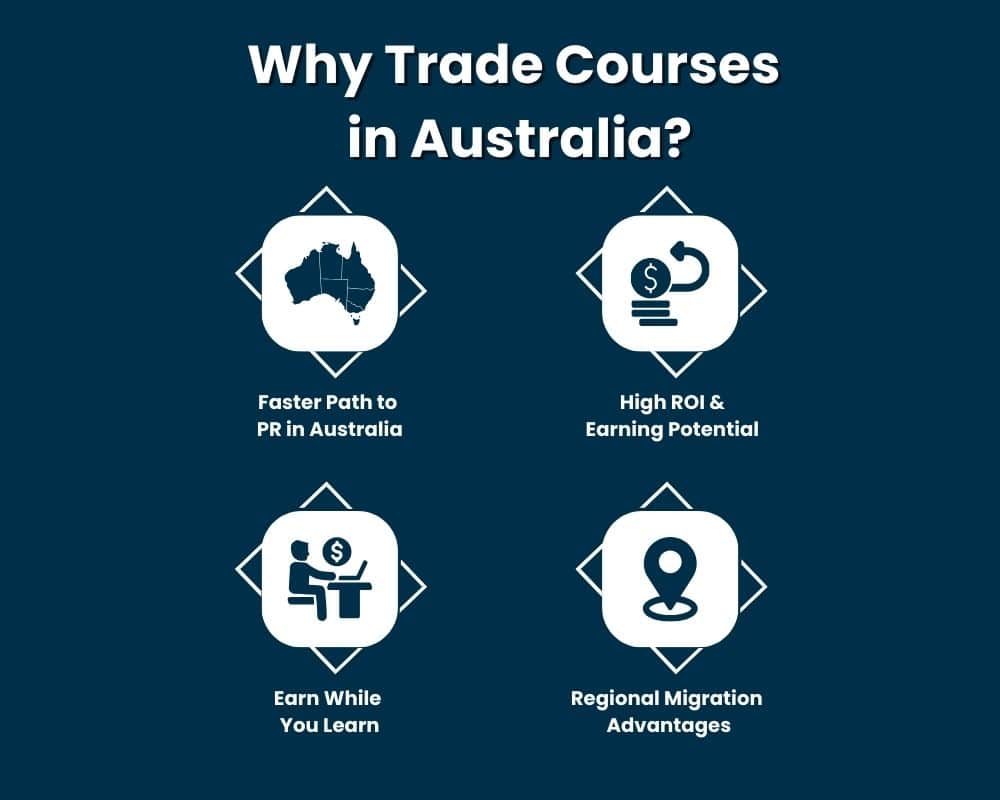
Faster Path to PR in Australia
Trade courses in Australia for PR are often regarded as a more effective pathways to PR in Australia than a traditional degree. Most courses related to trade are listed on the Medium and Long-term Strategic Skills List (MLTSSL). As these courses are essential and demanded highly in the labor market, DHA provides invitations to trade applicants with lower points scores which often range between 65 to 75 points as compared to the 90+ points required for highly competitive academic courses like accountants or engineers.
High ROI and Earning Potential
The Trade Courses in Australia provides a high Return on Investment (ROI) pathway for international students. As of 2026, the earning potential for these courses is high. With the total cost of 2 years vocational course and total investment of around AUD $25,000 for an electrician or carpenter, you can earn about AUD $85,000- $110,000. This course typically allows students to get a higher ROI and recover their educational costs with the 1st year of full-time work in the field.
Earn While You Learn
If you are a student who is competing a Trade Corse in Australia then typically with the Job Ready Program (JRP), you gain around 1,725 hours of paid work experience. With this it is typically not considered as an internship or more of a part time job while you are learning. It is a requirement that make sures that you are paid at Australian award rates while fulfilling the criteria for your full skills assessment.
Regional Migration Advantages
If you are someone who wants to pursue trade courses in Australia in the Regional Locations (Category 2 and 3 cities) of Australia, it gives you access to an extended Subclass 485 Graduate Visa and five extra points toward your PR application. This will give you more time to get an employer sponsorship or state nomination.
Top Trade Courses in Australia
To address the critical shortage of trade occupations in Australia like construction, energy, and automotive sectors, the Government of Australia has increased its primary focus on Skilled trades. Choosing to pursue one of these Trade Courses in Australia not only provides you with the pathway to earn more but also provides you with a pathway to PR in Australia through the MLTSSL.
| Occupation | Duration | Estimated Cost (Total) | Avg Annual Salary (2026) | Top Providers |
|---|---|---|---|---|
| Electrician | 2 Years (Cert III) | AUD $22,000 – $30,000 | $95,000 – $115,000 | TAFE QLD, Victoria University, Skills Australia Institute |
| Carpenter | 2 Years (Cert III) | AUD $18,000 – $26,000 | $85,000 – $110,000 | TAFE NSW, RMIT University, Holmesglen Institute |
| Plumber | 2 Years (Cert III) | AUD $20,000 – $28,000 | $90,000 – $115,000 | Box Hill Institute, TAFE SA, Chisholm Institute |
| Motor Mechanic | 1.5 – 2 Years (Cert III) | AUD $16,000 – $24,000 | $90,000 – $110,000 | Kangan Institute, AVTA, TAFE International WA |
| Chef (Commercial Cookery) | 2 Years (Cert III/IV) | AUD $15,000 – $25,000 | $75,000 – $95,000 | Le Cordon Bleu, William Angliss Institute, TAFE QLD |
Entry Requirements for Trade Courses in Australia
With the current migration scenes of Australia in 2026 that is very competitive, the DHA has made the entry requirements for trade courses in Australia more standardized to make sure that international students are able to meet the strict demands that are required by the Trades Recognition Australia (TRA) skills later in this pathway. Regardless of whether you are looking for trade courses in Australia for international students in Carpentry, Electrotechnology, or Commercial Cookery you must satisfy the following requirements:
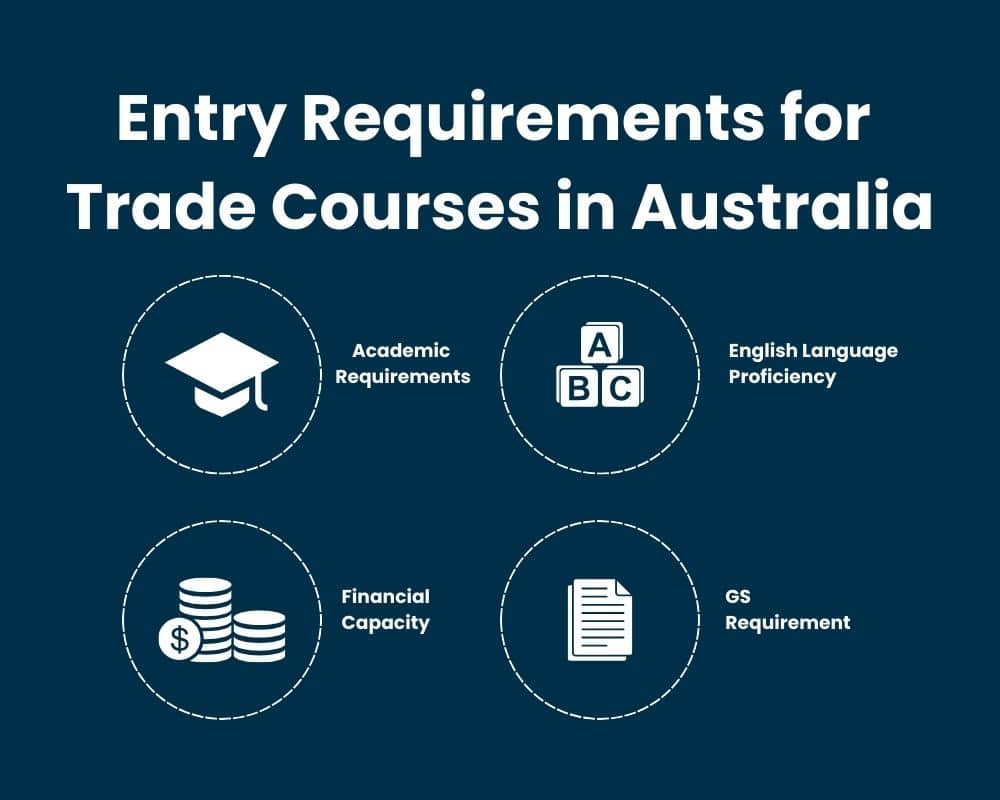
Academic Requirements
- You are required to complete year 10 or equivalent certification like High School/Secondary School Certificate if you want to be eligible for most Certificate III programs.
- If you are looking for advanced entries like the Certificate IV or Diploma Level Trade Courses, then most providers usually require that you have completed your Year 11 or 12 or a relevant Certificate III that is in the related field of occupation.
- At the start of your course, you must be at least eighteen years old.
English Language Proficiency
In the current migration scene of Australia, the DHA has approved of 9 different English Proficiency Test that can be attended in order to meet the English Requirements. The English requirements have recently been scrutinized in 2026 in order to make sure that students can safely follow the complexities of the language in their workspace.
| English Test | Required Score (Certificate III/IV) | Required Score (Diploma) |
|---|---|---|
| IELTS (Academic) | 5.0 – 5.5 Overall Band | 5.5 – 6.0 Overall Band |
| PTE Academic | 36 – 42 Overall score | 42 – 50 Overall score |
| TOEFL iBT | Total 35 – 46 score | Total 46 – 60 score |
Financial Capacity
If you want to secure your Subclass 500 Student Visa in order to get your trade course in Australia, you are required to demonstrate that you have sufficient and genuine access to required funds. As of February 2026 data, the requirements are as follows:
- You are required to have AUD $29,710 funds available for the primary applicant.
- You are required to provide evidence of tuition fees for the first 12 months which typically range from AUD $8,000 to $15,000.
- You are required to show that you are able to pay AUD$2,500 for the travelling cost.
Genuine Student (GS) Requirement
With the Genuine Student (GS) requirement fully replacing the old GTE, in 2026, you are now required to provide a GS statement that satisfies the following criteria:
- Explain why you are choosing to pursue Trade Courses in Australia instead of the courses that are available in your home country.
- Explaining how this particular trade role such as the automotive or plumbing fits your life and your prior experiences and how is it going to contribute to your future in Australia.
- Explaining your understanding of the role you wish to pursue and the Job Ready Program (JRP).
Step-by-Step Application for Trade Courses in Australia
If you are someone who wants to pursue trade Courses in Australia, then you are required to follow these guidelines step-by-step to make sure that your application stands out and has a positive outcome.
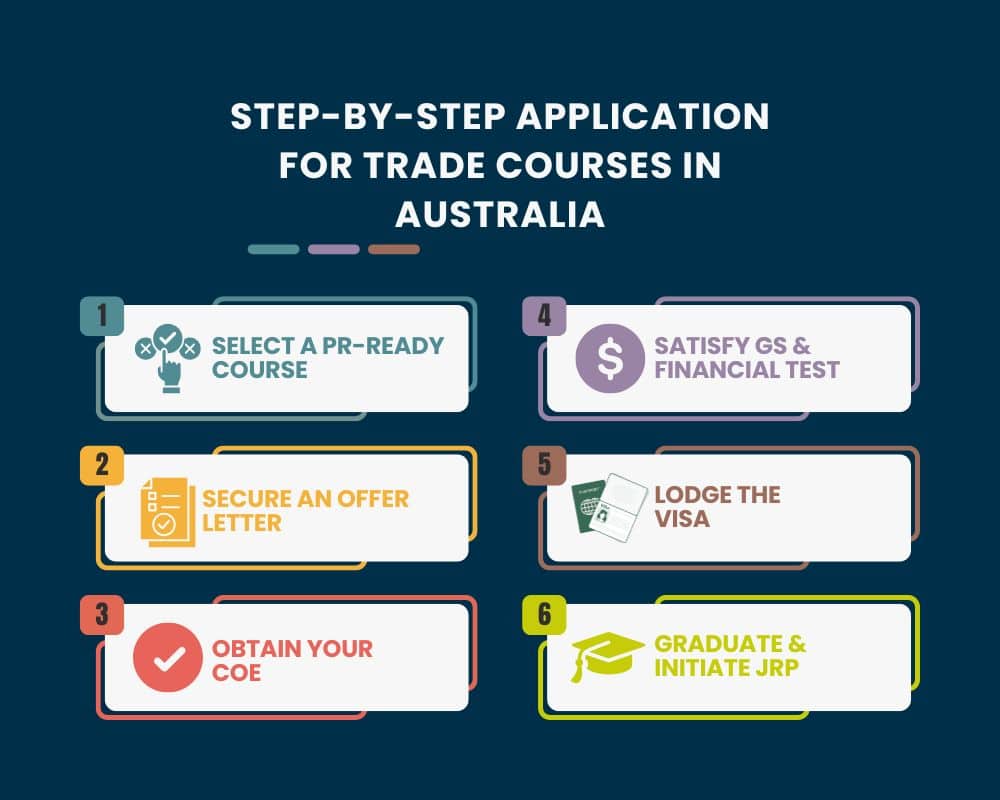
Step 1: Select a PR-Ready Course
Before you officially commence your application process, make sure that you choose a course that is CRICOS-registered and it has a minimum of 92-week duration like Carpentry or Electrotechnology. This is required to make sure that you satisfy the Australian Study Requirement for future migration.
Step 2: Secure an Offer Letter
After you have selected a CRICOS registered course, you are now required to submit your academic transcripts and English Proficiency test results that satisfy the minimum English Requirement to a “Priority 1” institution that makes sure that your visa application is processed faster.
Step 3: Obtain your CoE
After securing a letter offer from the concerned authorities, you are now required to obtain your Confirmation of Enrolment (COE) that is required for your visa application. You need to pay the Initial Tuition deposit required by the provider and the Health Insurance of OSHC to receive your CoE.
Step 4: Satisfy GS & Financial Test
For the Trade Courses in Australia pathway, you need to make sure that you satisfy the GS requirement by proving that your application is genuine. In this step, you are also required to provide verifiable proof that you are able to pay the cost of AUD $29,710 to afford annual living expenses.
Step 5: Lodge the Subclass 500 Visa
After you have successfully completed the step given above then you are now required to lodge your subclass 500 visa application through the ImmiAccount portal with a fee of AUD $2,000. Additionally, you are required to complete all the mandatory health exams and biometrics at a DHA approved center.
Step 6: Graduate & Initiate the JRP
Upon the completion of your course and successfully graduating, you must now apply for the Subclass 485 (Graduate Visa) and enroll in the Job Ready Program (JRP) that is governed by the Trades Recognition Australia (TRA). After your application you are now set to begin your formal path to PR in Australia.
Trade Courses in Australia PR Pathway
Unlike other academic degrees that often require you to have 90+ points, trade occupations under the Medium and Long-term Strategic Skills List (MLTSSL) receive invitations with scores of 65-75 points. Due to this, this pathway is considered as prominent pathway to PR in Australia.
For you to navigate thought the trade courses in Australia for PR, you are required to complete the Job Ready Program (JRP). For you to complete the JRP, you need to complete the mandatory 4 step employment-based skills assessment that help you to bridge the gap between your academic study and your permanent visa in Australia.
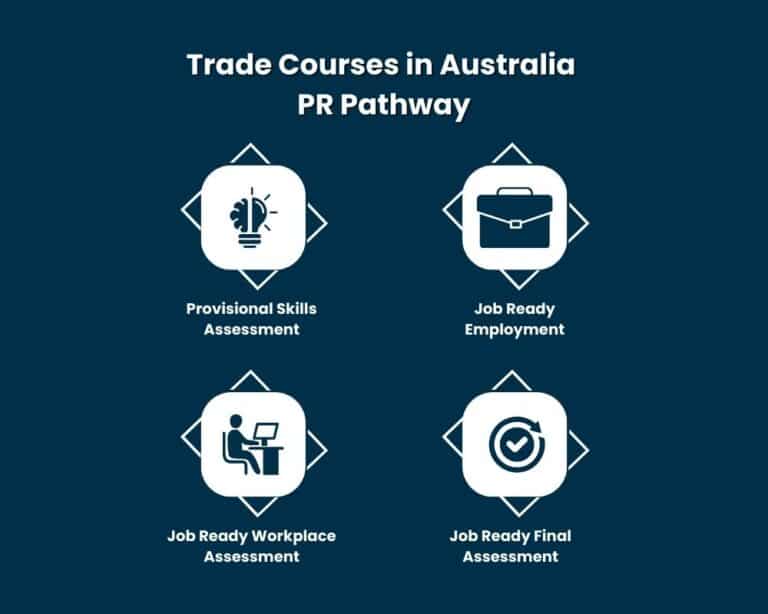
Stage 1: Provisional Skills Assessment (PSA)
After you have successfully graduated from your 2-year trade course in Australia, you should now apply for a PSA which then verifies your eligibility for the specific role and lets you submit an application for the Subclass 485 visa.
Stage 2: Job Ready Employment (JRE)
In this stage of Job Ready Enrollment, you are required to complete at least 1,725 hours of paid work over the minimum of 12 months in your nominated trade. In 2026, DHA lets you backdate up to 3 months of prior employment to accelerate your application for this stage.
Stage 3: Job Ready Workplace Assessment (JRWA)
After you have completed the JRE and completed the 6 months of employment, your application will now be assigned to a TRA approved accessor who will then assess your application and visit your workplace to observe your skills in the nominated occupation. This is a practical check that is used to verify your skills rather than your written exam.
Stage 4: Job Ready Final Assessment (JRFA)
In this stage of JRFA, you get your Full Skills Assessment after completing 1,725 hours and 12 months. This Golden Ticket is necessary in order to submit your Expression of Interest (EOI) for permanent residence.
Eligible Visas for Trade Graduates in 2026
- Subclass 189 (Skilled Independent)
- Subclass 190 (Skilled Nominated)
- Subclass 491 (Skilled Work Regional)
FAQs

In the current context of Australia in 2026, the best trade course for PR in Australia remains Electrotechnology and Carpentry. These specific occupations are classified as the category “Critical Shortage” on the Medium and Long-term Strategic Skills List (MLTSSL), which ultimately leads to it being highly demanded with higher employment rates and returns.
If you are someone who is looking to pursue Trade courses in Australia, then you must know that the earning potential for skilled trade workers in Australia is on a record high as for 2026. The top paying trade occupations are:
- Electricians: Specialized roles in mining or renewable energy provides specialist between AUD $140,000 – $170,000.
- Plumbers: With the high demand for this occupation and demand in maintenance and emergency services, you can expect an earning range of AUD $110,000 – $140,000.
- Carpenters: With high demand for housing push, qualified carpenters in 2026, this field of work typically grants you with an annual salary of AUD $85,000 – $115,000.
Yes. In 2026, one of the most alluring benefits that international students pursing a trade course is that they are able to enjoy the facility of Working while they are still studying. In this course, international students on a Subclass 500 visa can work up to 48 hours per fortnight while their course is in session allowing them to earn a decent amount. However, during official breaks from school, you have access to unlimited work rights which are mostly used by students to gain experience that is required for the Job Ready Program (JRP).
If you want to be eligible for PR in Australia under the General Skilled Migration (GSM) and with the subclass 189, 190 or 491, then you are required to be under the age of 45 years at the time of age to receive the invitation.
However, if you are someone who is applying through the Subclass 485 Graduate Visa, the age limit has been lowered to 35 years of age or younger for the majority of occupational streams. Specialized routes such as DAMA (Designated Area Migration Agreements) might still be accessible if you are over 35.

If you are someone who wishes to pursue Trade Courses in Australia, you are required to navigate through the complex migration scene of Australia. In 2026, it requires more than just enrollment and requires a comprehensive migration strategy. We here at BJay Education & Visa Services don’t just process applications but we build your future in Australia.
Why BJay?
Proven Expertise: With 13 years of experience in Visa services in Australia, we here at BJay Education & Visa Services have been providing tailored services to help you navigate through the complex migration scenes of Australia.
Expertise Team: Led by Mr. Jay Oli (MARN: 1570827), we have an exceptional team that is there to solve any queries and help you with your application. The team is well trained to provide the services that you may require assistance with.
Global Presence & Local Support: With offices present in multiple locations throughout Nepal (Putalisadak and Birtamode) and a head office in Sydney, BJay provides you with seamless support you may require whether you are in your home country or already in the turf of Australia.
Tailored Strategic Planning: We help you find the best trade course that is meant for you and provide help for permanent residence in Australia that fits your academic background, budget, and the most recent state nomination quotas.
Still Confused on How to navigate your Trade Course in Australia Application? Join BJay!
Book a Free Non-obligatory Consultation with BJay and get expert Help.