Bridging Visa being a part of the Australian Migration system and with the Department of Home Affairs “Integrity-First” approach has made managing the Australian immigration system in 2026 more challenging. Whether you are looking to switch from a tourist visa to a skilled visa, it is now necessary to know about it in order to ensure future permanent residency in Australia. Accurate information is essential as errors regarding bridging visa work permits could end up in visa cancellations.
With expertise for over a decade BJay education and Visa Services, this guide seeks to provide well-verified information against the DHA on bridging visa types, Bridging Visa processing dates, different Bridging Visa work/travel permissions, and efficient application techniques to maximize your visa application outcomes.
Bridging Visa
Bridging Visa is a temporary visa that is used to bridge the gap between visas or status changes, it is a visa that permits you to legally stay in a country (such as Australia) while their main visa application is still being processed, an appeal is being considered, or they make plans to depart.
There are further varieties to the bridging visa subclass, each addressing certain visa applications. Every one of them ensures lawful presence and prevents unlawful status while providing different privileges, such as the capacity to work or travel, depending on the particular circumstance.
The various Bridging Visa types are:
| Visa Type | Subclass | Primary Purpose (2026) | Grant Process for the visa |
|---|---|---|---|
| BVA | Subclass 010 | Maintains lawful status after substantive visa expires. | Automatic process |
| BVB | Subclass 020 | Travel rights: Departure and re-entry for a set window. | Manual Application |
| BVC | Subclass 030 | This Visa is Lodged when your previous visa has already been expired. | Manual / Automatic process |
| BVD | Subclass 040/041 | Short-term status (5 days) to lodge for a valid visa. | Manual process |
| BVE | Subclass 050/051 | For unlawful citizens or those awaiting deportation/appeal. | Manual process |
| BVF | Subclass 060 | Protection/Support for victims of trafficking. | Officer Referral |
Bridging Visa A (BVA) – Subclass 010
Among various types of bridging visas, the most common holding visa in Australia is BVA, which is also known as the BVA or Subclass 010. When you submit a genuine onshore application for a main visa while your present visa is still valid, it is automatically approved. It remains dormant until the expiration of your current visa. Once active, it maintains your rights until your fresh application is decided.
Visa for BVA typically represents the conditions of your prior visa. However, even if your prior visa (such as a visitor visa) had no work rights, you might be granted full work rights if you apply for a high-demand visa (such as a 485 or 189).
You are unable to travel with this visa due to BVA’s zero-travel rights policy. When you leave Australian territory on a BVA, it is instantly canceled, which frequently leaves you trapped offshore.
Bridging Visa B (BVB) – Subclass 020
BVB is a visa option which is in particular designed for BVA visa holders in cases when they need to travel abroad and then they can get a lawful entry into the turf of Australia while returning. In the year of 2026, you must apply for the BVB via ImmiAccount before you leave Australia. The current 2026 fee for this visa is $190 AUD.
The BVB is granted for a specific travel facility window which is usually 3 months long and can extend up to the timespan of 12months in case of emergencies.
If your BVB expires while you are traveling overseas, you automatically lose your right to enter the turf of Australia. Therefore, it is important that you check your VEVO status 48 hours prior to your return to Australia.
Bridging Visa C (BVC) – Subclass 030
BVC is a special kind of Bridging Visa. This visa may be granted to you when you apply for visa subsequent to the expiration of the last substantive visa you hold. Unlike the BVA, a BVC comes with Condition 8101 by default which basically means that you can’t work with this visa.
But if you want to work, you must prove your Financial Hardship Condition though Form 1005. Under the rules provided in 2026, you are also required to pay the AUD $230 Work License fee if your application for the work condition is approved. You cannot apply for a BVB if you hold a BVC. You are effectively stuck in Australia until your main visa is being processed.
Bridging Visa D (BVD) – Subclasses 040 & 041
BVD is a highly restrictive, short-term visa used for the sole purpose of emergencies. This visa is valid for only 5 working days as it is meant to serve only the purpose of emergencies. This visa has no work rights and no travel rights whatsoever.
Subclass 040 (Prospective Applicant): if you are someone who tried to lodge a visa but failed (e.g., credit card declined or wrong form submission) then will automatically become unlawful within 3 days leaving you the emergency window where it gives you 5 days to fix the error.
Subclass 041 (non-applicant): if you are someone who doesn’t want to apply for a visa but if you need time to arrange your departure and concerned officer wasn’t available to your interview process then this is the one for you.
Bridging Visa E (BVE) – Subclasses 050 & 051
BVE is a visa subclass which is a compliance visa. Bridging Visas can only be held if you are an individual whose status is illegal, your visa has been revoked, and if you are someone who is appealing an Administrative Review Tribunal (ART) denial. Strict reporting requirements, such as visiting a DHA office once a month, are frequently associated with the BVE. The four years of residency required for Australian citizenship do not apply to time spent on a BVE.
6. Bridging Visa F (BVF) – Subclass 060
The BVF is a specialized type of visa that is a humanitarian visa that is used only for the suspected victims of human trafficking, slavery, or forced labor.
It is a visa that permits the bearer to remain in the turf of Australia for the specific duration of police investigations or until the authorized authorities determines that a longer stay is necessary for the administration of justice. Typically, a single extension is possible after the first 45-day period for this visa. Welfare and housing assistance are included, but employment and foreign travel are strictly forbidden.
Bridging Visa Australia Processing Time
The processing times for Bridging Visas Australia in 2026 are greatly affected by the subclass that is being applied for and the kind of difficulty of the substantive visa application. The Department of Home Affairs has implemented manual verification for candidates from various countries in the Evidence Levels 3 category (India, Nepal, Bangladesh, Bhutan), which can sometimes result in irregular processing delays even though these visa programs are usually issued quickly.
| Bridging Subclass | 2026 Processing Time | Note |
|---|---|---|
| BVA (Subclass 010) | Instantly to 48 Hours | Only grantable if previous visa is still valid. |
| BVB (Subclass 020) | 1 – 10 Business Days | Apply 3 weeks before travelling to avoid being stranded. |
| BVC (Subclass 030) | 1 – 7 Days | No travel rights allowed. |
| BVD (Subclass 040) | On-the-spot to 24 Hours | Valid for only 5 working days and strictly no work rights provided. |
| BVE (Subclass 050) | 2 – 6 Weeks | Used for the purpose of appeals or while arranging departure. |
| BVF (Subclass 060) | Priority / Case-by-Case | Exclusively for victims of trafficking/forced labor. |
2026 Bridging Visa Cost
Since the 2026 cost structure now divides between the base visa application and employment authorization, it is essential to understand the financial requirements of your stay. The Department of Home Affairs’ approach to ensuring labor market integrity has significantly changed with the implementation of the mandatory AUD $230 Work License Fee, even though many bridging subclasses still have “Nil” fees for the base grant. The following is a list of fees for all types and also for emergency and humanitarian visas.
| Visa Subclass | Visa Type | Base Application Charge (AUD) | 2026 Work License Fee (AUD) |
|---|---|---|---|
| 10 | BVA | AUD $0 | AUD $230 (If work rights are wanted) |
| 20 | BVB | AUD $190 | AUD $230 (If work rights are wanted) |
| 30 | BVC | AUD $0 | AUD $230 (Mandatory in case of Form 1005) |
| 040 / 041 | BVD | AUD $0 (Nil Fee) | N/A (Strictly work rights are Prohibited) |
| 050 / 051 | BVE | AUD $0 | AUD $230 (Mandatory in case of Form 1005) |
| 60 | BVF | AUD $0 (Nil Fee) | N/A (Strictly work rights are Prohibited) |
How Can I Apply for Bridging Visa?
The bridging visa application process is now completely online as of 2026. Paper applications for bridging visa will only be taken into consideration in particular kinds of situations, suggesting a major modernization of the visa application process.
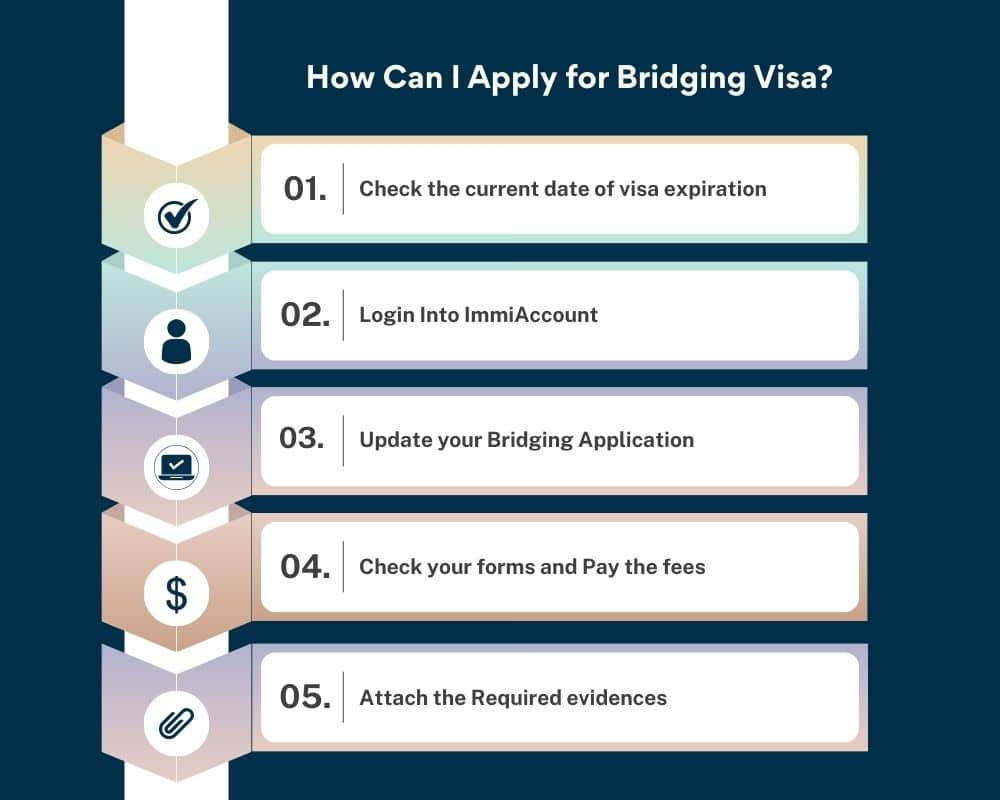
- Before starting with anything, make sure to check the current date of visa expiration via VEVO before you apply for the BVA, as you are not eligible for BVA if you are marked “unlawful.”
- Make sure you are able to Log in to your existing substantive visa application visa immiaccount.
- Go to Update Us available in the left-hand menu, select Application for a Bridging Visa to proceed to your further process.
- Complete the correct forms as per your requirements and Pay the Mandatory fees of base charges and work licensing fee if you want to request work rights.
- Make sure to attach the required evidence that is clear and concise as per the visa requirements.
Bridging Visa Australia Validity Rules
To avoid unlawful status and a possible three-year re-entry ban, Bridging Visa Australia validity rules must be properly managed. The visa system, which lacks any time limit but instead relies upon specific “trigger events” around which certain legally defined periods revolve, protects residency rights under transitional provisions. In fulfilling the requirements of the Department of Home Affairs under the new system in 2026, it is vital that one monitors the three key validity pillars.
- Activation If your new visa is granted before the expiry of the current visa, you shall never be in the bridging visa if it comes into effect at the moment of expiry of your substantive visa.
- The 35-Day Rule: Your bridging visa will automatically be expired in 35 days from the day of the decision in the circumstances where your substantive visa application is rejected. You will have to leave Australia or start the appeals process within this time period.
- Travel Cessation: The visa immediately expires if you go outside of Australia with BVA, BVC, or BVE. But without BVB, you are unable to return to the nation.
Documents Checklist for Bridging Visa
In order not to have any hold-ups in the processing of your bridging visa application, you are required to give the authority unambiguous and verifiable proof that will back up your individual claim. The general document checklist for the year 2026, which is divided by major application areas, is provided below.
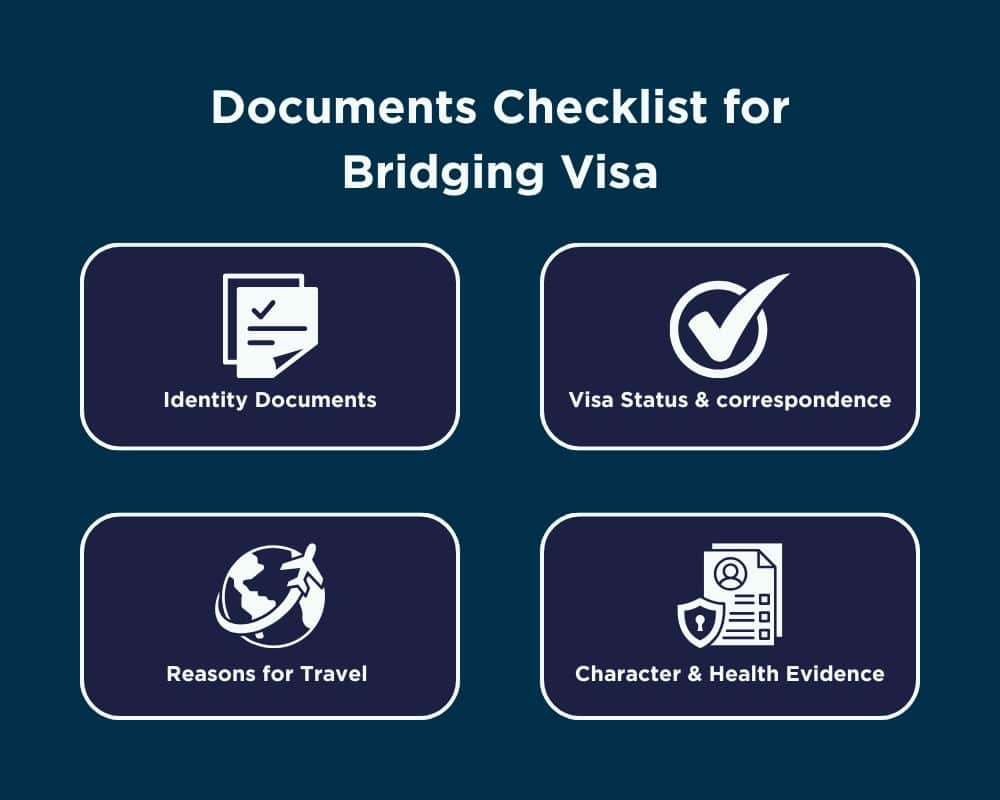
Identity Documents:
- Current Passport with validity
- National Identity Card
- Proof of Name Change (if applicable)
- Passport-Sized Photographs
Visa Status and Correspondence
- Copy of Substantive Visa Grant that you currently holf
- Application Acknowledgement from the Department of Home affairs
- VEVO Record to confirm your current expiry and conditions
Substantial Reasons for Travel (For BVB – Subclass 020)
- Written Statement explaining the need for travel
- Flight Itinerary showing the proof of travel dates
- Supporting Evidence that supports the purpose of travel
Character and Health Evidence
- AFP Certificate
- Form 80
- NAATI Translations
FAQs on Bridging Visa

In order to receive Bridging Visa A (Subclass 010), you should apply to the visa when you are already in Australia, submit your substantive visa application, and when that visa is still on. In 2026, should you want to apply again, you will also need to meet the requirements of Evidence Level 3 (EL3), meaning that you have to have been born in a high-risk country. After your visa has expired, an application is made to lead to a Bridging Visa C being issued instead of a BVA.
Your right to work on a bridging visa usually “mirrors” the conditions of the visa you held previously. However, under January 15, 2026, Work License regulations, many holders must pay a $230 Work Licence Fee to activate these rights. You must file Form 1005 and provide documented evidence of financial hardship where your bridging visa was issued on the No Work condition (Condition 8101).
You must already have either a BVA or a BVB in order to apply to get Bridging Visa B. Applications should be submitted via ImmiAccount at least two or three weeks before you are going to travel. In 2026, the application fee is AUD 190. The trip has to be accompanied by a Statement of Reason, and this can include an explanation of family issues, business meetings, or other urgent personal reasons, and be accompanied by a confirmed flight schedule.
Bridging Visa A and C normally take one to seven working days to be processed, as of January 2026. Many BVAs are granted almost instantaneously upon the lodgment of a substantive visa. Bridging Visa B processing times currently range from 3 to 10 business days. However, if your application requires manual integrity checks which is common for EL3 applicants and processing can extend beyond 14 days.
In case you are not in Australia at the time your Bridging Visa B runs out, the visa ceases to exist and as a result you have no legal right of re-entry to Australia any longer. In this situation, you cannot “renew” the BVB from offshore. You will generally be required to apply for a new substantive visa, such as a Visitor Visa (Subclass 600), to return to Australia. Be aware that being stuck offshore can lead to the cancellation of certain onshore-only applications, like the Partner Visa (Subclass 820).

Why Choose for BJay Education as Your 2026 Visa Approach?
We at BJay Education and Visa Services provide pathways rather than only filing paperwork for you. Our team has been helping over 10,000 clients in navigating the complicated visa application process in Australia since 2011.
- Dual-Nation Specialization: With the offices in Sydney, Kathmandu, and Birtamode, we provide the hassle-free service to you whether you are in Australia, or you are in Nepal.
- End-to-End Compliance: We offer a 360-degree service that generic agencies cannot match, from managing Administrative Review Tribunal (ART) appeals to obtaining your Professional Year and NAATI points.
- Proven Outcomes: Over the course of ten years, our senior education counselors and registered migration agents have successfully converted challenging bridging situations into permanent residency.
Start with your Free, Non-obligatory Consultation with BJay Education and Visa Services.