Temporary Protection Visa also known as the Subclass 785 is considered as a critical pathway in 2026 that is meant for you if you are someone who is in Australia that require safety but have arrived in the turf of Australia without a valid visa. If you want to be able to navigate through the difficulties of the Temporary Protection Visa then it requires you to have a complete understanding of the current updates regarding to it as with the migration scene of Australia in 2026, major changes are required to be kept in mind.
With 13 years of experience in handling difficulties in visa services in Australia, we here at BJay Education & Visa Services have meticulously drafted this guide on Temporary Protection Visa in order to help you with the precision that you require for this visa program. In this guide you will understand the requirements, costs, and the pathways to Permanent Residency (PR) in Australia. This guide has been drafted against the Department of Home Affairs (DHA) to provide you with the latest data in February 2026.
Temporary Protection Visa (Subclass 785)
The Temporary Protection Visa also popular known Subclass 785 is a visa program that is designed for you if you are someone who is already in the turf of Australia and require safety. It is required if you have been found to engage in Australia’s protection obligations. This Visa is reserved especially for people who were not cleared by immigration upon arrival or who landed as Unauthorized Maritime Arrivals (UMAs).
The Temporary Protection Visa provides you with instant security, but it isn’t the long-term fix on its own. After the three-year stay, if the holder is not eligible for the new permanent paths, they usually have to apply for a Safe Haven Enterprise Visa (SHEV) or another temporary protection visa.
Rights & Benefits of Temporary Protection Visa
With the Temporary Protection Visa in 2026, visa holders are granted with certain set of rights and benefits that is meant to support your safety and integration while you are in the turf of Australia. It is important to understand that although these benefits are substantial, they differ slightly from those of permanent residents, especially when it comes to family sponsorship and travel.
The Temporary Protection Visa (Subclass 785) rights and benefits are listed below:
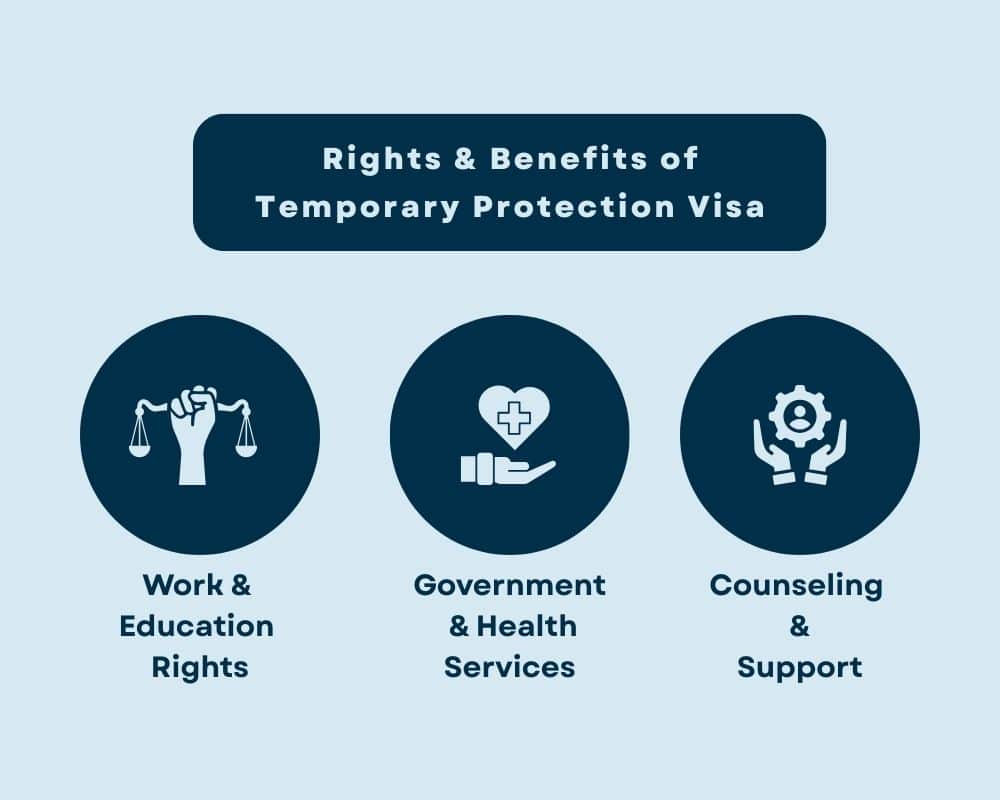
Work and Education Rights
The Temporary Protection Visa provides you with the full freedom that you are able to participate fully in the Australian economy and education system. It provides you with full work rights where you can work for any employers in any industry across Australia. You are not required to have a specific sponsor to maintain your visa status in Australia.
This visa program also provides you with full study rights where you are eligible to enroll in any Australian school, TAFEs or universities. You are also eligible for the Adult Migrant English Program (AMEP) which provides free English Language Classes to help you reach the vocational level of English.
Government and Health Services
With the Temporary Protection Visa, you are able to receive certain government & health services that are accessible to the taxpayer-funded that supports all residents.
- Medicare Access: With this visa program, you are eligible to enroll in Medicare Australia which provides free or reduced bills that includes services like doctor visit and treatment in public hospitals.
- Centrelink Services: If you meet the standard activity and mean-test conditions for the Centrelink facility in Australia, you are eligible for social security benefits and payments through Services Australia.
- Workforce Australia: With this visa program, you are able to obtain and maintain full employment in Australia with the help of the government-funded job seeker assistance.
Counseling and Support
As with the Temporary Protection Visa, visa holders face significant problems and government of Australia provides you with certain specialized support. As an individual holding this visa, you are able to access short-term, specialized counseling services if you have experienced trauma in your home country or during your journey to Australia.
Subclass 785 Vs Subclass 866
While both the Temporary Protection Visa (Subclass 785) and the Protection Visa (Subclass 866) are visa programs under the Australian migration systems that are specifically designed to protect individuals that are engaged in Australia’s Protection Obligations, they are distinct pathways determined primarily by how an applicant first arrived in the country.
Below is the set of differences between the subclass 785 and the protection visa 866:
| Feature | Temporary Protection Visa (785) | Protection Visa (866) |
|---|---|---|
| Arrival Method | Unauthorized arrival (no valid visa/not immigration cleared). | Lawful arrival (entered on a valid visa like Student or Visitor). |
| Stay Duration | Temporary (3 Years). | Permanent (Indefinite). |
| Pathway to PR | Restricted (Only via Subclass 851 for eligible cohorts). | Direct (Granted as a permanent visa). |
| Application Fee | $0 (Nil). | $40 AUD. |
| Family Reunion | No (Cannot sponsor family members). | Yes (Eligible to sponsor family through humanitarian programs). |
| Travel Rights | Restricted; requires written DHA approval. | Allowed for 5 years (excluding home country). |
| Citizenship | No direct pathway. | Eligible to apply after meeting residency requirements. |
| Government Support | Medicare, Centrelink, and AMEP (English classes). | Full Medicare, Centrelink, AMEP, and Higher Education Support. |
Eligibility for Temporary Protection Visa
If you want to secure a Temporary Protection Visa (Subclass 785) in Australia, then you are required to satisfy a certain set of strict requirements that has been defined in the Migration Act 1958. The eligibility process places a strong emphasis on your identity and the sincerity of your need for protection.
In order for you to become eligible, you are required to satisfy the following pillars of requirements:
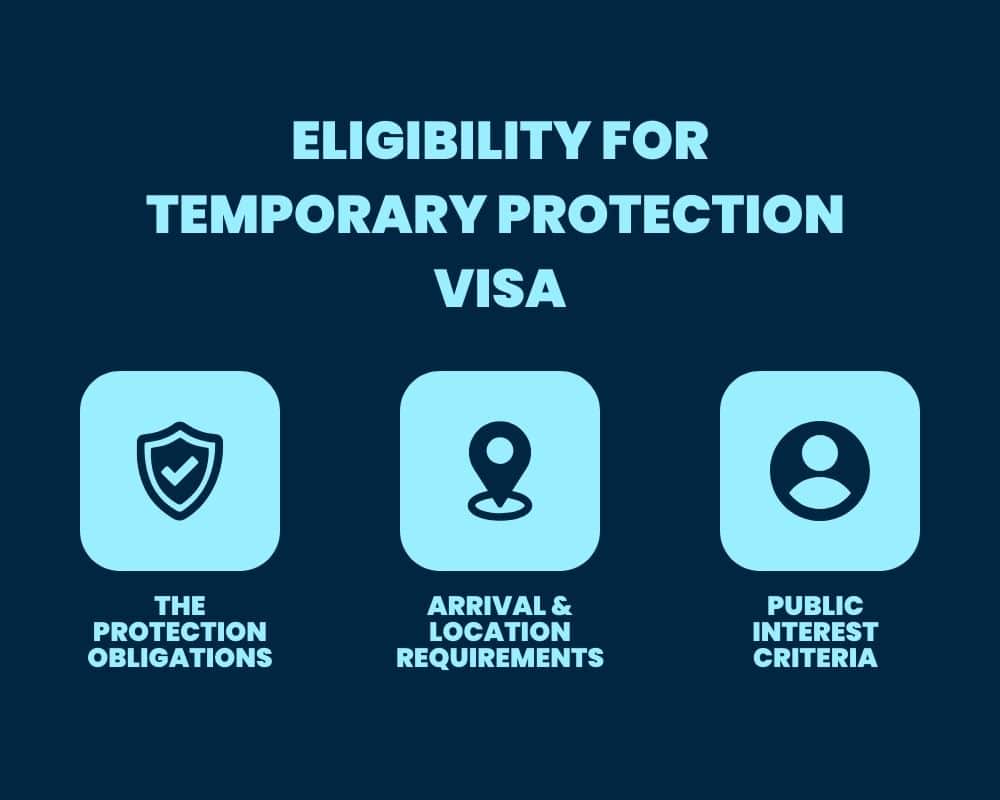
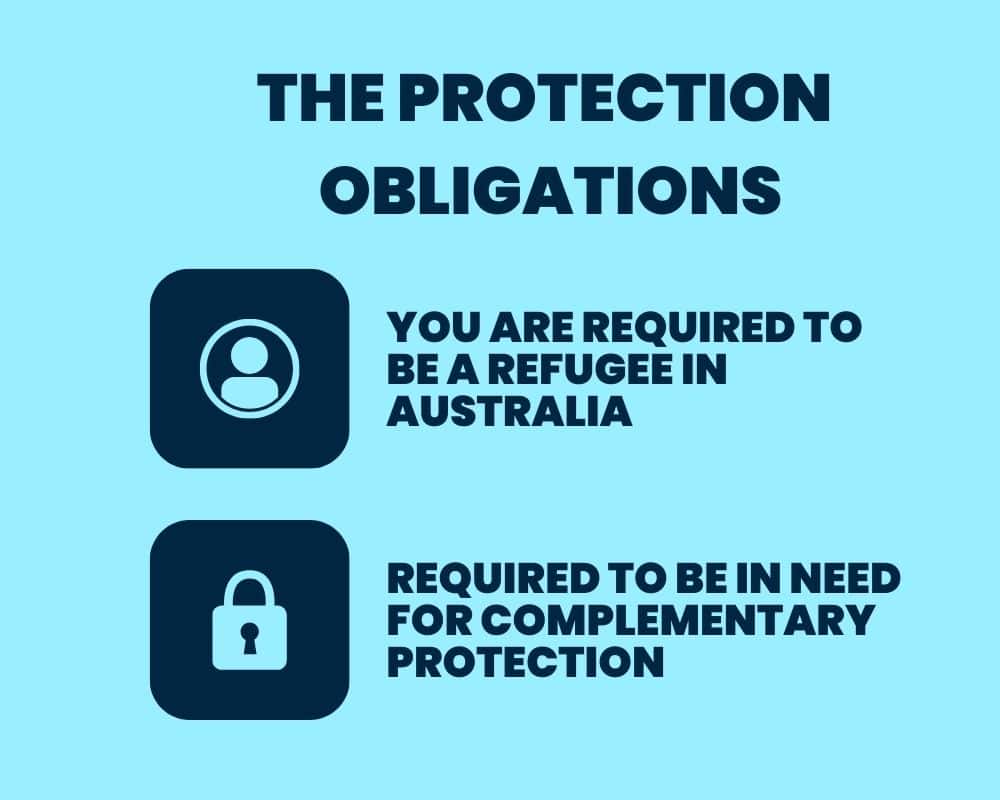
The Protection Obligations
Under the Temporary Protection Visa 785, you are required to prove that the government of Australia is obliged legally to protect you. Under Section 36 provided in the Migration Act, you are required to satisfy one of the following two criteria:
Refugee Status: You are required to prove a legitimate fear of being persecuted based on country, race, religion, political beliefs, or affiliation with a specific social group.
Complementary Protection: If you are someone who doesn’t fit the strict definition of a refugee in Australia then you are still eligible to qualify if there are certain criteria describing the risk you may encounter if returned. The harms can include:
- Arbitrary deprivation of life or the death penalty.
- Torture
- Cruel, inhuman, or degrading treatment or punishment.
Arrival and Location Requirements
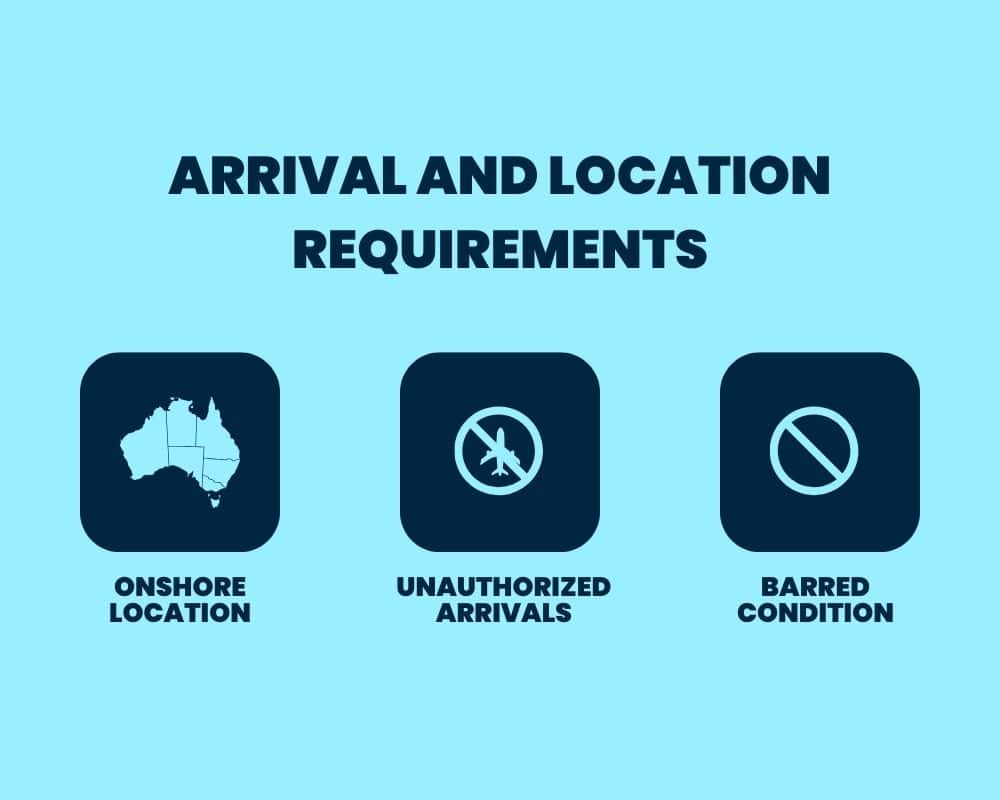
The Temporary Protection Visa is specifically designed to cater the individuals who are currently residing inside the turf of Australia, you must be in Australia in order to apply for this visa program. The requirements that are required to be fulfilled in this section are:
Onshore Location: You need to be in Australia to apply for this visa program as the subclass 785 visa only allows onshore applications.
Unauthorized Arrivals: You must have arrived in the turf of Australia without a valid visa and as an unauthorized maritime arrival or you were someone who was not immigration cleared upon your last entry in Australia.
Barred Condition: You must not be someone who is prohibited to apply for Australian visa programs due to prior visa refusals or visa cancellations.
The “Public Interest” Criteria
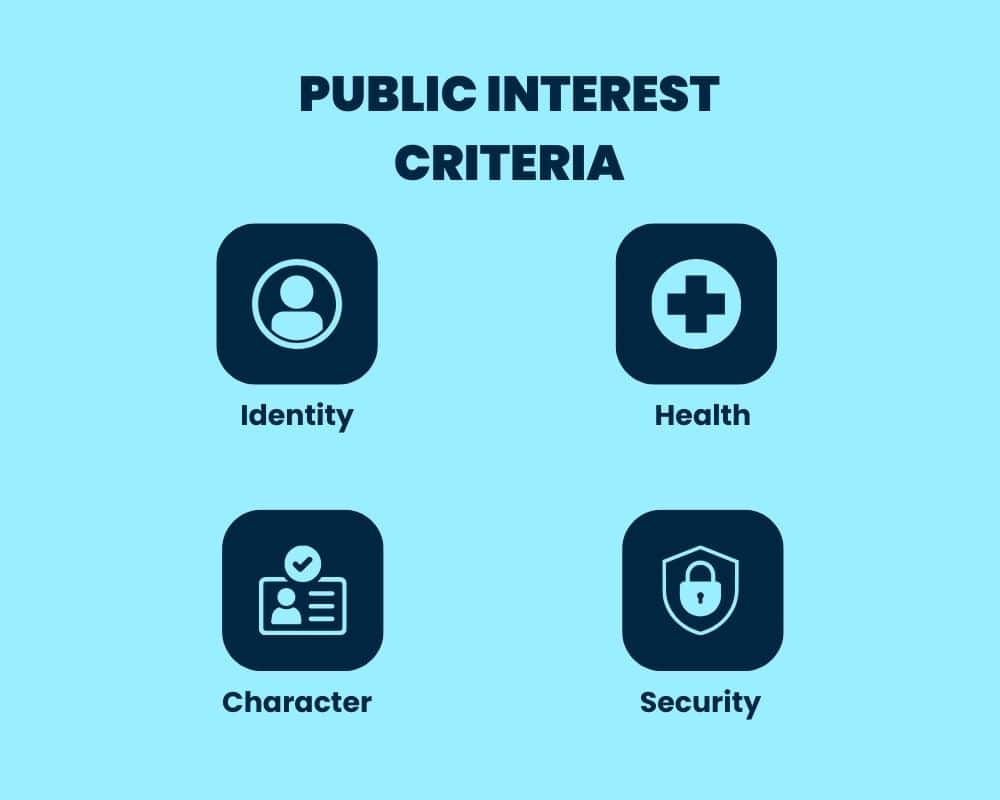
Even if you satisfy other requirements for the eligibility for the Temporary Protection Visa, you are required to satisfy the following standards that have been made in order to ensure that you do not pose a risk on to the Australian community.
Identity: You are required to provide evidence showing your identity, nationality, and citizenship. If in any case scenario that you are unable to provide the required documents related to your identity, you must cooperate with the DHA to establish your identity.
Health: You are required to undertake medical examinations via Certified medical service providers like Bupa proving that you do not possess any condition that poses as a threat to Australian government. (E.g. Tuberculosis)
Character: You must pass the character test under Section 501 of the Act. Under this Act, you are required to declare all the criminal history of your past and provide police certifications and clearances.
Security: As for the security criteria, you should not be someone who is considered as a threat to the Australian national security which is assessed by the Australian Security Intelligence Organization (ASIO).
Temporary Protection Visa Cost
As we always mandatorily keep the financial aspect while we do anything, it is a crucial aspect in the Temporary Protection Visa as well. You need to keep the cost related to it into account. The table below shows the latest costs that are related to this visa program:
| Category | Item / Metric | Details & Costs |
|---|---|---|
| Visa Application Fee | Base Application Charge | AUD $45.00 |
| Additional Costs | Health Examinations | ~ AUD $300 – $550 (via Bupa Visa Medical) |
| Additional Costs | Police Clearances | ~ AUD $42 – $55 (AFP) |
| Additional Costs | Biometrics | Included in application / Nil |
Temporary Protection Visa Processing time
The Processing times for the Temporary Protection Visa is mostly dependent on the accuracy of your protection claims and the speed of required security clearances, even though the Department of Home Affairs (DHA) has expanded resources to reduce humanitarian backlogs.
The approximate processing time for this visa can be seen below:
| Item / Metric | Processing Time |
|---|---|
| 50% of Applications | 18 – 24 Months |
| 90% of Applications | Up to 36 Months |
| Fast-Track (Low Complexity) | 5 – 7 Months |
Temporary Protection Visa Application Process
The application process for a temporary protection visa is a systematic legal process that requires consistency in testimony and complete clarity in documents. In order to speed up the assessment of protection demands, the DHA switched mostly to digital filing using ImmiAccount in 2026.
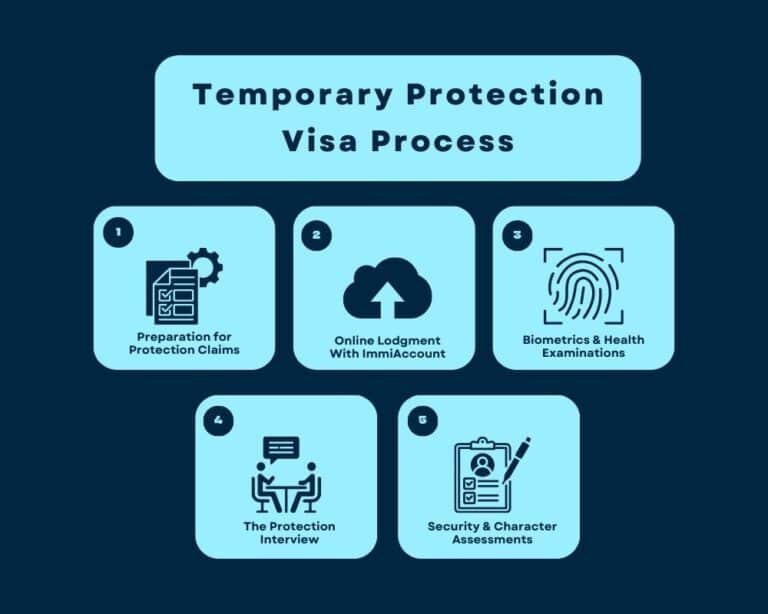
Step 1: Preparation for Protection Claims
Before you even think about opening the Temporary Protection Visa form, you are required to clearly know the protection narratives which include the Core four questions that case officers use to determine the status.
- Why did you leave your home country?
- What specific harm do you fear if you return?
- Who is the source of this harm (e.g., government, militia, or non-state actors)?
- Why can’t you not safely relocate to a different part of your country?
Step 2: Online Lodgment (ImmiAccount)
After you prepare for protection claims, you are then required to lodge your application. In 2026, you must lodge the application using Form 866 or Form 1505 if you are reapplying for the Subsequent visa. This process is to be done using the ImmiAccount Portal. Make sure that all identity documents, such as national IDs, passports, and birth certificates, are supplied as high-quality color scans.
Step 3: Biometrics and Health Examinations
Once you have successfully lodged your application through the ImmiAccount portal, you will then receive a letter from the DHA requesting you to provide the required biometric information and a health Assessment.
Biometrics: You are required to provide your digital fingerprints and facial photograph and must visit an Australian Visa Application Center (AVAC) for the process.
Medical: You are required to book a medical exam using Authorized Medical Service providers like Bupa. This check is a mandatory action that has be fulfilled in order to meet the Public Interest Criteria.
Step 4: The Protection Interview
After you have successfully provided your biometrics to the concerned authorities, you are then required to attend an interview with a DHA case accessor who will then discuss your claims in detail. Make sure to be prepared for this interview as this is considered as the most pivotal stage of the Temporary Protection Visa process.
- Consistency: Your written declarations in your temporary protection visa form will be compared to the responses you provide in the interview by the officer.
- Evidence: Bring original copies of all the required documents (such as threat letters, medical records from your own country, or political membership cards) that support your claims.
- Support: You may have a support person or legal representative present, and you are entitled to an interpreter who is certified by the NAATI.
Step 5: Security and Character Assessments
While you wait for the visa decision, your application is sent for external security checks which involve:
- ASIO Clearance: A mandatory national security check.
- AFP Check: A review of any criminal history within Australia.
FAQs
In order for you to become eligible for a Protection Visa in Australia, you are required to pass the strict health, character and security checks of DHA and also meet one of the following criteria:
- You need to meet the definition of a refugee showing the fear of persecution based on race, religion, nationality, or political opinion.
- You need to satisfy the protection criteria showing real risk of arbitrary death, torture, or cruel treatment.
The Subclass 785 visa program typically allows you stay in the turf of Australia for 3 years. If you want to stay longer then you are required to apply for the subsequent TPV or SHEV before your current visa expires.
The primary difference between the Subclass 785 and the 866 is the factor of “immigration status”. The Subclass 866 is for the individuals who are in Australia with a valid visa and had their immigration status cleared. Whereas the subclass 785 is specifically designed for the individuals that are in Australia due to unauthorized arrivals and didn’t have a valid visa at the time of entry in Australia.
While you are on a Temporary Protection Visa, the travel facility is strictly restricted. You should never go back to the nation that you sought protection from. Before departing for any other nation, you must have written permission from the DHA for “compassionate or compelling” reasons. Your visa may be revoked if you travel without authorization.
You may be able to file an appeal with the Administrative Review Tribunal (ART) if your request to the Temporary Protection Visa is refused. However, you will have to leave Australia if the rejection is defended and you have no other choices for a visa. To make sure this high-risk scenario is avoided make sure to have a “decision ready” approach.

Navigating through the Temporary Protection Visa in 2026 has become extremely complex in 2026 with the recent changes in the Australian migration scenes of Australia. Understanding the complex visa program is not always the point that ensures the case is handled with precision. Due to the complex behavior of the visa program, you need a strategic partner that can help you secure the visa.
Why BJay?
Proven Expertise: With 13 years of experience in Visa services in Australia, we here at BJay Education & Visa Services have been providing tailored services to help you navigate through the complex migration scenes of Australia.
Expertise Team: Led by Mr. Jay Oli (MARN: 1570827), we have an exceptional team that is there to solve any queries and help you with your application. The team is well trained to provide the services that you may require assistance with.
Global Presence & Local Support: With offices present in multiple locations throughout Nepal (Putalisadak and Birtamode) and a head office in Sydney, BJay provides you with seamless support you may require whether you are in your home country or already in the turf of Australia.
Ethics-First Approach: We give direct, honest counselling. We provide outcomes rather than unrealistic expectations. The stability and safety we assist you in achieving serves as an index of our success.
Still in doubt about the Temporary Protection Visa? Book A free Consultation with BJay!