
Study IT in Australia in 2026 is the best choice for students who are aiming to pursue a high demanding career with highest demands available in the current economy. Australia has established itself as a “Silicon Continent,” providing a unique combination of top-notch education and attractive migration pathways, as the technology sector continues to evolve faster than other specific industries.
In this Guide by BJay Education and Visa Services, we will go through everything you need to know about the 2026 environment to study IT in Australia, from the most desired specializations that lead to Permanent Residency (PR) to the most recent Department of Home Affairs (DHA) financial requirements ensuring a seamless transition from your degree to a high-paying career.
Why Should You Study IT in Australia in 2026?
With the Australian Tech Industry contributing a huge chunk to the GDP of the country, there are about 456 CSOL occupations guaranteeing 485 visa eligibility in Australia. Graduates after they Study IT in Australia program enjoy world-class infrastructure, industry-aligned curricula, and direct PR pathways. While many ask, ‘Why study IT in Australia in 2026?’, the advantages of this pathway are clear and concise which are given below:
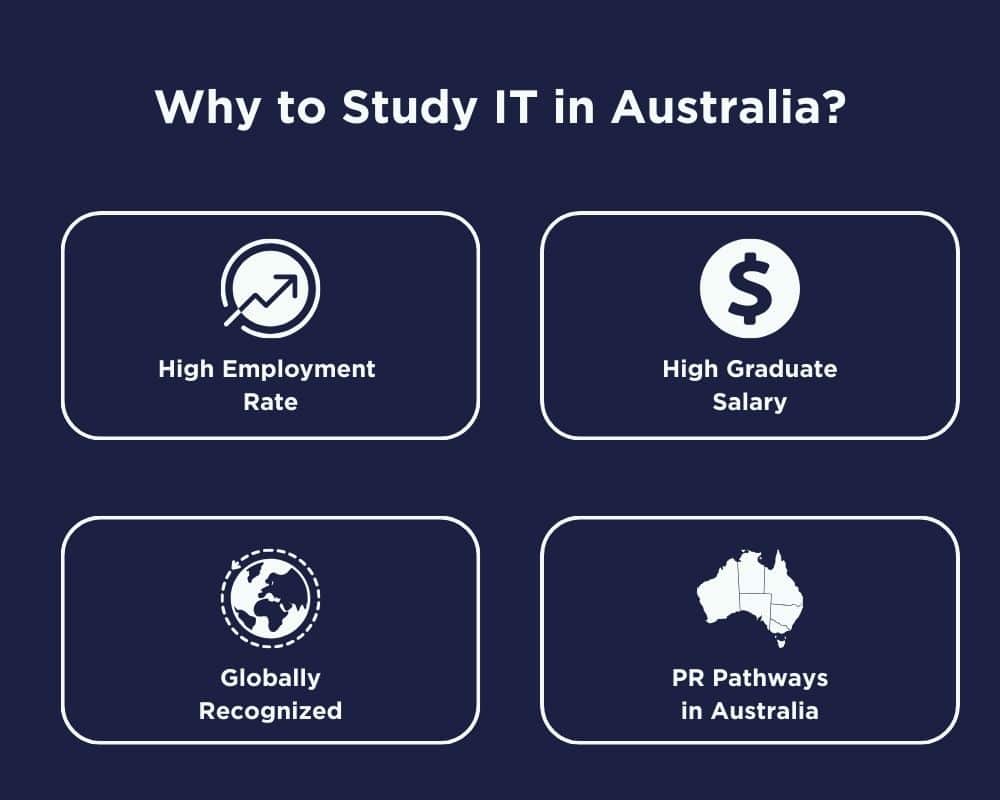
- Employment Rate After Graduation is very high: According to the Australian government’s “National Skills Strategy 2026,” which is known as ICT as the most urgent sector of labor shortage, Australia is seeing a growing need for IT talent. The full-time employment rate for IT postgraduates is 88.1% soon after graduation, rising to over 91% for those who stay in Australia for three years, according to the QILT Graduate Outcomes Survey. There is a huge need for qualified workers in this industry, with a target of 1.2 million tech positions by 2030.
- High graduate salary on average: With growing demand and rise in living expenses, as of 2026, starting salaries of entry-level tech jobs in Australia will be between $75,000-$90,000 AUD, or between 0-2 years of experience. The average salary of professional careers in cloud computing, cybersecurity, and artificial intelligence is typically more than AUD $95,000. Also, the income could grow to AUD $110,000 and $130,000 with two years of experience in Australia.
- Global Recognized Universities: As of 2026, nine Australian universities rank among the top 100 in the Global Top 100, including such well-known universities as the University of Melbourne and UNSW, which are famous with their expertise in AI and software engineering, studying IT in Australia provides some recognition on the international level. Moreover, most of the degrees have been accredited by Australian Computer Society (ACS), which is a member of the Seoul Accord. This enables it to be recognized legally in countries such as USA, Canada, UK and Japan and this has provided employment opportunities in countries across the globe.
- PR Pathway: In the case of IT graduates, the move to Skills in Demand (SID) visa (2026) will be critical based on the 482 Visas. One of the biggest changes is the inclusion of software engineers, developers and analysts on the Core Skills Occupation List (CSOL). One of the major changes is that the Graduate Visa (485) is now revised into the SID visa with only one year of work experience, and this means that now the applicant takes only two years instead of three years to apply and be sponsored to get the Permanent Residency status. Most of the IT graduates will most probably earn higher than the Temporary Skilled Migration Income Threshold (TSMIT), which is pegged at AUD $76515 in the first year.
Hence, it is a feasible decision to Study IT in Australia in 2026 as it has various benefits and can help you achieve your Australian Dream.
Degrees to Study IT in Australia
If you want to study IT in Australia, the Australian IT education system is set up to cater to all levels of professional aspirations in 2026, from those looking to enter the workforce quickly to those pursuing leadership and high-level research positions. There are various levels to Study IT in Australia, i.e.
- Diploma in IT
- Advance Diploma in IT
- Graduate Diploma in IT
- Bachelors in IT
- Masters in IT
| Course Level | Duration | Avg Annual Tuition Fee |
|---|---|---|
| Diploma of IT | 1 Year | AUD $12,000 – $25,000 |
| Advanced Diploma of IT | 1.5 - 2 Years | AUD $15,000 – $28,000 |
| Graduate Diploma of IT | 1 Year | AUD $25,000 – $40,000 |
| Bachelor of IT | 3 Years | AUD $30,000 – $45,000 |
| Master of IT | 1.5 - 2 Years | AUD $32,000 – $52,000 |
Top Courses to Study IT in Australia
If you are having trouble choosing the best course to study IT in Australia, below we have integrated the data for the specialized courses with their demand levels and top universities providing the specific course.
| Rank | Course Specialization | Demand | Salary after Graduation | Top University |
|---|---|---|---|---|
| 1 | Cybersecurity | 12% | AUD $92,000 | RMIT / Edith Cowan |
| 2 | Software Developer | 10% | AUD $85,000 | Monash / QUT |
| 3 | Data Science | 9% | AUD $88,000 | UTS / Univ. Melbourne |
| 4 | Cloud Computing | 8% | AUD $82,000 | QUT / Swinburne |
| 5 | AI / ML | 7% | AUD $95,000 | UNSW / ANU |
Top 10 Universities to Study IT in Australia
One of the most important steps to in Study IT in Australia is choosing the right university that is dedicated for you. The rankings for 2026 show a strong focus on “Employability” and “Innovation,” with a number of Australian universities climbing to the top of the world rankings.
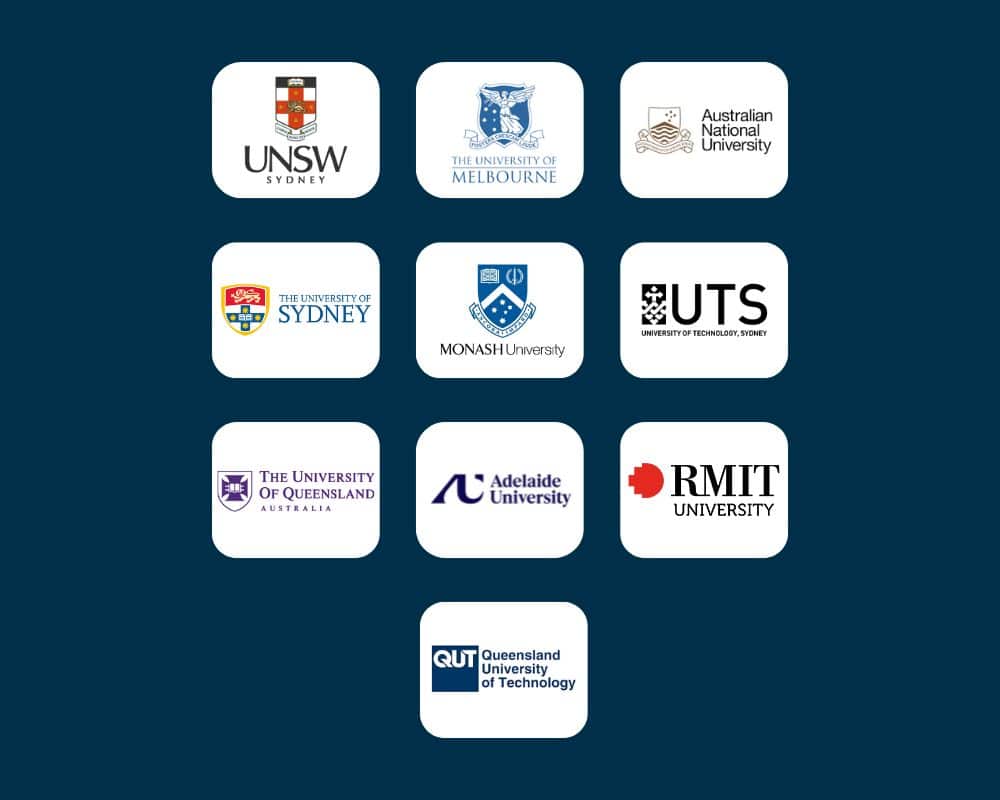
The top ten IT institutions to Study IT in Australia for the year 2026 are provided below, along with their most recent QS rankings, flagship courses, and average fees related to it.
| Rank | University | QS Ranking (CS) | Flagship IT Course | Intake | Annual Fees (AUD Approx.) |
|---|---|---|---|---|---|
| 1 | UNSW Sydney | #20 | M. Information Technology | Feb / June / Sept | AUD $52,000 - $62,500 |
| 2 | University of Melbourne | #19 | M. Computer Science | Mar / July | AUD $56,000 - $63,000 |
| 3 | Australian National University | #32 | M. Computing (Advanced) | Feb / July | AUD $50,000 - $55,000 |
| 4 | University of Sydney | #25 | B. Advanced Computing | Feb / Aug | AUD $53,000 - $58,000 |
| 5 | Monash University | #63 | B. Computer Science (AI) | Feb / July | AUD $49,000 - $54,000 |
| 6 | UTS (Sydney) | #88 | M. IT (Cybersecurity) | Feb / July | AUD $42,000 - $48,000 |
| 7 | University of Queensland | #77 | M. Information Technology | Feb / July | AUD $48,000 - $58,000 |
| 8 | Adelaide University | #82 | B. Information Technology | Feb / July | AUD $45,000 - $53,000 |
| 9 | RMIT University | #125 | M. Cybersecurity | Feb / July | AUD $40,000 - $46,000 |
| 10 | QUT (Brisbane) | #226 | B. IT (Data Science) | Feb / July | AUD $38,000 - $44,000 |
Requirements to Study IT in Australia
If you want to study IT in Australia in 2026 then you are required to meet 2 specific criteria, one being the requirement given by the DHA and the another being the specific requirement of the University Entry Requirements. By 2026, the Australian government has completely transitioned from the previous GTE system to the Genuine Student (GS) framework, which will make it more rigorous and integrity focused.
Academic Requirements
The academic requirements or the benchmark varies with each other according to the AQF level or the qualification level that you are applying for. The entry requirements and the minimum grade requirements for specific qualifications are given below:
| Qualification Level | Academic Entry Requirement | Minimum Grade/Standard |
|---|---|---|
| Diploma of IT | High School Completion (Year 12) | 55% – 60% average |
| Advanced Diploma of IT | Year 12 OR completion of a Diploma | 60% or relevant work experience |
| Bachelor of IT | High School Completion with Math | ATAR 70+ (65% - 75% equivalent) |
| Graduate Diploma | Bachelor's Degree (any discipline) | Pass grade (50%+) |
| Master of IT | Bachelor's Degree (IT or any relevant degree) | 60% – 65% (GPA 4.0/7.0) |
English Language Proficiency
With the changes in the student visas in Australia, the DHA has increased the minimum English Scores which remain baseline as for the 2026 intakes in Australia. The minimum English Score for the subclass 500 is overall 6.0 IELTS score or relevant scores of another English test like PTE and TOEFL. A total of 9 English test has been approved by the DHA that is accepted for visa programs in Australia and only the tests conducted in physical centers is considered.
Financial Requirements
In 2026, the financial requirements to Study IT in Australia or for any student visa courses has become an important factor to be considered. The “Proof of Funds” is a Critical hurdle which should be always considered. According to this, you need to show that you have access to enough financial capacity to cover the tuition fees of your first year and also the living expenses for a year. The To satisfy the “proof of funds” criteria make sure to satisfy the following formula:
Total Proof of Funds = 1st year tuition Fee + 1st year Living Expenses + Travel Costs.
Another thing you should consider if you are an international student is that Student Visa (Subclass 500) fee is now $2,000 AUD (up from $1,600).
The Genuine Student (GS) Requirement
With the recent changes in the Australian Migration Scene, the GS requirement replaces the “Genuine Temporary Entrant” (GTE) statement, requiring visa applicants in 2026 to answer targeted questions to demonstrate their primary intent for education. Key assessment areas include alignment of the chosen IT course with prior education or work, evidence of financial stability during the stay, explanation of how the Australian degree will enhance career prospects, and identification of ties to the home country that ensure compliance with visa conditions.
Documents Checklist to Study IT in Australia
If you are looking to study IT in Australia, make sure to go through this meticulously crafted document checklist to make sure that your application has a positive outcome and it is decision ready.
| Category | Specific Document Needed | 2026 Requirement / Specification |
|---|---|---|
| Identity | Valid Passport | Must be valid for at least 6 months beyond course end. |
| Academic | Transcripts And Certificates | Certificate Copies of your academic background |
| Experience | CV/Resume | Professional CV containing your personal history and work experience |
| Enrollment | eCoE (Electronic Confirmation of Enrolment) | Issued after paying the first semester deposit and OSHC. |
| Enrollment | GS Statement | GS statement, Letter of Recommendation and the Evidence of Home Country Ties |
| Health | OSHC Certificate | Must cover the entire visa duration (not just the course). |
| Financial | 6-Month Bank Statement | Must show a stable history; "sudden deposits" require a formal source explanation. |
| Financial | Relationship Certificate | Legal proof of link between the student and the financial sponsor. |
| English | IELTS/PTE Score Report | Must meet the updated Competent English (IELTS 6.0 equivalent) threshold. |
| Character | Police Clearance Certificate (PCC) | Required for applicants from specific high-risk regions in 2026. |
Pitfall to avoid to Study IT in Australia
If you want to fulfill your goal to study IT in Australia, the 2026 migration scenario is unforgiving on minor mistakes. A “Decision-Ready” application is the only method to guarantee your success because the Department of Home Affairs (DHA) has recently increased its strictness in inspection process.
The most frequent mistakes that result in student visa denials in 2026 are given below along with tips on how to prevent them and can achieve a positive outcome in your applications.
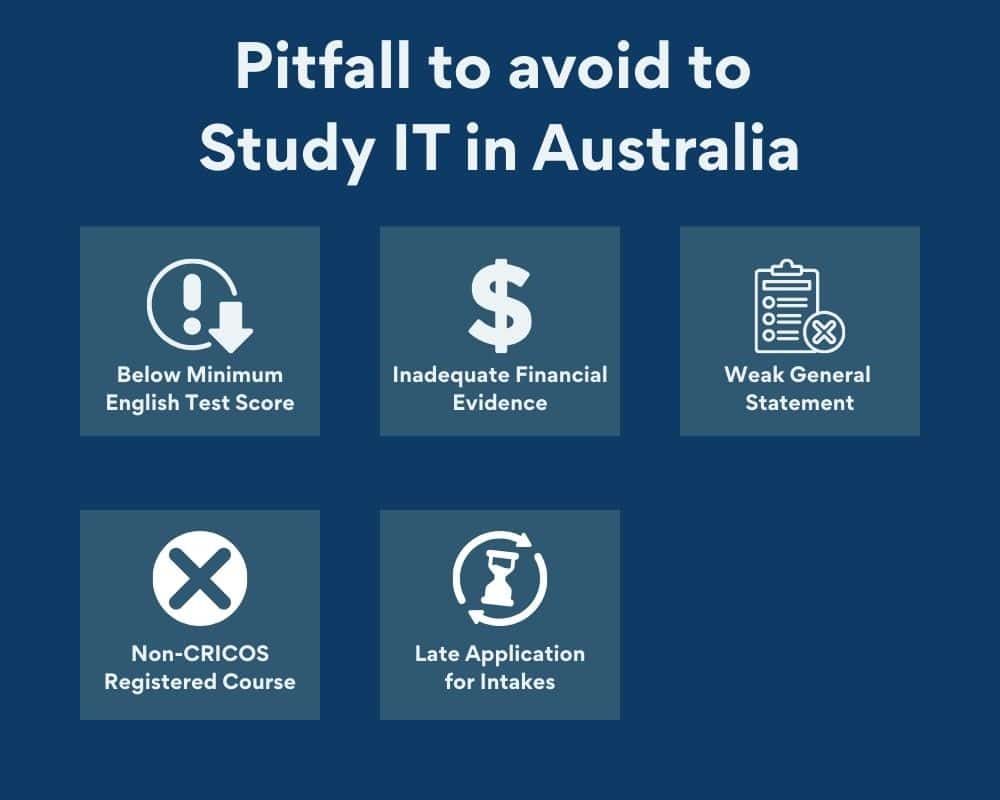
Below Minimum English Proficiency Test Score
With the start of 2026, the English Language Test has become more stricter and has increased the bar to make the students able to cope with the technical degrees to study IT in Australia. Many International Students applying for Certain Courses to study in IT are ignorant about the Minimum English Scores which ultimately leads to application refusals. Hence, you should have a minimum Score of IELTS 6.0 or any equivalent scores of DHA approved English Proficiency tests.
Inadequate Financial Evidence
In 2026, the main reason that your application may be rejected is the financial aspect of your application. Especially if you are an international student who is specifically from the South Asian or Southeast Asian region. Therefore, students often make the mistake of providing inadequate data and only provide the tuition fee and ignore the living cost factor which the DHA may flag as non-genuine. Hence, to solve this you must show a 12-month stable history of funds.
Weak GS
With the GS replacing the GTE, it has become even more strict where if the use of generic template that doesn’t explain a specific career plan or “Return on Investment” (ROI) is discarded and can lead to refusals. Hence, you have to name three concrete IT topics and tell how they will address a gap in your local labor market (e.g. a Bachelor of Advanced AI at Monash will make me a Senior ML Architect at Delhi/Kathmandu with a salary that is 40 times more).
Choosing a Non-CRICOS Registered Course
One of the common mistakes students make in the application process is choosing a Non-CRICOS (Commonwealth Register of Institutions and Courses for Overseas Students) registered course as only the CRICOS-registered courses are eligible for subclass 485 visa. Hence, if you want to study IT in Australia or any other Courses then make sure that you verify the CRICOS code.
Late Application for Main Intakes
As Rushed Applications lead to inconsistent documentation. In 2026, the median processing time for the application process is 41 days so make sure to apply before the date available as we have encountered students applying urgently and receiving refusals. Hence, to avoid this you should apply for university in advance and lodge your visa.
FAQs

Your decision to study IT in Australia is entirely on you. The element of what you should study is your own goals and career aspirations. By the year 2026 intake, three specializations are the most employable and potentially highest paid:
- Cybersecurity: Network protection and code crackers are also in demand because of the current Cyber Security Strategy in Australia.
- Machine learning and artificial intelligence (AI): Starting at an average of 90,000 -110,000 AUD, degrees in machine learning and artificial intelligence (AI) begin to be offered by businesses that use it.
- The most varied is, however, software engineering that involves all the mobile app development, and cloud systems.
The cost to study IT in Australia is very distinctive and can widely range with the vocational universities and the elite “Group of Eight” institutions considerations. The following are the annual tuition ranges to Study IT in Australia: Diploma/Advanced Diploma: AUD $12,000–22,000 (1-2 years), Master of IT: AUD $30,000–55,000 (1.5–2 years), and Bachelor of IT: AUD $25,000–48,000 (3 years).
The Department of Home Affairs claims that the annual living costs of a single student will be $29,710 AUD by January 2026. The approximate annual expenses in major cities such as Sydney or Melbourne are lodging, which is expected to cost an individual between AUD $15,000 and $20,000, food and groceries that are estimated to cost one between AUD $5000 and $7000, utilities and internet, which is estimated to cost one between AUD $2500 -3500, and transportation that is estimated to cost one between AUD $1500-2500. This translates to AUD $32000- 38000 AUD.
Yes, although there is a work cap of 48 hours per fortnight currently which must be maintained during the academic semesters, this cap is said to be raised on July 1, 2026. During official university holidays, there are no restrictions on working hours.
Higher education programs like the Bachelor of Computer Science and the Bachelor of Business Information Systems, as well as Vocational Education and Training (VET) programs like Certificates and Diplomas in IT, Networking, and Web Development, are among the many CRICOS-registered programs that are open to international students. Additionally, they can pursue postgraduate degrees, including master’s degrees in data science, cybersecurity, and information systems.
The window for the July 2026 intake is closing fast. To ensure your “Genuine Student” (GS) statement is bulletproof and your financial documents meet the new AUD $29,710 AUD threshold, you need a professional strategy.
Why BJay Education & Visa Services:
- University Shortlisting: Get a customized list based on IT courses in Australia for international students’ fees and rankings.
- GS Statement Writing: We help you draft 150-word responses that satisfy the 2026 DHA logic requirements.
- Scholarship Assistance: Access exclusive 2026 bursaries that can reduce your tuition by up to 25%.
- Experienced Team: With an experienced team, BJay education and visa services have been providing specialized and tailored services for the past 13 years.
Contact BJay Education & Visa Services to begin your journey to Study IT in Australia with the confidence you need. Book a Free non-Obligatory Consultation!