
Student Visa Australia processing priorities is a hot topic that has been discussed frequently with 2026 in effect. With rapid changes in the migration scenes of Australian migration system, the student visa Australia Processing Priorities are processed based on a hierarchy design instead of the traditional “First-in First-Out (FIFO)” method. As a result of implementation of such priority processing, the student visa Australia processing priorities needs more precision. If you want to make sure that you visa program doesn’t stay in longer queues or has unexpected refusals, make sure to understand the Student Visa Australia Processing Priorities well.
With more than 13 years of excellence in providing visa services, BJay Education & Visa Services has meticulously drafted this guide in order to help you with your student visa Australia processing priorities and provides you a brief on how the priorities are maintained by the Department of Home Affairs (DHA).
Student Visa Australia Processing Priorities
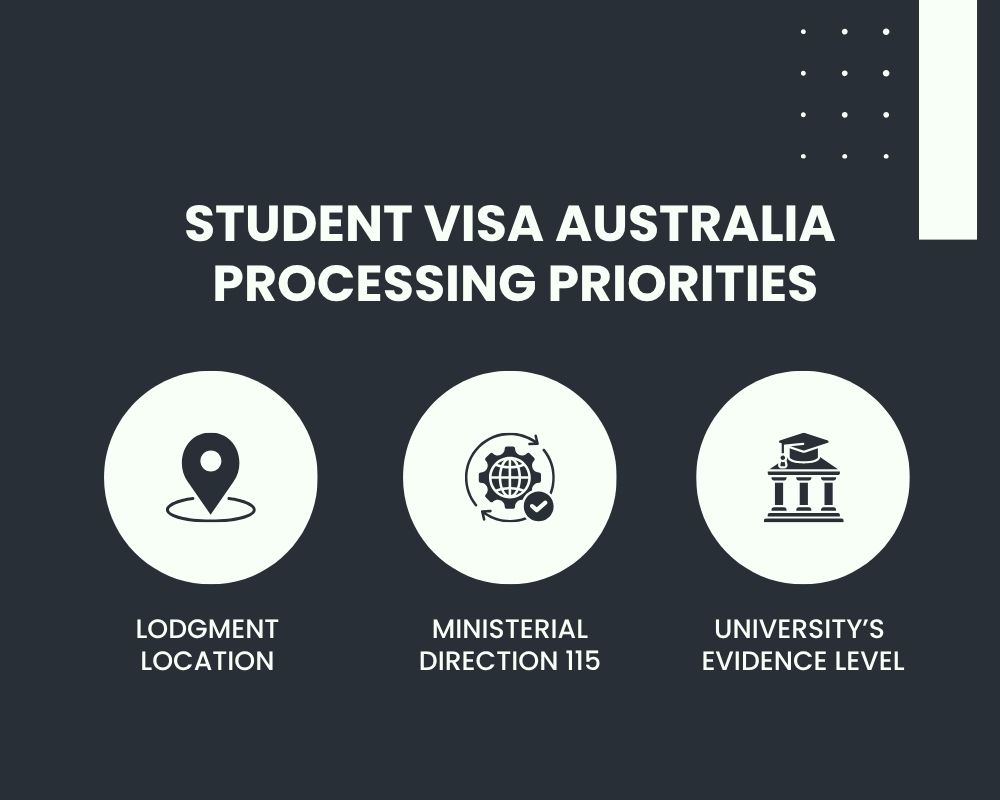
As of 2026, the Processing for Student Visa Australia doesn’t focus on the traditional FIFO method rather than that it is now focused on a certain Processing Priority list according to which the visa programs are then processed forward. The Student Visa Australia Processing priorities is currently based on policy objectives under 3 different criteria:
- Lodgment Location
- Ministerial Direction 115 (MD115)
- University’s Evidence Level
Student Visa Australia Processing Priorities Based on Location
The Location of lodgment of your application is also a factor that affects the Student Visa Australia Processing Priorities. The DHA maintains different mechanisms that are used to manage the volumes of applications on the basis of where the application is being lodged from.
Onshore Applications (inside Australia)
If you are someone who is applying for a student visa and already inside the turf of Australia, then you are exempt from the MD115 priority tiers. The onshore applications are processed based on a standard service benchmark and the processing times can differ due to various range of reasons.
Offshore applications (outside Australia)
If you are someone who is applying for a student visa and are outside of Australia, then your application is exerted by the MD115. If your application is an offshore application, then it goes through the priority level system which determines your processing times. If your application is lodged before November 14, 2025, then it is under the framework of MD 111 else if your application is lodged after November 14, 2025, then it is under the framework of MD115. As of March 2026, the MD115 is used so we will further detail the MD115 in this article.
Ministerial Direction 115 (MD115)
The Ministerial Direction 115 also popular known as the MD 115 is the primary framework that is used for managing the Student Visa Australia Processing Priorities. This framework has been implemented in the Australian migration system from November 14, 2025, which has replaced the older frameworks being MD107 and MD111. Under the MD115, the student visa Australia processing time is not just about risk levels of a university, but it is linked to the National Planning Levels (NPL) and the Student Cap of each provider.
As the Student Visa Australia Processing Priorities is handled through the MD115, the DHA on the basis of the framework prioritizes the offshore applications into three different priority levels.
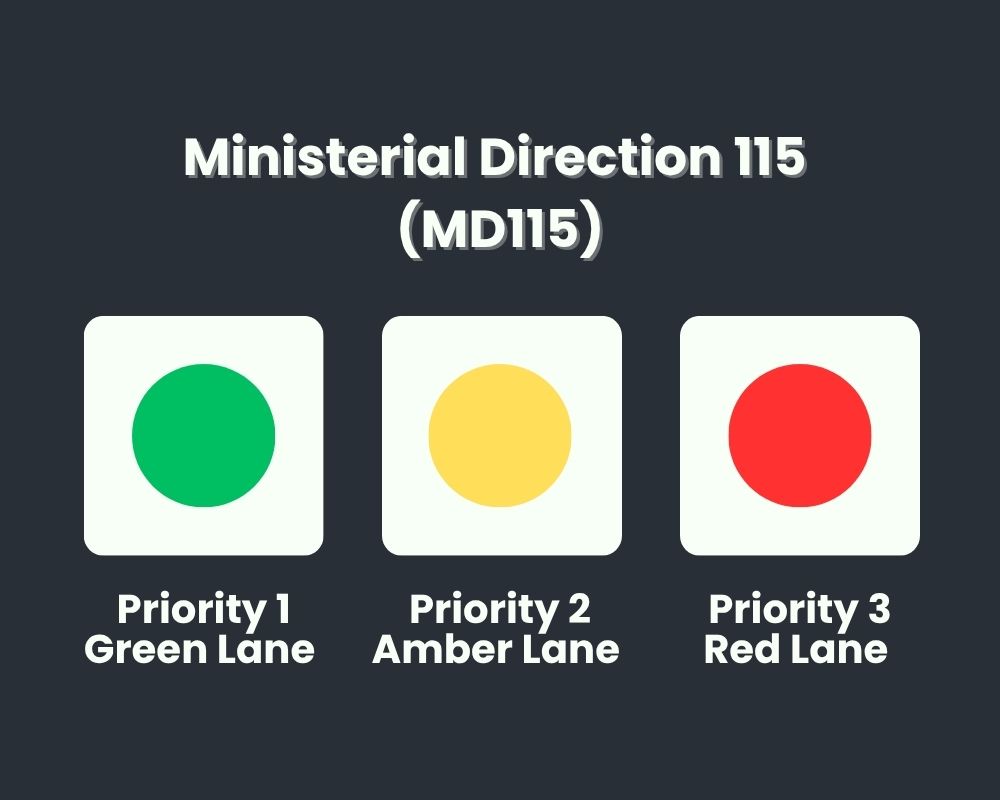
Priority 1: The Green Lane (Fastest)
Priority 1 is the fastest priority level for the student visa Australia applicants. The application under this tier is processed case officers from DHA and most of them are finalized within 1 to 4 weeks of lodgment. For this priority level, the institution you are applying for needs to have filled in less than 80% of their allocated caps.
Under Student Visa Australia Processing priorities, priority 1 includes the following applications:
- Students who are enrolling for PhD courses
- All applications for School Students.
- Students who are enrolling with a TAFE provider.
- Students who are sponsored by the Foreign Affairs or DFAT.
- Students who are Pacific and Timor-Leste Applicants
- Students who are standalone ELICOS
Priority 2: Amber Lane (Standard)
The priority 2 of the Student Visa Australia processing Priorities is the standard processing tier which is the tier where if your university or college is near the annual cap that has been allocated but hasn’t been overfilled significantly. For your institute to be in a Priority 2 tier, it needs to be filled between 80% and 115% of their annual allocation. Under this priority list, you are expected to have a wait time of 5 to 8 weeks.
Under the Student Visa Australia Processing Priorities, priority 2 includes the following applications:
- Higher Education Vocational Education and Training applications for universities or vocational providers that have utilized their priority threshold.
- Adult Subsequent Entrants which do not include a minor.
Priority 3: The Red Lane (Slowest)
The priority 3 of the Student Visa Australia Processing Priorities is the slowest lane in the given priority lanes. This priority list is introduced specifically to make sure that over subscription is avoided making sure that the system integrity is maintained. In this priority lane, you are required to be an applicant who is applying for the institutions that have specifically exceeded the 115% threshold of their allocation caps. The estimated time for this priority level is about 9 to 12 weeks or longer.
Under the Student Visa Australia Processing Priorities, priority 3 includes the following applications:
- Higher Education Vocational Education and Training applications for universities or vocational providers that have overutilized or have reached their upper threshold for the applicants according to the allocation caps.
| Tier | Provider Status | Priority Level | Estimated Processing |
|---|---|---|---|
| Green Zone | Below 80% of Allocation | Priority 1 (Fastest) | 1 – 4 Weeks |
| Amber Zone | 80% – 115% of Allocation | Priority 2 (Standard) | 5 – 8 Weeks |
| Red Zone | Above 115% of Allocation | Priority 3 (Slowest) | 9 – 12 Weeks+ |
Student Visa Australia Processing Priorities based on University Level
The University Level or the Evidence Level of the University is a crucial part of student visa Australia processing priorities as it bridges the gap between the institutional risks and the MD115 priorities. If you are a student who is applying for visa in Australia, then you need to make sure that you know about the processing priorities based on the University as well as the processing priorities based on priority level of MD115.
While the MD115 is purely based on the annual enrollment caps that are allocated, the Evidence Level (EL) of the university that you choose also determines your application. The DHA updates these levels 2 times a year (March and September) which is based on the immigration compliance of the institution’s previous students.
Evidence Level 1 Universities
The institutions having the EL1 tag are the institutions that are highly trusted by the government of Australia. This is considered a streamlined pathway for students. The EL1 applications are the first ones that are going to be assessed in the processing. When the EL1 application is combined with the Priority 1 allocation under the MD115, the whole process takes 14 days or less, making the Student Visa Australia Processing Priorities highly valuable.
Note: If you are someone who is from an Evidence Level 3 country like Nepal, India, Bangladesh under the Immigration Changes that took place in Australia then even if you apply for a EL1 university, you are required to provide full financial and English documentation upfront to avoid an immediate refusal.
Popular EL1 Providers:
- Group of Eight (Go8) Universities like University of Melbourne, ANU, University of Sydney, UNSW, UQ, Monash, UWA, University of Adelaide.
- Universities that are recognized for Technology & Research like UTS, RMIT, Curtin University, Deakin University, Macquarie University.
- Regional Leaders like University of Tasmania (UTAS), University of Wollongong.
Evidence Level 2 Universities
The EL2 universities are the institutions that have a good track record of student visa Australia but have some minor issues relating to visa cancellation or student overstays in Australia. The processing time under the EL2 falls under the standard processing queue. Under the MD115, these are usually categorized as Priority 2. In this level, the processing time is about 5-8 weeks long.
Popular EL2 Providers:
- Expanding Universities like Western Sydney University (WSU), Victoria University (VU), James Cook University (JCU).
- Specialized Colleges like reputable private Higher Education providers and major city TAFE institutes.
Evidence Level 3
The universities under the EL3 are the most scrutinized applications under the 3-evidence level priority. These are usually small private colleges or providers that seem to have a high rate of visa refusals. Under the MD115, these institutions are always last to open and are always likely to fall under the Priority 3 of allocation caps. In this case, the “Regular” (manual) evidentiary checks are carried out by case officers. This includes strict work experience verification and phone interviews with the student and their financial sponsors who sponsored them in Australia. The estimated time under this level is about 12 weeks to 6 months.
Popular EL3 Providers:
- Smaller, high-volume private VET (Vocational) colleges in metropolitan Sydney and Melbourne focusing primarily on trade certificates.
Strategies to Maximize Student Visa Australia Processing Priorities
If you are a student who is looking to apply for a student visa in Australia, then you need to make sure that you know about the Evidence Level of the insutitures and the priority caps under the MD115.
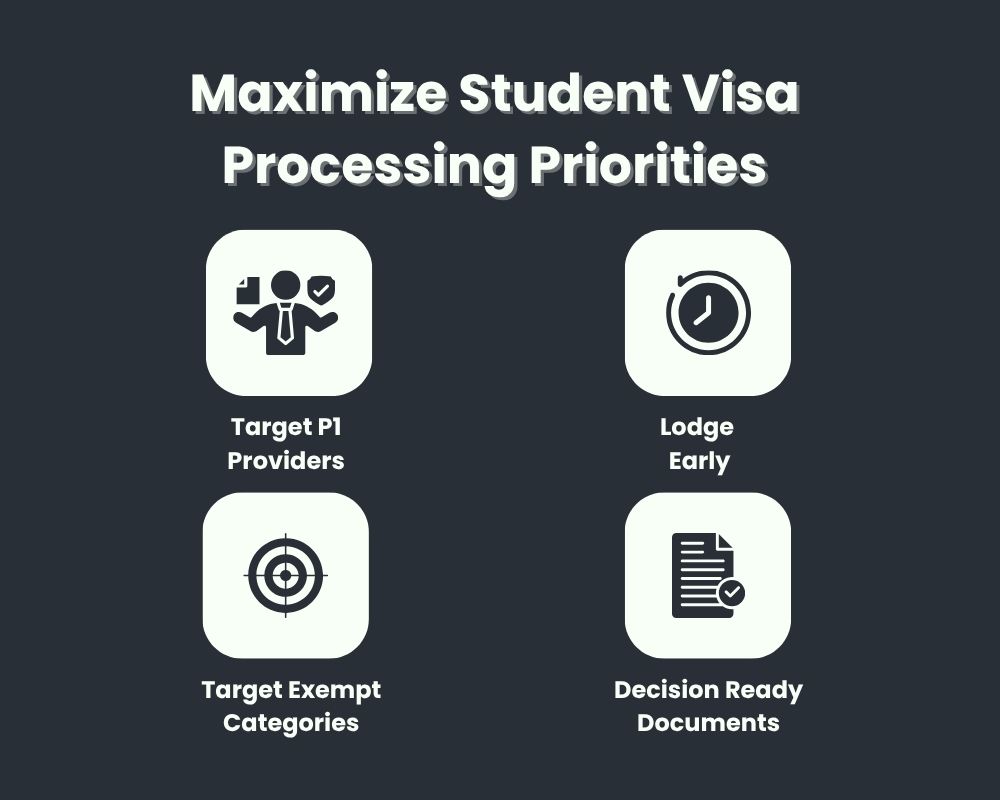
Target P1 Providers
If you are a someone who is wanting to utilize the Student Visa Australia Processing Priorities, then make sure you choose a P1 Provider institution that has utilized less than 80% of its annual student cap. As the DHA gives heavy attention to P1 applications, it is highly recommended that you choose a P1 provider if possible.
Lodge Early
As timing in everything matters a lot, you need to make sure that you lodge your student visa Application as early as possible. For this step, we highly recommend you lodge your visa application 4-6 months prior to the beginning of the intake. Lodging early in your institution guarantees that your application will be processed before the allocation is finished.
Target Exempt Categories
The DHA provides certain exemptions under the Student Visa Australia processing priorities, which can be used to help you in your application in Australia. Under the MD115, there are certain lanes that are in the P1 regardless of how many students have enrolled in the program. Some exemptions are:
- School Students
- Master of Research/ PhD of Research
- Standalone ElICOS
- TAFE and government-sponsored students
Decision Ready Documents
As the DHA puts high focus on “decision ready” documents, you need to make sure that your application has all the required documents for submission. You need to make sure that documents like Health and character certificates, Biometrics and English proficiency Test that are approved by the DHA like IELTS, PTE and TOEFL are present. Make sure to check multiple times to ensure that there is no deviation in the application process.
FAQs
The primary difference between the Ministerial Direction 111 (MD 111) and the Ministerial Direction 115 (MD 115) is that the MD 111 has handles every application that is lodged before November 14, 2025, whereas the MD 115 handles every application from November 14, 2025. These Frameworks under the DHA are used to manage caps for enrollment which then affects the speed.
Under the MD115 in 2026, the Priority of an institution depends solely on the Allocation Caps it has for the year. According to MD 115, the priority caps are divided into 3 priorities:
- Priority 1: Provider is below 80% of its cap.
- Priority 2: Provider is between 80% and 115% of its cap.
- Priority 3: Provider has exceeded 115% of its cap.
According to the Caps, the processing time is then affected. Priority 1 enjoys the fastest processing time whereas priority 3 has the slowest processing time.
No. If you are someone who is applying from inside of Australia then the MD 115 does not apply to you, and you can enjoy the exemption from the framework. The priority tiers of MD115 apply strictly to offshore applications only. If you are an onshore applicant, then your application is processed based on standard Department of Home Affairs (DHA) benchmarks.
Yes. Regardless of the institution you are applying for, there are some exemptions that are always treated as priority 1 and can enjoy the benefit of faster processing speed. The courses exempt from the priority list are:
- ELICOS-only courses at Level 1 providers.
- Foreign Affairs or Defense sponsored students.
- Schools Sector (Primary and Secondary).
- Postgraduate Research (master’s in research/PhD in Research).
As of January 8, 2026, the Department of Home Affairs (DHA) classifies Nepal, India, Bangladesh and Bhutan as Evidence Level 3 countries which requires more scrutiny. Due to this, even though your university is at priority level 1, your country’s evidence level requires a mandatory manually verified financial and English evidence, which can extend processing times to 4–8 weeks.
No. You cannot change your priority level after you have lodged your visa application. If you lodge your visa application while the institute is at priority 1 and then it goes on to become a priority 2 in the coming month, on the basis of the lodgment, your visa is processed under priority 1. This is main reason why applying early for a visa program is a crucial step in applying for student visa Australia.

With Student Visa Australia Processing Priorities in effect, navigating through the Student Visa has become more and more complex as we reach 2026. The complex MD115 priority tiers, ever changing Evidence Levels and the strict National Planning Level (NPL) caps had made understanding the processing priorities a necessity. A single mistake in your application may cause longer processing times or even rejections so you need a partner to guide you in your application.
Why BJay?
13+ Years of Proven Excellence: With over a decade long experience working with visa services in Australia, BJay Education & Visa Services has provided support to numerous clients around the world.
Global Presence, Local Support: With dedicated office available in Nepal (Putalisadak and Birtamode) and head office in Sydney, BJay Education & Visa Services provide you with the support you require in your preferred time.
Documents Auditing: We make sure that every document that you have is “decision-ready” so that your application doesn’t face any problem in the migration scene of Australia.
Priority Lane Check: We help you by checking which universities are on the Level 1 priority to ensure that your application has a quicker processing speed.
GS Drafting Excellence: The experts at BJay help you create a powerful, evidence-backed Genuine Student requirement that satisfies the latest 2026 DHA standards and makes your application stronger and decision ready.
Make your Australian Dream Come True for Studying in Australia. Understand Student Visa Australia Processing Priorities and apply Now!
Book a Free Nonobligatory Consultation with BJay Education & Visa Services!