
Partner Visa Australia is the pathway to securing your future with your loved one in Australia. The process of it is often complex, which is why the Partner Visa Australia pathway can feel overwhelming and may feel exhausting. As experts at BJay Education and Visa Services, we know this is one of the most important and one of the difficult visa applications to navigate around. Our success isn’t just about filling out forms or giving suggestions, it’s about providing strong, authentic and verifiable evidence across every stage of the Partner Visa Australia process.
This comprehensive guide helps you to deliver the exact, and the up-to-date information on Partner Visa Australia requirements, the tentative Partner Visa Australia cost for 2025, the realistic processing times according to the DHA, and which help you ensure your application is perfect and stands out to the Department of Home Affairs (DHA). Whether you’re exploring onshore or offshore options, de facto relationships, or transitions from tourist visas, we got you covered, this guide is meant for you all to help you succeed with your Partner Visa Australia application.
Partner Visa Australia Onshore vs. Offshore – Your Key Decision
The first key decision that you will need to take before pursuing Partner Visa Australia is to decide between 2 different types: onshore and offshore applications. The Partner Visa Australia typically follows a two-stage process which includes a temporary visa first, which then leads to permanent residency (PR) after the successful verification of the relationship stability for about two years. However the subclasses may differ by the location, which then impacts the rights, timelines, and strategies accordingly.
| Feature | Onshore Partner Visa Australia | Offshore Partner Visa Australia |
|---|---|---|
|
Subclasses |
Subclass 820 (Temporary) converting into Subclass 801 (Permanent) |
Subclass 309 (Provisional) converting into Subclass 100 (Permanent) |
|
Bridging Visa |
Yes – Immediate work/study rights and Medicare upon lodgment. |
No – Must stay outside until 309 granted, no work rights initially. |
|
Ideal For |
De facto or married couples in Australia on valid visas. |
Overseas applicants who are planning to join sponsor later. |
The Five Partner Visa Subclasses Explained
Beyond the main pathways, there are three primary subclasses you need to be aware of:
- Subclass 820 Partner Visa (Provisional Onshore): This is a Temporary visa subclass in the program which is lodged by applicants residing inside Australia. It basically provides legal status, work rights, and Medicare while waiting for the permanent stage of the program.
- Subclass 309 Partner Visa (Provisional Offshore): This is also a Temporary visa which is lodged by applicants that are residing outside Australia. This visa is granted first, allowing the applicant to enter and reside in Australia before the permanent stage assessment is done.
- Subclass 300 Prospective Marriage Visa: This sub-class visa is for applicants outside Australia who are thinking of marring their sponsor within nine months of arrival. After that they must then apply for the Subclass 820 Onshore Partner Visa after the marriage.
- Subclass 801 Partner Visa (Permanent Onshore): This sub-class visa is the Permanent visa granted to Subclass 820 holders after approximately two years of holding the temporary visa, conferring Permanent Residency (PR).
- Subclass 100 Partner Visa (Permanent Offshore): This sub-class visa is also the Permanent visa granted to Subclass 309 holders after approximately two years of holding the temporary visa, conferring Permanent Residency (PR).
Partner Visa Australia Requirements
The core of Partner Visa Australia requirements is proving that you or the sponsor has a genuine and ongoing relationship with each other who may be an Australian citizen, PR, or eligible NZ citizen. Based on these 4 essential pillars the DHA verifies the authenticity, which are:
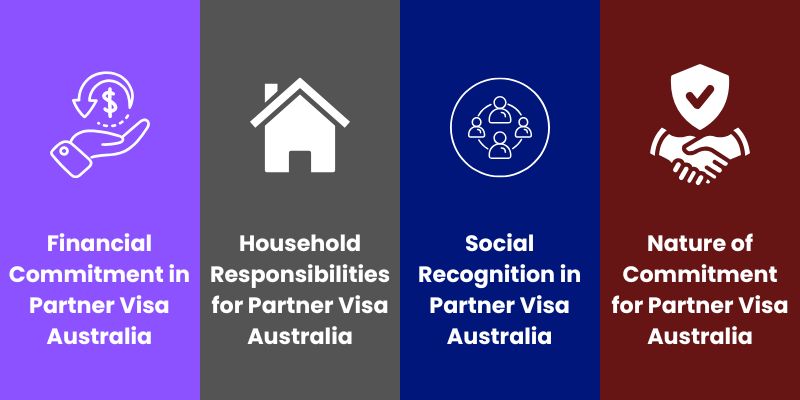
- Financial Commitment in Partner Visa Australia
Demonstrate your interlinked finances with each other through joint bank accounts. Verifiable 12+ months statements, shared loans, property titles, or superannuation beneficiaries.
- Household Responsibilities for Partner Visa Australia
For the Partner Visa Australia you need to prove that you have a shared domestic life via joint leases, mortgages, utility bills, or shared address mail.
- Social Recognition in Partner Visa Australia
The Partner Visa requires you to show public couple status with 10+ dated photos, joint travel tickets, and 5–10 Form 888 statutory declarations from friends/family which should preferably by Australian Citizen.
- Nature of Commitment for Partner Visa Australia
It requires you to highlight exclusivity and future with your partner through personal relationship statements which should be around 1,000–2,000 words each and the state relationship registrations.
Partner Visa Australia Full 2025 Fees & Hidden Expenses
Are you looking for “Partner Visa Australia Cost”? Searching for it typically reveals substantial upfront Visa Application Charge (VAC) covering both stages. Based on the DHA’s July 2025 data, the base Partner Visa Australia cost has been confirmed but it is always recommended to verify the latest fees on immi.homeaffairs.gov.au before going forward with your visa application.
| Applicant Type | Partner Visa Australia Cost (VAC July 2025) |
|---|---|
|
Main Applicant (Standard) |
AUD $9,365 |
|
Adult Family Member |
AUD $4,685 |
|
Child Family Member (Under 18) |
AUD $2,345 |
(Source: immi.homeaffairs.gov.au)
Total Budgeting: Beyond the VAC or the Hidden fees involved
As we know only looking the VAC upfront isn’t always the ideal condition, hence you must budget an additional of about AUD $1,500–$3,000 for various expenses:
- Medical Examinations: AUD $400+ per person.
- Police Clearances: AUD $50–$100 per country for 12+ months residence since age 16.
- Professional Agent Fees: Expert guidance from Various agents for evidence optimization and strategy typically costs extra but minimizes refusal risk (which forfeits the $9,365 fee).
Partner Visa Australia Processing Time & The 5-Year Rule
The Partner Visa Australia processing time is usually lengthy and exhausting due to the high volumes of application with it. Typically, Partner Visa Australia processing time for the temporary grant (820/309) is 22–30 months. We suggest you make your application with a decision-ready result which can be the best strategy to potentially skip the unrequired long-awaited times involved in the process.
| Visa Stage | Median Partner Visa Australia Processing Time (75% Granted) |
|---|---|
|
Temporary Onshore (SC 820) |
22–24 months |
|
Provisional Offshore (SC 309) |
24–30 months |
|
Permanent (SC 801/100) |
12–18 months (post 2-year wait) |
The 5-Year Rule for PR
The 5-Year Rule for PR helps you with your PR grant. If you have a proven 3+ years relationship (or 2+ years with a child) while you are lodging your application, you can receive a direct permanent grant, skipping the temporary stage’s waiting period.
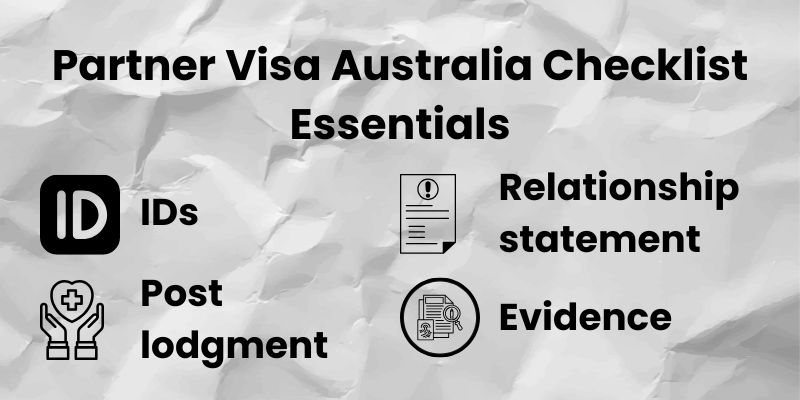
Partner Visa Australia Checklist Essentials
Confused on how you should apply for Partner Visa in Australia? Use this Checklist to get through your application with less hassle:
- IDs: Passports, birth certificates that show the names of both parents.
- Evidence: Organized folders according to the pillars mentioned in the above section.
- A compelling relationship statement for partner visa sample Australia.
- Post-lodgment: Health/police via HAP ID, requirements for partner visa in Australia proofs.
How to Lodge Your Partner Visa Australia?
Just a heads-up, the application to Partner Visa Australia application process is not as simple as you think and without any professional help you might have trouble submitting even the simplest of forms. It requires precise sequential steps within the DHA’s online system.
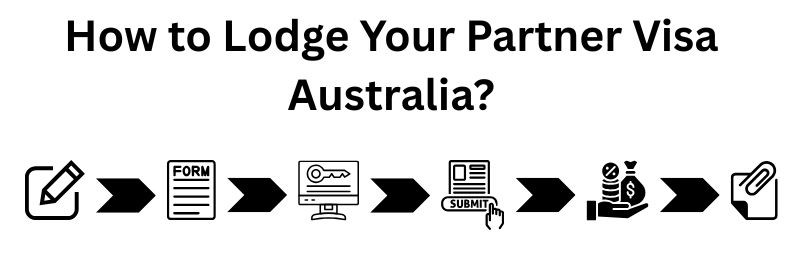
Here is the full Step-by-Step process you will need to follow if you want to lodge your application successfully:
- Creating an ImmiAccount: The first step for the process includes that you must first set up an online ImmiAccount on the Department of Home Affairs website with your proper credentials.
- Applicant Lodges Form 47SP: In this step. The main applicant completes and submits the initial application form which includes the Form 47SP, Application for migration to Australia by a partner.
- Generate the TRN: Once the main applicant’s form is submitted then they should receive a Transaction Reference Number (TRN).
- Sponsor Submits Form 40SP: The sponsor uses the TRN to link their application and submit their own sponsorship form: Form 40SP, Sponsorship Form for a Partner to Migrate to Australia.
- Pay the Partner Visa Application Fee: Once all forms are complete, the entire application fee (AUD $9,365) is paid online via ImmiAccount.
- Attach All Documents: You then have time to attach the voluminous evidence bundle (police checks, relationship statements, financial records) to the application via ImmiAccount.
- Review and Submit: Only after the fees are paid and the minimum required evidence is attached should you press Submit to officially lodge the application.
Sponsor Eligibility, The 5-Year Rule, and Exemptions of the Partner Visa Australia
While the applicant’s relationship evidence is supreme, the sponsor (the Australian partner) must also meet strict criteria. Failing the sponsor checks is a guaranteed refusal in your application process.
Sponsor Eligibility Requirements for the application
The sponsor must:
- Be an Eligible Citizen/Resident: The Sponsor is required to be an Australian citizen, permanent resident, or eligible New Zealand citizen for the application.
- Pass Character Checks: The Sponsor is required to provide required police certificates to show that they pass character requirements.
- Provide Undertaking: Commit to financially supporting the applicant and providing accommodation for at least two years after the visa grant.
What is the 5-Year Rule for Partner Visa?
The 5-year rule for Partner Visa is a critical restriction placed on the sponsor. The rule says that a sponsor generally cannot sponsor more than two partners in their whole lifetime, and the sponsor must wait at least five years before sponsoring a new partner if they have previously sponsored one since January 1997.
Why does this matter?
The 5-year Rule for partner Visa is crucial as it prevents the repeated use of the program and the misuse of the program leading to more lead time and more applications being piled up and the actual and authentic applications being delayed due to repetitive applications for an individual.
Exemptions
The Exemptions in the Program are very rare but may be granted in compelling condition, such as if the previous relationship ended due to the sponsor’s death or if there are dependent children involved and evidence of domestic violence.
De Facto Partner Visa Australia Pitfalls and Solutions
The De Facto Partner Visa Australia is the process of applying for the Partner Visa for individuals who are not married or have a documented proof but is based on an unmarried, committed relationship. This is a main and specific type of application, and the most common reason for refusal is failure to meet the 12-month cohabitation rule given by the DHA.
- Pitfall (12-Month Cohabitation): You must prove that you are in 12 months of continuous cohabitation immediately before lodging your application. Short gaps due to travel or work must be logically explained to the authorities concerned and supported by solid evidence to back up the application (e.g., communication records, joint financial support during separation).
- Solution (Relationship Registration Waiver): The solution to the problem is to simply and formally registering your relationship in an Australian state or territory (e.g., NSW, Victoria) which can usually waive the 12-month cohabitation requirement altogether, as the DHA accepts the registration as compelling proof of commitment.
Partner Visa Australia FAQs

The main applicant or the standard cost is AUD $9,365 base for the main applicant (2025). This fee covers both the temporary (820/309) and permanent (801/100) stages. We strongly suggest that you look at the latest fees on immi.homeaffairs.gov.au before going forward with your visa application, as they can change annually.
The current Partner Visa Australia processing time is lengthy, typically ranging from 22–30 months for the temporary stage (SC 820/309). The permanent stage (SC 801/100) is then processed in an additional 12–18 months after the mandatory two-year waiting period. Quality applications are the only way to potentially move faster than usual.
For you to qualify for the Visa, you must make the DHA believe and prove a genuine and exclusive relationship with your spouse or de facto partner. Additionally, your sponsor must be an eligible Australian citizen/PR/eligible NZ citizen and must pass character and sponsorship limitations.
Yes, a Tourist Visa to Partner Visa Australia is possible which is provided your tourist visa did not have the “No Further Stay” condition (8503) attached. If you apply onshore (SC 820) while your tourist visa is valid, you will be granted a Bridging Visa A (BVA) allowing you to stay and work while your partner visa is being processed.
Partner Visa Australia Success:
We here at BJay have MARA-qualified agents who have achieved high success rates in Partner Visa Australia applications. We specialize in evidence audit, crafting persuasive statements, navigating the 5-year rule, and handling complex de facto partner visa Australia cases. By choosing BJay, you ensure your application meets the highest standards, minimizing risk and cutting down on the overall Partner Visa Australia processing time.

Book a free consultation at BJay Education & Visa Services for your personalized Partner Visa Australia strategy and path to permanent residency.