Parent visa 143 is a type of Visa that is offered by the Australian government to the permanent residency for parents of eligible Australian citizens, permanent residents, or eligible New Zealand citizens living outside Australia at the time of grant under the Parent Visa Australia programs. Officially known as the Contributory Parent Visa (Subclass 143), it is the primary pathway for families that are planning a family reunion by paying a sum of money in exchange for comparatively faster processing compared to the non-contributory stream.
This ultimate guide provided to you by BJay Education & Visa Services, backed-up by current Department of Home Affairs (DHA) data and established migration principles, helps you identify the benefits, processing realities, costs, and key requirements of the contributory parent visa 143.
What is the Contributory Parent Visa 143?
Contributory parent visa 143 is basically a type of parent visa that strikes to provide permanent residency to the eligible parents residing outside Australia, providing them with various rights like indefinite stay in Australia, work rights, Medicare access, and citizenship pathways with the same visa.
| Feature | Subclass 143 Details |
|---|---|
|
Visa Type |
Permanent |
|
Location |
Offshore (Must be outside Australia) |
|
Processing Priority |
High and faster |
|
Rights |
Live, work, study, Medicare, citizenship,
sponsorship, travel rights
|
|
Annual Cap |
Approximately 6,800 places |
Core Benefits of the Parent Visa 143
| Benefit Category | Entitlements |
|---|---|
|
Residency |
Live in Australia indefinitely + 5-year travel facility |
|
Work/Study |
Unrestricted rights any employer/education |
|
Healthcare |
|
|
Citizenship |
|
|
Family |
Sponsoring other relatives for PR |
Source: (Department of Home Affairs, Subclass 143 Visa Benefits)
Difference Between Contributory Parent Visa 143 and Contributory Parent Visa 173
In the topic of Parent Visa there arises a question “What is the difference between the subclass 143 and 173”. The Parent Visa 173, which is also known as the Temporary Contributory Parent Visa is the first step in a two-stage process that ultimately leads to the permanent 143 visa. The Parent Visa 173 basically allows families to spread the financial contribution over two large payments, enabling parents to reside in Australia sooner after the long queue wait.
| Feature | Visa 173 (Temporary) | Visa 143 (Permanent) |
|---|---|---|
|
Onshore or offshore |
||
|
Duration |
||
|
Processing Time |
36-38 months |
36-38 months
in a shared queue
|
|
Total Cost |
AUD $32,525 |
AUD $48,640+ upfront |
|
Financial Benefit |
Allows cost-splitting over approx. 2 years |
All paid upon grant |
|
Final Step |
Must apply for 143 within 2 years |
Single application |
Source: Department of Home Affairs, Subclasses 143 & 173
Difference between Contributory parent visa 143 and Non-contributory parent visa 103
The Australian Government offers different types of Visa services programs, some of which are subclass of Parent Visa. These are Contributory Parent visa subclass 143 and Non-contributory Parent visa subclass 103. These two visas seek to provide visa services to the parents of eligible Australian citizens, permanent residents, eligible New Zealand citizens.
There is a common question that arises in everyone’s minds while choosing a visa for their parent “What is the difference between 143 and 103 parent visas?” So, the major difference that differs from the subclass 143 with the subclass 103 is the speed and the cost involved in both. The Parent Visa 143, or Contributory Parent Visa 143 visa, is a subclass of the parent visa that is processed comparatively faster as compared to other parent visas within a period of 14 years relative to the long-waiting period of 31+ years for the 103-parent visa. This visa requires a higher financial contribution.
| Feature | Parent Visa 143 (Contributory) | Parent Visa 103 (Non-Contributory) |
|---|---|---|
|
Low cap (approx. 1,700) |
||
|
AoS Bond |
||
|
Processing Time |
up to 15yesars |
31+ years |
|
Visa Fees |
AUD $48,640 |
AUD $7,345 |
|
Best For |
Speed seekers |
Budget-conscious |
(Source: Department of Home Affairs, Subclasses 143 & 103)
Hence, if you are an individual who is seeking faster processing time and can afford to spend comparatively more money you should pick the Parent Visa 143 else if you can wait for a longer processing time then you are advised to go for the Parent Visa 103.
Contributory Parent Visa 143 Full Cost Breakdown
As per the Data given by the DHA in their respective website, the parent visa 143 cost can be broken down into:
| Cost Component | Primary Applicant | Additional (18+) |
|---|---|---|
|
AUD $1,700 |
||
|
Second VAC Installment |
||
|
Total VAC |
AUD $48,640 |
AUD $45,300 |
|
AoS Bond |
AUD $10,000 |
AUD $4,000 |
|
Health Exams |
AUD $350-500 |
AUD $350-500 |
|
Police Certificates |
AUD $200-400/country |
AUD $200-400/country |
|
Total Estimate |
AUD $60,000+ |
AUD $50,000+ |
Source: (Department of Home Affairs, Visa Pricing Estimator & Parent Visa Charges, FY 2025)
Contributory Parent Visa 143 Processing Time
The contributory parent visa processing time is the most searched question at the moments as the long processing time of the parent visa 143 is unavoidable due to the annual caps and allocations that are placed by the Australian government on all parent visa. It is a 2-stage process that includes:
- Initial Assessment: This is the first step in the process which is about 4-6 weeks long. In this phase, the DHA checks the basic visa criteria like balance of Family test verification and if the requirement is satisfied queue date assignments are done.
- Final Assessment: This is the phase in the process which is done post-queue which the DHA asks to provide updated health and police updates, and the VAC second payment and the finalization of the AoS is supposed to be made in this phase.
| Processing Milestone | Timeframe |
|---|---|
|
EOI → Queue Date |
4-6 weeks |
|
Queue Wait (to June 2018) |
10-12 years |
|
Final Processing |
2 years |
|
Health/Character/AoS |
3-6 months |
|
TOTAL 90% |
15 years |
Source: (Department of Home Affairs, Parent Visa Caps, Fees and Processing Times)
Parent Visa 143 Eligibility
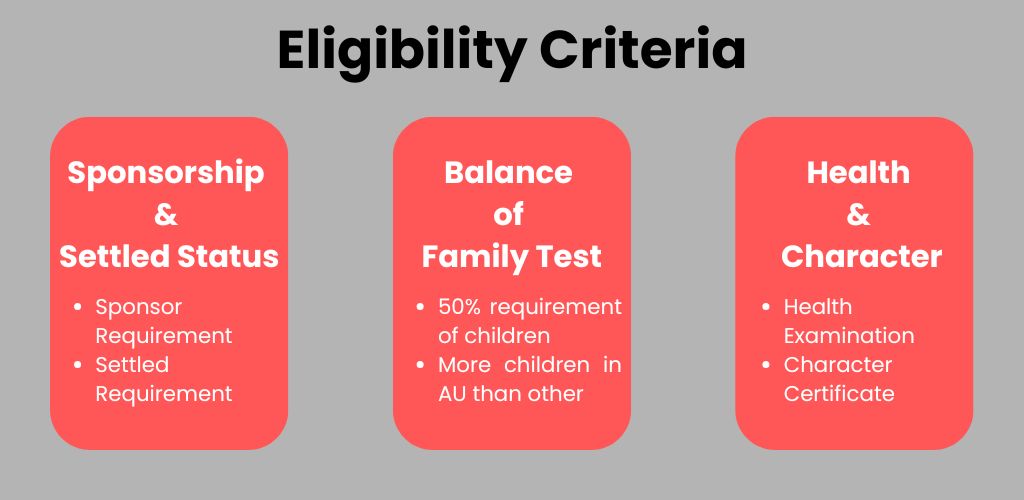
In case you have been searching for the eligibility requirements for the Parent Visa 143 and could manage to acquire a queue date and ultimately achieve the grant for the parent visa 143, you will have to satisfy the following mandatory fundamental requirements:
Sponsorship & Settled Status
- Sponsor Requirement: The applicant or sponsored individual must be sponsored by a qualified child who is either an Australian citizen, a permanent resident of Australia, or a qualified citizen of New Zealand.
- Settled Requirement: The applicant sponsor seeking the visa will have to show their “settled” status within Australia. This always requires the sponsor to make sure he or she has been lawfully residing in Australia for a minimum of two years.
“Balance of Family Test” (BOFT)
The Balance of Family Test is a test which verifies the fact that the parent’s main family relationships are located within Australia. The applicant seeking to sponsor the visa has to fulfill one of the following circumstances:
- At least 50% of the applying children are Australian citizens or Australian permanent residents, or eligible New Zealand citizens who are usual residents in Australia.
- More of the candidate’s children live in Australia than in any other nation.
Health & Character
All applicants and accompanying family members are required to meet the Australian requirements regarding health and character:
- Health: The Mandatory Medical examinations will have to be done by an approved physician of the DHA for the verification of the health of the applicant.
- Character: To make an understanding of the character and the circumstances of the applicant, the police clearance certificates must be collected from all the countries in which the applicant has lived for a period of 12 months or more in the past 10 years.
Parent Visa 143 Bridging Visa
Strategic planning in relation to the contributory parent visa 143 bridging visa is an essential aspect of migration for the fact that this specific visa does not comply with the resident rules about onshore residence. The visa, in effect, being an offshore visa, means that for the relatives to keep physical proximity, there has to be the strategic deployment of entry permits for the 15-year term.
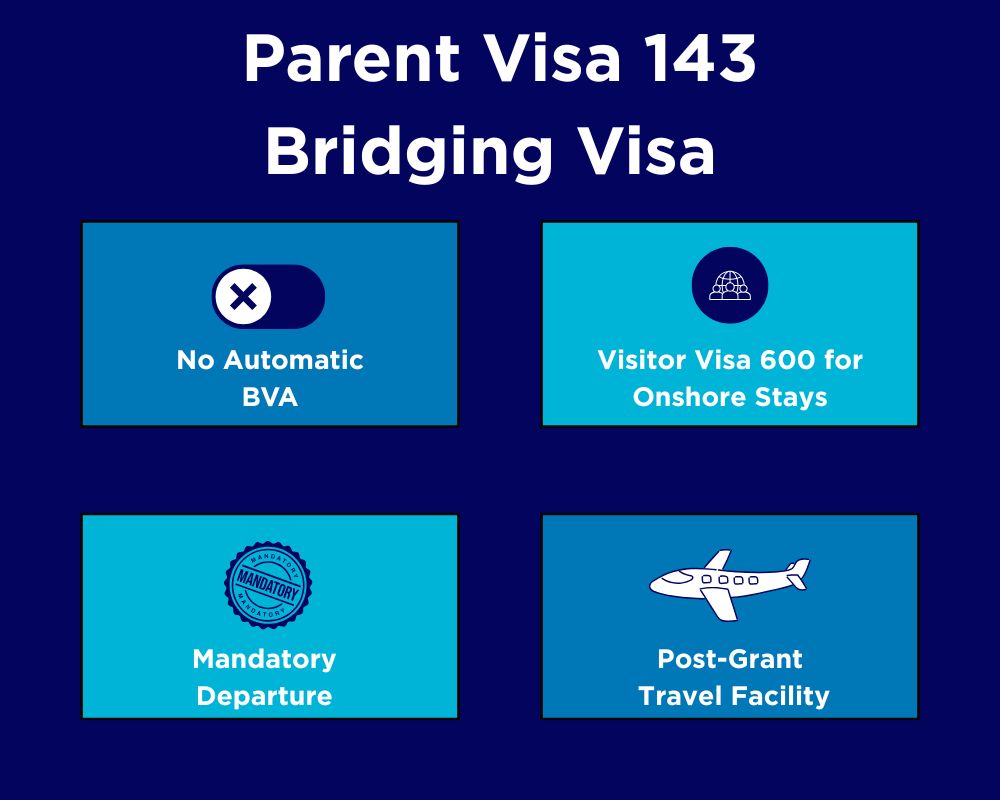
- No Automatic BVA (Offshore Grant Priority): Unlike the Aged Parent (804) visa program provided by the Australian government, lodging a 143 application does not automatically give the Bridging Visa A (BVA). Which basically means that the parents of the sponsor cannot remain in Australia for indefinite period of time just because they have a pending application in the process queue.
- Visitor Visa 600 for Onshore Stays: If you want to be with family during the 15-year wait, parents usually opt-in for the Visitor Visa (Subclass 600) for temporary stays in Australia. This condition requires you have careful management tactics to ensure they have departed the grounds of Australia before their tourist stay expires and do not breach No Further Stay conditions, which is illegal.
- Mandatory Departure for Final 143 Grant The subclass 143 is legally classified as an offshore grant; therefore, parents must be outside Australia when the visa is finalized. Once the second installment is paid and the “pre-grant” is issued, a short trip to a nearby country is required to facilitate the grant.
- Post-Grant Travel Facility: Once you have been granted the bridging visa, your parents can re-enter Australia immediately with full permanent residency rights. The visa includes a 5-year travel facility which allows them to move freely between Australia and their home country as they settle in.
Step-by-Step Parent Visa 143 Application Process
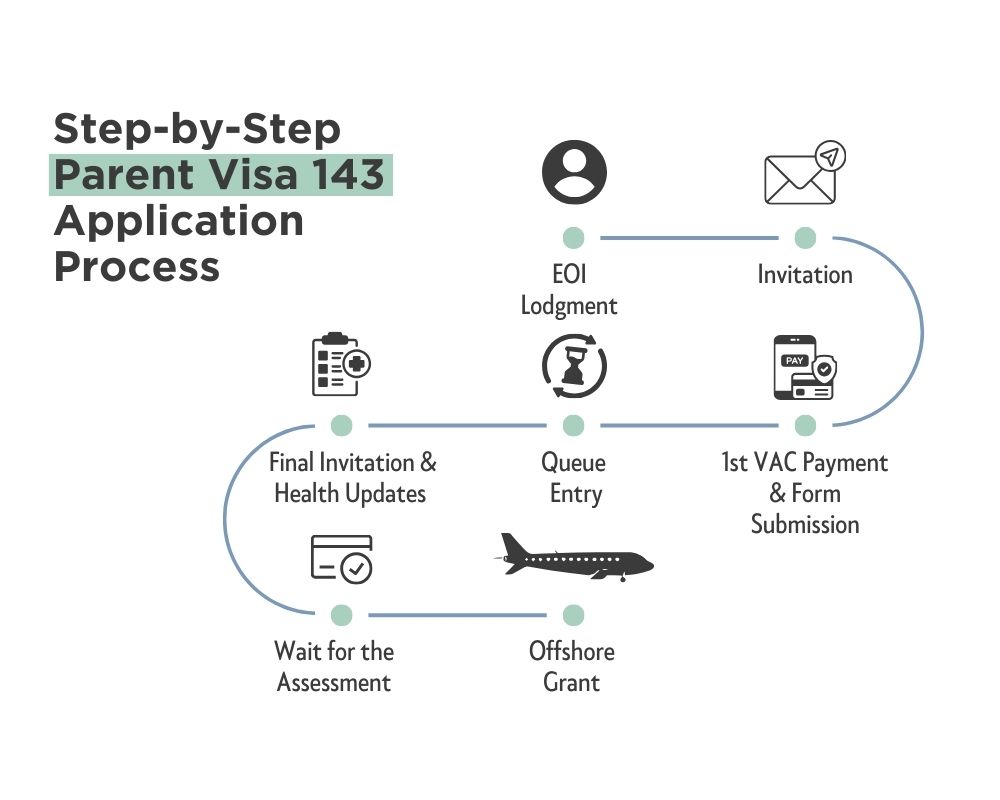
If you want to obtain a Contributory Parent Visa 143, it is a tedious and multi-phase process that calls for careful planning and financial planning. The essential turning points from your initial Expression of Interest to the activation of permanent residency in Australia are outlined in the following steps.
Step 1: EOI Lodgment via ImmiAccount Create a digital profile to submit your Expression of Interest, providing certified evidence that you meet the Balance of Family Test.
Step 2: Invitation (4-6 Weeks) Receive a formal invitation to apply, which establishes your priority date and allows you to proceed with the full application.
Step 3: 1st VAC Payment & Form Submission Pay the initial Visa Application Charge of $5,040 and submit your comprehensive 47PA and 40PA migration forms.
Step 4: Queue Entry & Long-Term Wait Once your core eligibility is verified, you are placed in the official queue for a processing period that currently averages 12–15 years.
Step 5: Final Invitation & Health Updates Years later, when you reach the front of the queue, you will be asked to provide updated police clearances and fresh medical examinations.
Step 6: 2nd VAC & AoS Bond Lodgment Pay the significant final “contribution” of $43,600 per parent and lodge a $10,000 refundable bank guarantee with Centrelink.
Step 7: Offshore Grant & Activation Travel outside of Australia to receive your formal grant notification, which officially activates your permanent residency status.
Parent Visa 143 FAQs

The parent visa 143 usually takes about 14 years in total according to the DHA processing April 2018 queue dates.
The Difference between them is that143 = permanent offshore; 173 = temporary onshore pathway to 143.
The cost of 143 parent visa is Approx AUD $48k whereas the cost of 103 parent visa is $5k.
Yes. The Contributory Parent Visa 173 application may be made in or outside of Australia. However, it is essential that the applicant is outside of Australia when the DHA makes the final decision and grants the visa, unless exemptions pertaining to the temporary COVID-19 circumstances currently in place are met.
The individual or the Parents of the sponsor that have successfully passed the BoFT with a settled Australian sponsor (2+ years)
Yes, the subclass 173 grants you with full work rights, allowing you to engage in any legal employment or business activities without any hour restrictions.
Yes, you may include your partner as a secondary applicant, but they have to meet the standard health and character requirements with the balance of family test remaining satisfied.
No, unlike the many skilled migration programs, there is no exact formal English language test required for the parent contributory visa 173 or 143 streams.

Get your free Consultation with BJay
Starting your journey in Australia can be hard and overwhelming, when it comes to knowing the requirements of the skill assessment, visa eligibility and the documents required for the process. That’s why we BJay Education & Migration offer you a completely free, no-obligation consultation service so you can get all the support you need and boost the chances of studying or working in Australia.
Take the Free Consultation Today: Book your free consultation with BJay and let us guide you through every hurdle that comes in the path of you and a positive skill assessment in Australia.