Individual Tax Return is one of the most important annual financial obligations that needs to be completed by any working person in the turf of Australia. The Australian Taxation Office (ATO) has currently implemented certain rules that has implemented high level tech and data-matching algorithm that impact your financial aspects. It doesn’t matter if you are a salary earner, a freelancer, digital creator or a businessman, you need to be clear of the individual tax return to make sure that you maximize your refunds while being compliant to the rules of the Australian government.
With more than 13 years of experience in providing expert help to numerous clients, BJay Education & Visa Services have meticulously drafted this article to help you with your individual tax return process. With the latest data as of March 2026 from the ATO and Department of Home Affairs (DHA), this guide serves as the roadmap that can help you with your individual tax returns in 2026. This 2026 guide covers all the topics on what an individual tax return in Australia, due dates, costs, process and pitfalls is.
Individual tax return in Australia
The individual tax return in Australia is basically a formal declaration that you need to submit to the ATO which consists of all your total income according to which your tax deductions for the financial year (1 July to 30 June) is calculated. With major changes in the reforms of Australia, as of March 2026, the scope of Individual Tax Return in Australia has significantly expanded and no longer just covers your standard salary but includes the following as well:
- Consists of earnings from ridesharing, food delivery, or freelance platforms.
- Consists of digital assets like capital gains from cryptocurrency, NFTs and staking rewards.
- Consist of any money that is earned from overseas assets or employment while you are currently an Australian resident.
- It consists of all the investment returns and interest from bank accounts, dividends from stocks and rental income.
Individual Tax Return Due Date 2026
As time is a crucial factor that needs to be considered, while you need to make sure that you pay your taxes, it is equally important that you abide by the deadlines and timing given by the ATO. As the ATO has scrutinized the timing factor, missing the individual tax return due date can result in factors like financial penalties that generally compound every 28 days.
| Lodgment Method | Individual Tax Return Due Date | Notes |
|---|---|---|
| Self-Lodged (myTax) | 31-Oct-26 | Mandatory for those not using an agent. |
| Registered Tax Agent | 15-May-27 | Only if registered with the agent by 31 Oct. |
| Special Concession | 5-Jun-27 | For eligible low-income or simple files. |
Maximizing Refunds on Your Individual Tax Return
If you are looking to maximize your refunds on your individual tax return, then you need to know about all your assessable income and your allowable deductions. In order to satisfy the ATO’s current enhanced data-matching algorithm, you must provide a proven direct link between the expense and your ability to earn in Australia.
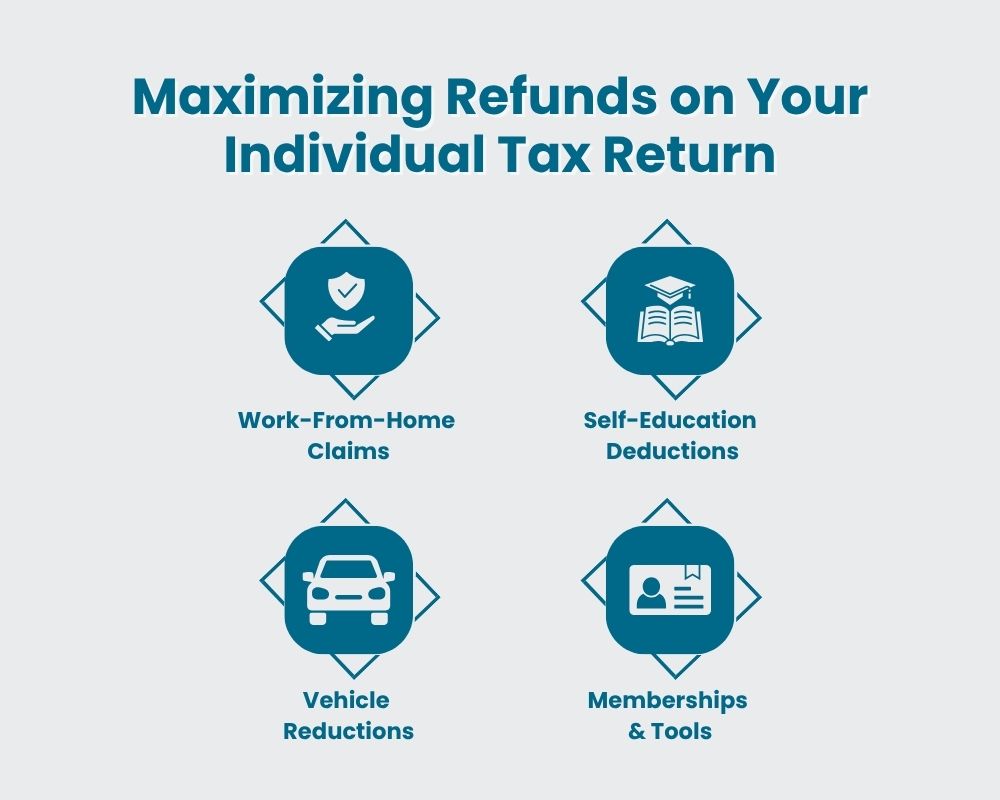
Mastering Work-From-Home (WFH) Claims
For the tax season of 2026, the fixed rate method still remains the most streamlined way that is used to boost your individual tax return refund. For the season of 2026, the rate for it is 67 cents per hour in case you have worked from home. In this it includes electricity, gas, stationery and computer consumables. Additionally, you can claim extra for the depreciation of expensive assets like ergonomic chairs and high-end monitors that are above AUD $300. For this you are not required to have a home office but make sure that you have proper evidence.
Self-Education Deductions
Another majorly overlooked way to increase your Individual Tax Return is through claiming refunds and deductions through self-education. In case you are a student who is currently studying in Australia and enrolled in a course such as a trade course or a professional certification that helps you maintain or improve the required skills required for the current role that you are working on. In this section, you are able to claim deductions for Tuition fees, textbooks, and the travelling expenses incurred during the travel to the institution.
Vehicle Reductions
In case that you use your personal vehicle like a car for your work-related excluding your normal commutation, then you can claim for vehicle reductions as well. In order to address the rising fuel costs, the ATO currently has provided the facility to claim up to 5,000 work kilometers without a full logbook, provided you can show how you calculated the distance. Hence, with this step from ATO you are able to claim the reimbursement for a total of 5,000km ultimately making you able to claim thousands of dollars to your deductions.
Professional Memberships and Tools
As it is said that “Little drops of water make a mighty ocean”, similar to that small expenses and deductions can lead to significant and higher individual tax return refund. If any tools or equipment are used in your field of work, which costs less than AUD $300 then it can be claimed as a deduction. Another deduction that can be claimed is the Union & Professional Fees which are 100% deductible. These include software or subscriptions that are used for your professional journey or industry-specific requirement.
Individual Tax Return Process in Australia
As the ATO currently utilizes pre-filling technology and real-time data matching, the process for Individual Tax Return in Australia in 2026 has been modernized. In order to ensure that your Individual Tax Return is processed within the timeframe follow the steps given below:
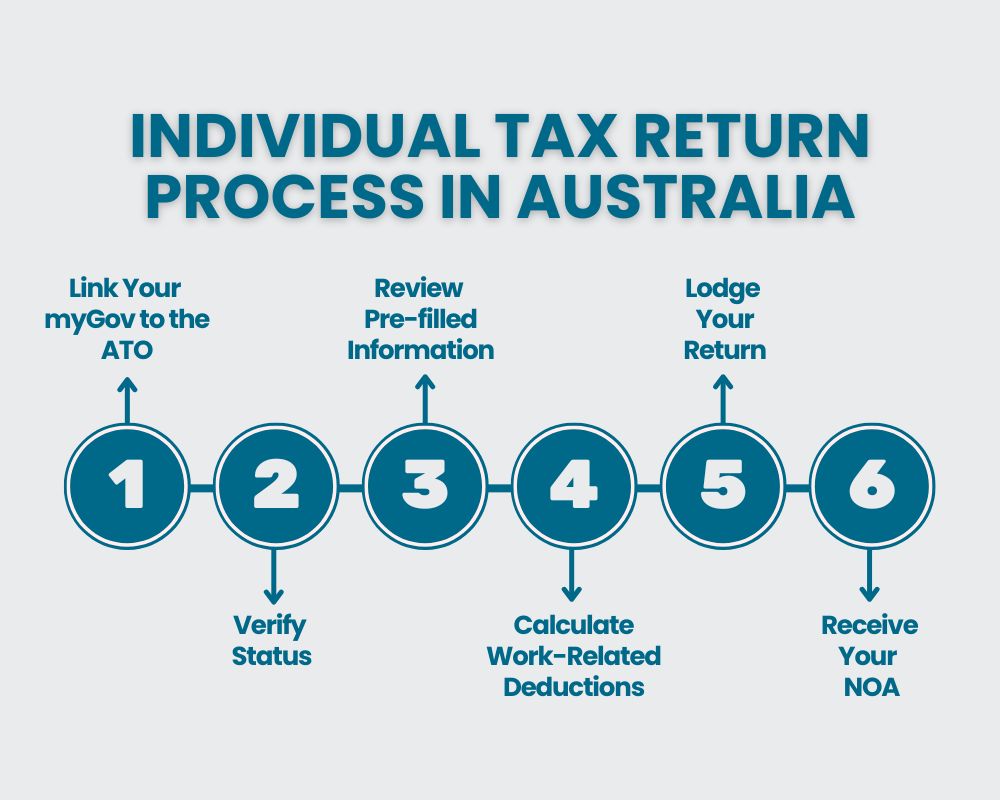
Step 1: Link Your myGov to the ATO
Before you start the process of Individual Tax Return, make sure to first link your myGov account with the ATO before the individual tax return due date arrives so that there is no rush during that period. As the myGov is a central hub where you are able to lodge your individual tax return, track your refund, and view your “Notice of Assessment”, it is essential that you link it to your ATO.
Step 2: Verify Status
After you have linked your myGov to the ATO, the next step is to verify your account’s status. As of 2026, employers are required to provide and finalize your income statement with the help of Single Touch Payroll (STP). The most common mistake in the process is lodging your return before the status in your account says that you are “Tax Ready”. Hence, to avoid the mistake make sure to wait until late July so that it includes accurate data from banks, health funds, and government agencies, preventing the need for future amendments.
Step 3: Review Pre-filled Information
As of 2026, the ATO has a strong algorithm that automatically populates your Individual Tax Return with fields like salary and wages, Interests from Banks and dividends gained from holding stocks, health insurance details & centrelink payments. Even though all these fields are automatically populated, make sure to cross-check these data with your data to make sure there are no discrepancies and if any discrepancies are there make sure to contact the provider for corrections.
Step 4: Calculate Your Work-Related Deductions
This is the step where you actually maximize your returns. All the money that you have spent on yourself related to your job can be claimed. To make sure the claim can be made, keep receipt of the expense. It includes Work from Home, Vehicle expenses, & self-education expenses.
Step 5: Lodge Your Return
In this step, you need to lodge your individual tax return after all the deductions and claims. If you are a self-lodger, then make sure that you review your documents and submit the lodgment within the time frame of 31st October.
In case you are lodging your return via Tax Agent Users, make sure that you are in their books by the 31st of October 2026 if you want to secure the 15th of May 2027 extension.
Step 6: Receive Your Notice of Assessment (NOA)
Once you have successfully lodged your individual tax return, the ATO will then process your application within the next 14 days of lodgment. After that you will receive a NOA which will then confirm the total deductions or individual tax return payment due date if you owe a debt to the Commonwealth.
Documents required for Individual Tax Return
In 2026, the ATO currently heavily emphasizes automated data-matching so having correct documentations while applying makes sures that delays in your application are avoided. In order to ensure that your application is “decision ready” for the year of 2026, you must provide a comprehensive list of evidence to make sure that you don’t have to go through the cancellation of tax return individuals for manual verification.
Make sure that you have the following documents ready before you proceed with your Individual Tax Return:
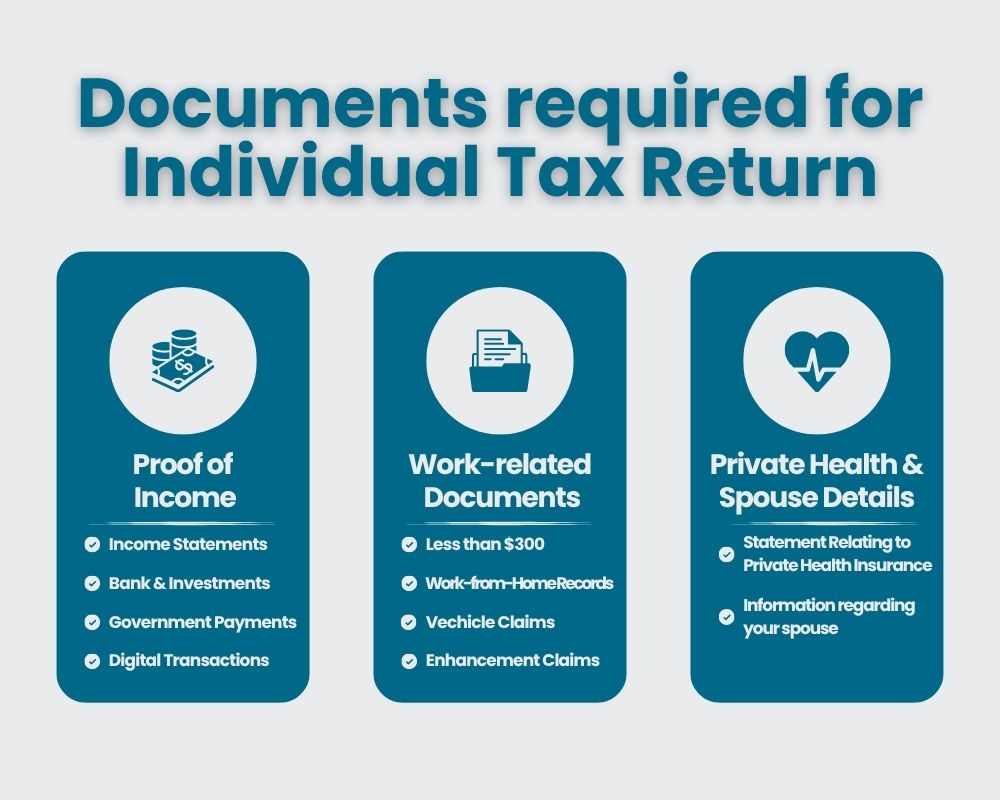
Proof of Income
As of March 2026, most of the data under this section will be automated by the ATO but you are required to check if there are any discrepancies in them.
- The income statements that are provided by your employer has been finalized and your status in the myGov portal is “Tax Ready”.
- Bank and Investment records that act as a record for all the interests earned, share dividends received and managed fund tax statements.
- Records of government payments like Centrelink, JobSeeker, or Paid Parental Leave payments.
- Transaction records of all your digital assets from your exchange for any trades in cryptocurrency, rewards, or sale of NFTs.
Work-related Documents
In order to claim a deduction on your Individual Tax Return, the expense must be directly linked to the production of the income.
- In case your total claims for work-related expenses are less than AUD $300 then you don’t need receipts but are required to be able to explain how the calculations for the deductions have been made.
- You need to provide a 4-week representative diary of your work hours to support your deductions for the Work from Home records.
- If you use a vehicle to commute daily to workplace, then you need to have a 12-week logbook which can be used to claim deductions for up to 5,000km of travel.
- If you need professional certifications or trade assessments that are related to enhancing your work, then you can have claim deductions if you have invoices for it.
Private Health & Spouse Details
In this section of document requirements, you are required to provide all the documents related to your private health and the details of your spouse. These documents are required as these documents impact your Medicare Levy Surcharge and various tax offsets.
- Statements of Private Health Insurance are required in this section. Even though these are usually pre-filled by the ATO, make sure to verify the details to make sure that there are no discrepancies.
- You need to provide information regarding your spouse and their taxable income figure to make sure that your Individual Tax Return correctly calculates the family-based offsets and collection of taxes.
Common Mistakes and Fixes for Individual Tax Returns
As of March 2026, the ATO currently has scrutinized and refined its frameworks which basically means that even the slightest overlook in your Individual tax return can be flagged for manual review. To make sure that you don’t have any problems with your Individual Tax Returns make sure to review your returns for these mistakes and if any deviations are found make sure to apply the given fixes.
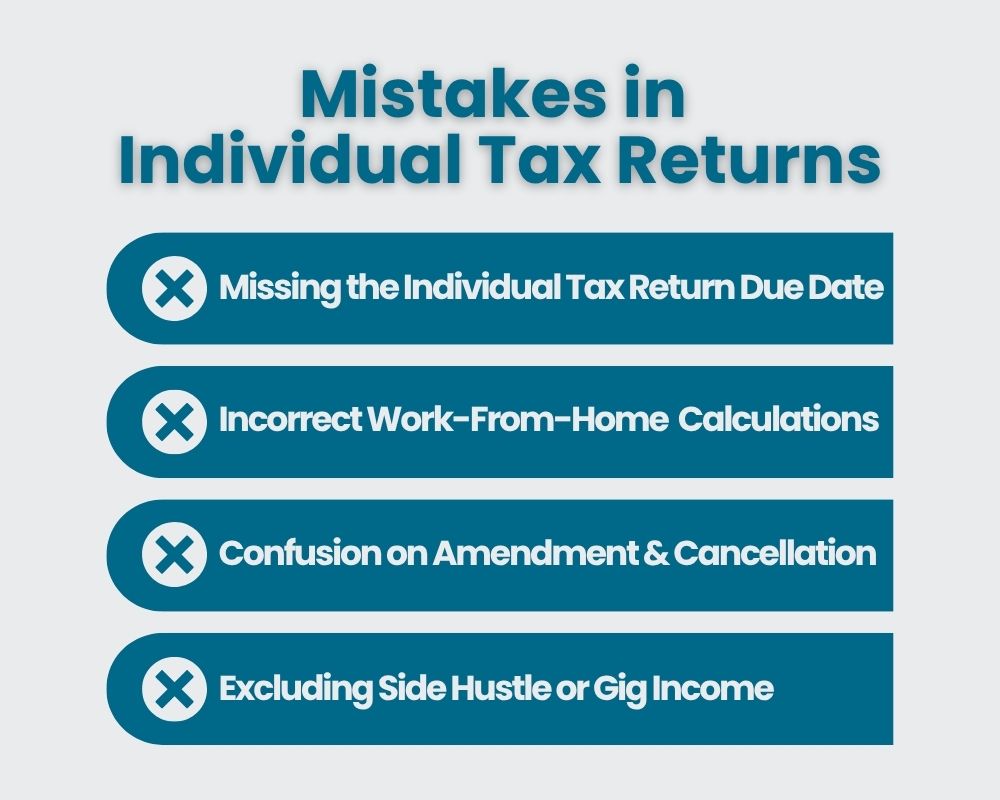
Missing the Individual Tax Return Due Date
Pitfall: Many people who are looking for a refund tend to think that because of that they are obliged with the deadline. Many taxpayers tend to wait until January or February to lodge their application, unaware that the Individual Tax Return due date for self-lodger is to be done with on 31st October 2026.
Solution: In case you have missed your deadline to file your Individual Tax Returns, don’t wait until the ATO contacts you and lodge your application as soon as possible. The ATO in 2026 usually offers waiver (especially for first-time offenders) for penalty for late tax return individual Australia so make sure you lodge your application before the ATO issues a “Failure to Lodge” notice to your application.
Incorrect Work-From-Home (WFH) Calculations
Pitfall: Using outdated rates from previous years or claiming without evidence. For the financial year of 2025-26, the ATO has strictly enforced a 70 cents per hour fixed rate.
Solution: In case you over-claim your returns make sure to lodge an amendment via the myGov portal. Before you claim anything make sure that you have a 4-week representative diary of your hours to support the individual tax return claim.
Not Including “Side Hustle” or “Gig Economy Income”
Pitfall: Some individuals tend to think that small amount of incomes from sources like Uber, Airtasker or other digital media platforms are “tax-free” or separate from their Individual Tax Returns. As in 2026, the ATO uses a Sharing Economy Reporting Regime (SERR), it directly receives data from these platforms and is populated in yout TFN automatically.
Solution: Make sure to review your bank statements for any digital transfer or extra incomes. In case you have missed this income in your already lodged application, make sure to apply for amendment. Using the amendment function on the myGov before the ATO flags your application can reduce your penalties by up to 80%.
Confusion Between Amendment and Cancellation
Pitfall: If many cases, individuals realizes that they have made a mistake in this Individual Tax returns and try for cancellation of tax return individuals. They tend to cancel the application in order to start over the application but once the return has been lodged, the ATO then locks the record for assessment.
Solution: In the current context of 2026, you are not able to cancel a lodged return and wait for your “Notice of Assessment (NOA)” and then lodge an amendment. However, if the error in your application is minor then you can contact the ATO voluntarily and disclose the mistake to protect yourself from a severe penalty for late tax return individual Australia.
FAQs
An individual tax return is an official document that is submitted to the Australian Taxation Office (ATO) which is used to declare all the total assessable incomes ad allowable tax deductions for the financial year which starts from the 1 July to the 30 June. As of 2026, you are now required to include all incomes like salary, side incomes, bank interest etc.
As of March 2026, the Personal tax return service is totally dependent on the complexity of your application. The cost for certain returns can be found below:
- Self-lodgment through myTax: AUD $0
- Basic Agent Lodgment: AUD $120-$190 for simple salary/wage earners.
- Complex Returns: AUD $350- $600 if you have certain complex returns like rental properties, capital gains or foreign incomes.
If you want to lodge your application for the Individual Tax Return in Australia for the financial year then in 2026, most individuals lodge their application in one of the following 2 ways:
- Self-lodgment through the myTax portal.
Provide your records to a registered tax agent and let the professional do your work for a certain charge
The Australian tax season officially commences on the 1st of July every year. While it is usually recommended that you wait until late July or early August to file your Individual Tax Returns so that the ATO can auto-fill the fields for you, which leads to reduced errors in your application.

With 2026 in effect, the Individual Tax Returns have become more and more complex and requires you to do a lot more than just filling out forms and requires you to comply with the ATO’s latest standards. Navigating through this complex nature of work alone can be tiresome so you need a strategic partner to help you throughout the process.
Why BJay?
Proven Expertise: We here at BJay Education & Visa Services have been providing continuous support for more than 13 years that is specifically tailored to help you navigate through the complexities in your application.
Expertise Team: BJay has a specialized and expert team which is led by Mr. Jay Oli (MARN: 1570827) who is available to support you with any queries you might have in your application process.
Global Presence & Local Support: With offices present in multiple locations throughout Nepal (Putalisadak and Birtamode) and a head office in Sydney, BJay provides you with seamless support you may require whether you are in your home country or already in the turf of Australia.
Deadline Integrity & Protection: We here at BJay provide you with a structured framework that is an essential factor that is used to meet the individual Tax Return requirements and making sure that your application is crafted with precision and lodged in time.
Having troubles with navigating through the complexities of the Individual Tax Returns? Get expert help from BJay!