

Bachelor of Nursing in Australia is a pathway that opens doors for a rewarding career in healthcare sector of Australia. The healthcare sector of Australia has a high number of requirements for skilled nurses, making the pathway a viable and future-proof. With 2026 in effect, Bachelor of Nursing in Australia remains the backbone of Australian healthcare and is also a reliable pathway to Permanent Residence (PR) in Australia.
This guide by BJay education & Visa services has been made meticulously to mee the ACU Bachelor of Nursing requirements and also contains the latest Costs and migration pathways related to Bachelor of Nursing.
Bachelor of Nursing
The specific course of Bachelor of Nursing is a course under the Nursing in Australia that is developed for healthcare enthusiasts which is recognized an undergraduate degree which is governed by the Australian Nursing and Midwifery Accreditation Council (ANMAC). This specific bachelor’s degree has been tailored in such a way that the graduates of this course get to be Registered Nurse (RN) in Australia after the completion of the course after 3 years. This course provides individuals with clinical knowledge, analytical skills, and patient care abilities that are required in the working environment of an RN.
You may also apply to have your name registered with the Nursing and Midwifery Board of Australia (NMBA) and the Australian Health Practitioner Regulation Agency (AHPRA) in case you have completed a Bachelor of Nursing degree qualification in Australia.
Why Bachelor of Nursing?
Are you an international student who is a healthcare enthusiast or are you someone who is looking to study in Australia and looking for options? Either way, Bachelor of Nursing in Australia could be your pathway to your dream healthcare job. The Bachelor of Nursing of is a highly preferred choice for students as it is a special combination of high earning potential, legislated employment security, and the most dependable route to permanent residency (PR) in Australia, in addition to the prestige of an Australian degree.
Reasons for Bachelor of Nursing in Australia:
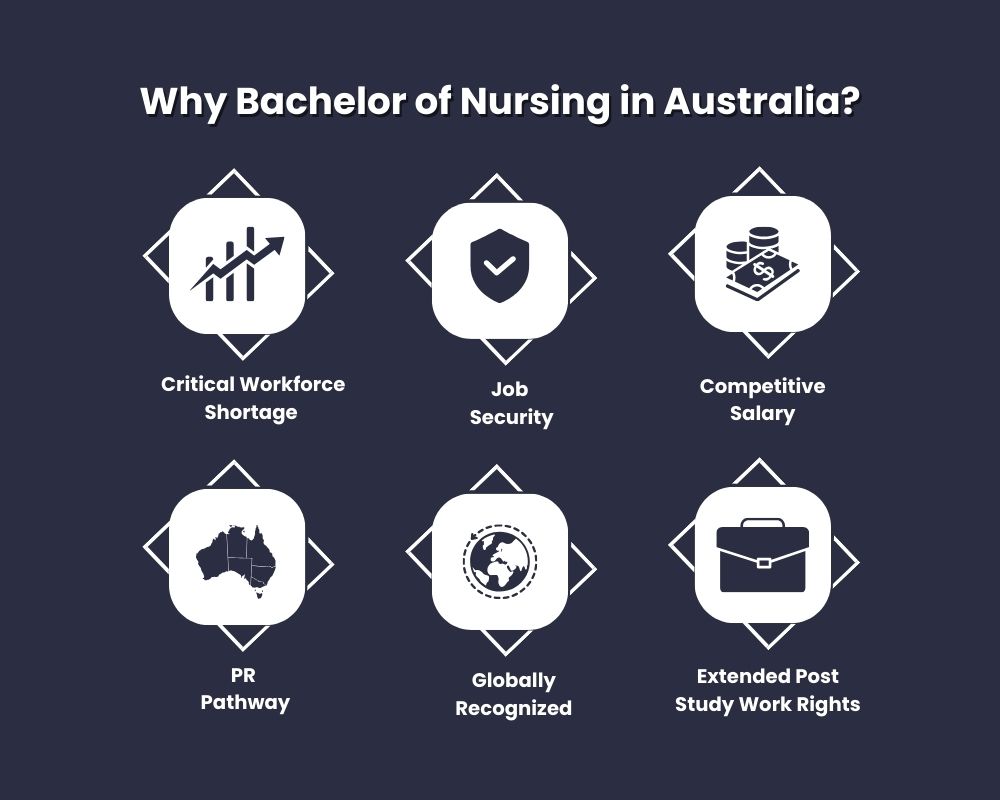
Critical Workforce Shortage
An aging population and a high rate of professional retirements are predicted to cause a shortfall of over 70,000 nurses in Australia by 2035. The need for Registered Nurses (RNs) is still “extreme” in every state, according to government data from early 2026, especially in the critical care, mental health, and elderly care sectors.
Job Security
As the demand for nursing is unmatched and the workforce is limited, almost all the graduates after a bachelor’s degree are guaranteed a job within the 4 months of graduating. Many receive employment offers before completing their last clinical rotation. Nurses are resistant to the economic swings that commonly affect industries like IT, finance, or construction because healthcare is a necessary service.
Competitive Salary & Compensations
As compared to other professions in Australia, this path typically provides a competitive salary benefit and higher compensation bonus. A newly graduated Registered Nurse (RN) will start out earning between $72,000 and $76,000 AUD in 2026, with shift penalties potentially up to $100,000 AUD.
Nurses earn massive loadings of 15% to 50% for working weekends, evenings, and afternoons alongside significant employer superannuation payments.
PR Pathway
On the MLTSSL, nursing is classified as a Priority Group 1 occupation, which means that invitations are sent out at lower points (often 75–85 points) than other occupations and visa applications are expedited. The Subclass 189, 190, and 491 visas allow nurses to get high-speed permanent residency; numerous states provide “fast-track” nominations for healthcare professionals.
Globally Recognized
An Australian nursing degree is recognized as a “global passport” for registration in the US, UK, Canada, and NZ since it has been approved by ANMAC. This ensures that your skills meet the highest international clinical standards, allowing you to enter global healthcare markets with ease.
Extended Post-Study Work Rights
A Temporary Graduate visa (Subclass 485), which normally grants two years of full employment privileges in metropolitan regions, is available to nursing bachelor’s degree graduates. You might qualify for a second graduate visa if you attend a regional campus (Category 2 or 3), allowing you to stay for an extra year or two in order to obtain the experience required for permanent residence.
Top 10 Bachelor of Nursing Universities in Australia
If you are someone who is a healthcare enthusiast and are seeking to study Bachelor of Nursing in Australia, then we have complied a list of top 10 Australian Universities that provides Bachelor of Nursing with their Unique Selling Point (USP) and their respective QS ranking.
| Rank in AU | University | Global QS Rank | Primary Locations | USP |
|---|---|---|---|---|
| 1 | University of Sydney | 14 | Sydney (Camperdown/Westmead) | Direct access to Top-Tier tertiary teaching hospitals. |
| 2 | Monash University | 21 | Melbourne (Clayton/Peninsula) | Heavy emphasis on research-led practice. |
| 3 | UTS | 24 | Sydney (City Campus) | World-class high-fidelity simulation and robotic labs. |
| 4 | University of Melbourne | 27 | Melbourne (Parkville) | Graduate with a master’s through the Melbourne Model. |
| 5 | Griffith University | 29 | Gold Coast / Brisbane | Study at Gold Coast for extra migration points. |
| 6 | QUT | 34 | Brisbane (Kelvin Grove) | Over 840+ scheduled clinical hours for students. |
| 7 | UQ | 37 | Brisbane (St Lucia) | Exclusive surgical and rehab placements at STARS. |
| 8 | Deakin University | 41 | Geelong / Melbourne | Consistently ranked #1 in Victoria for student experience. |
| 9 | ACU | 44 | North Sydney / Melbourne / Brisbane | Australia’s largest producer of graduate nursing talent. |
| 10 | La Trobe University | 44 | Melbourne / Bendigo / Albury | Extensive regional campus network for rural health focus. |
Bachelor of Nursing Cost in Australia
Before you apply for the Bachelor of Nursing in Australia, you need to know the costs which are involved though the course duration as financial planning is an essential part in deciding a course curriculum or a specific country. Therefore, here is the breakdown of the approximated related costs:
Tuition & Visa Costs
You must take financial commitment into consideration when you are planning your job or selecting a course of study. The following breakdown clearly outlines the necessary costs, including the current visa application fees and the minimum living balance required to ensure your stay in Australia.
| Expense Item | Estimated Cost (AUD) | Note |
|---|---|---|
| Annual Tuition Fee | AUD $31,000 – $45,000 | Varies by university rank and location of the universities. |
| Living Costs | AUD $29,710 | Minimum bank balance required for a student. |
| Visa Application Fee | AUD $1,600 | Subclass 500 visa fee (Base rate for 2026). |
| OSHC (Health Insurance) | AUD $600 – $850 | Mandatory annual health insurance cost for international students. |
Mandatory Clinical Costs
While tuition fees and visa costs are always discussed and kept under careful considerations, you should also be wary of the hidden charges that are included as well. Healthcare institutions have strict compliance requirements as of 2026, thus before students may enter a hospital ward, they must purchase certain equipment and obtain the necessary legal approvals.
To ensure that you are prepared for your 800+ hours of placement without any financial shocks, the accompanying table offers a reasonable budget for these required clinical charges.
| Expense Item | Estimated Cost (AUD) | Checks |
|---|---|---|
| Compliance & Clearances | AUD $400 – $700 | Police Checks, Working with Children Checks, and required Immunizations |
| Equipment & Uniforms | AUD $300 – $500 | Scrubs, clinical shoes, and stethoscope |
| Placement Travel | AUD $500 – $1,000 | Budget for transport/parking for 800 hours of unpaid hospital shifts |
Bachelor of Nursing Australia Requirements
If you are someone who is willing to pursue your career in nursing in Australia and wish to secure a seat in the Bachelor of Nursing program, then you are required to meet both academic and English requirements provided by concerned authorities. With the increase in demand of this course in Australia, various universities like ACU and QUT have enforced strict entry thresholds due to restrict unqualified candidates.
Academic Requirements
As the entry barrier for the Bachelor of Nursing program is competitive and based completely on your prior academic results, below are the prerequisites that you are required to satisfy in order to apply for this program.
| Category | Requirement | Details |
|---|---|---|
| Qualification | Year 12 / Equivalent | Completion of Australian Year 12, IB, A-Levels, or a recognized High School Diploma. |
| Selection Rank | ATAR: 65 – 85+ | Top-tier (USYD/Monash): 80+, Mid/Regional: 60 – 75. |
| English | Mandatory | Completion of Year 12 English |
| Science | Highly Recommended | Biology, Chemistry, or Physics |
| Mathematics | Recommended | Valued for clinical competency in drug dosage calculations. |
English Language Proficiency
With the recent change in 2026, the NMBA has revised its English standards. As Australia is an English native country and nursing requires you to be proficient with talking to patients, you are required to provide the English Language Proficiency test result in order to qualify for the Bachelor of Nursing program in Australia.
| Test Type | Overall Score | Listening / Reading / Speaking | Writing (New 2026 standard) |
|---|---|---|---|
| IELTS Academic | 7 | 7.0 in each | 6.5 (Reduced from 7.0) |
| PTE Academic | 66 | 66 in each | 58 (Reduced from 65) |
| OET | B (350) | B in each | C+ (300) (Reduced from B) |
| TOEFL iBT | 94 | L: 24, R: 24, S: 23 | 24 |
Clinical & Mandatory Compliance
If you want to be able to participate in the mandatory 800+ hours of clinical placement, you must provide:
- Police Checks: A National Police Check and an International Police Check (if you have lived outside Australia for 6+ months as an adult).
- Working with Children Check (WWCC): Known as a “Blue Card” in QLD or “Working with Vulnerable People” (WWVP) in other states.
- NDIS Worker Screening: Required for placements in disability sectors.
- Immunization Evidence: Verification of immunity/vaccination for:
- Hepatitis B
- MMR (Measles, Mumps, Rubella)
- Varicella (Chickenpox)
- dTpa (Diphtheria, Tetanus, Pertussis)
- Influenza & COVID-19: (Latest boosters often required by hospitals).
International Student Requirements (Visa Subclass 500)
If you are an international student that is trying to apply for the student Visa 500 then you are required to satisfy the requirements provided by the Department of Home Affairs (DHA):
- Genuine Student (GS) Requirement
- Financial Capacity
- Overseas Student Health Cover (OSHC)
PR Pathway with Bachelor of Nursing
As of 2026, the most reliable route to Permanent Residency (PR) in Australia is a Bachelor of Nursing. As a highly demanded occupation in Australia, and a priority group 1 occupation nursing still remains as a path that is highly preferred by international students. Registered Nurses are listed on the Medium and Long-term Strategic Skills List (MLTSSL) which basically means that they benefit from faster processing and lower invitation thresholds than almost any other profession.
With the Bachelor of Nursing in Australia, your journey from a student to Permanent Resident in Australia follows these strict rules which are required to be mandatorily fulfilled:
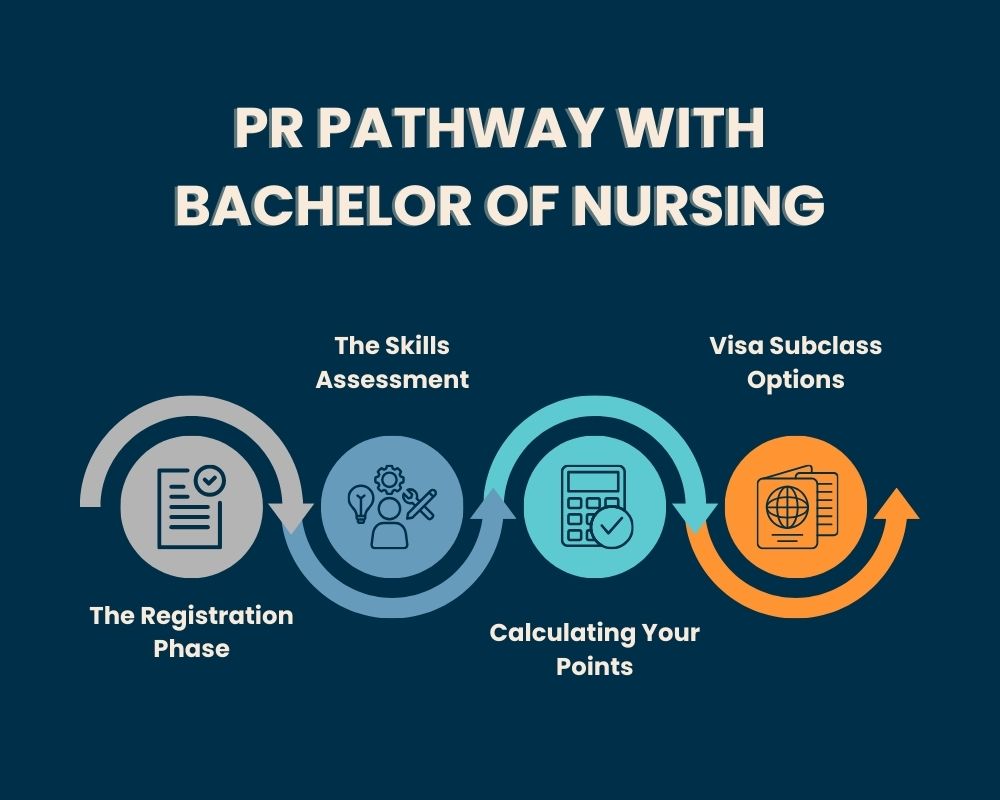
Step 1: The Registration Phase
The first step in the PR Pathway with Nursing is the registration phase. Before you apply for a PR in Australia, you are required to be legally allowed to practice. For this phase to come into effect, you need to obtain registration with the NMBA via AHPRA where AHPRA will verify your minimum clinical hours of 800 and verify your identity. In this step, you are mandated to complete your Bachelor of Nursing and meet the English Proficiency requirement of IELTS 7.0 in all bands or equivalent scores of other English proficiency test approved by the DHA.
Step 2: The Skills Assessment
After you have been successfully registered with AHPRA, you need to prove the concerned authority ANMAC of migration officers that your skills are on par with the Australian Standards. If you have completed your graduation in Australia, you are a qualified candidate for a Modified Skills Assessment which is rather faster and cheaper than a full assessment. At the end of this phase, you will receive a “Positive Skills Assessment” letter that is necessary for applying PR in Australia.
Step 3: Calculating Your Points
After you have received a positive Skills Assessment letter, you are now required to calculate your points so that you can claim these points for achieving PR in Australia. Australia uses a points-based system used for skilled migration. If you want to be invited, then you are required to be able to claim 65-85 points depending on the table below:
| Points Criteria | Potential Points |
|---|---|
| Age (25–32) | 30 Points |
| Bachelor of Nursing Degree | 15 Points |
| English (PTE 79+ / IELTS 8.0) | 20 Points |
| Australian Study (2 Years) | 5 Points |
| Regional Study Bonus | 5 Points (If studied outside Syd/Mel/Bri) |
| State Nomination (Subclass 190) | 5 Points |
| Regional Nomination (Subclass 491) | 15 Points |
Step 4: Visa Subclass Options
After you have claimed your points in the above table, you are now required to choose from the following visa subclass after you have lodged an Expression of Interest (EOI) via SkillSelect:
| Subclass | PR Status | Points Required | USP |
|---|---|---|---|
| Subclass 189 | Permanent | 75-80 points | Total Freedom |
| Subclass 190 | Permanent | 70-85 points | State Support |
| Subclass 491 | Provisional | 65-75 points | Points Booster |
FAQs

If you are trying to apply for a PR in Australia, most skilled migration pathways like Subclasses 189, 190 and 491 have an age limit of under 45 at the time you receive your invitation to apply for the visa. However, the nursing stream has a slight variation in that, provided certain exemptions of high income or regional health shortages are met, the applicant may be considered for the PR program through the Subclass 186 Employer Sponsored Paths, provided they are above 45 years of age.
Yes. With 2026 in place, overseas students studying in Australia will be allowed to work as many as 48 hours every two weeks during the academic year and as much as they like during the scheduled semester breaks.
It is also common for students to work as personal care workers or assistants in nursing (AIN) during or after their first year in nursing school. In addition to offering priceless clinical experience, this frequently results in a graduate employment offer before you have even completed your degree.
- A three-year Bachelor of Nursing degree is necessary to become a Registered Nurse (RN). RNs are capable of managing units, doing complicated jobs, and giving out all prescriptions. They have more PR points and a higher wage floor (about $76,000+).
- A 1.5–2-year nursing diploma is required to become an enrolled nurse (EN), who works under an RN’s supervision. Compared to registered nurses, their PR paths are more limited to regional locations, despite their great demand.
The average base pay for a first-year Grade 1 Registered Nurse in 2026 is between $72,000 and $78,000. However, the majority of graduating nurses earn between $85,000 and $92,000 a year due to required “shift loadings” (additional compensation for afternoons, nights, and weekends).

Even though nursing is a popular field with high-demanding occupations in Australia, completing the ANMAC skills testing and AHPRA registration might be difficult. We at BJay Education & Visa Services offer healthcare students specific assistance to help you with your Bachelor in Nursing.
Why BJay?
Global Presence: with offices in Kathmandu, birtamode and Sydney, BJay education and Visa Services provides you services that is uninterrupted and available for you at your convenience.
Proven Track Record: Since 2011, we have assisted more than 10,000 clients from more than 20 nations in obtaining Australian visas and enrolling in prestigious universities.
Decade long Experience: BJay Education and Visa Services has been in this field for over 13 years of services providing help to numerous clients around various countries of the world.
Registered & Regulated: We comply with the stringent code of conduct. Jaya Oli, our head agent, has firsthand knowledge of your path because he was an international student in Australia.
Result-Oriented Specialization: We specialize exclusively in Australian education and migration. We help you choose the right course (like Nursing) and the right location (like Regional Perth) to maximize your PR points from day one.
Do you have any questions on Bachelor of Nursing in Australia? Get a free Consultation with BJay Education & Visa Services!