

Course Change in Australia is a hot topic that has been discussed in 2026. It is a complex matter that requires a high level of planning and execution to ensure that your course change in Australia is valid and within the Australia course change rules. Whether you have realized that your current course or institute doesn’t aligns with your goals or have better alternatives, course change in Australia requires you to adhere strictly to the regulations and National Code provided by the Department of Home Affairs (DHA).
With more than 13 years of experience in providing education and Visa Services, BJay Education & Visa Services have helped numerous clients in their migration journey. With the 2026 migration scene of Australia becoming more and more scrutinized, BJay Education has meticulously drafted this article on Course Change in Australia to help you along the way.
Course Change in Australia Updates in 2026
With major changes in the current migration scenes of Australia, one of the most frequent questions that is there is “Can international students in Australia cannot change courses under new law?” To clarify this question, there is not a certain restriction on course change in Australia for international students, but the Australian government has recently introduced structural changes on January 1,2026 to prevent visa violations.
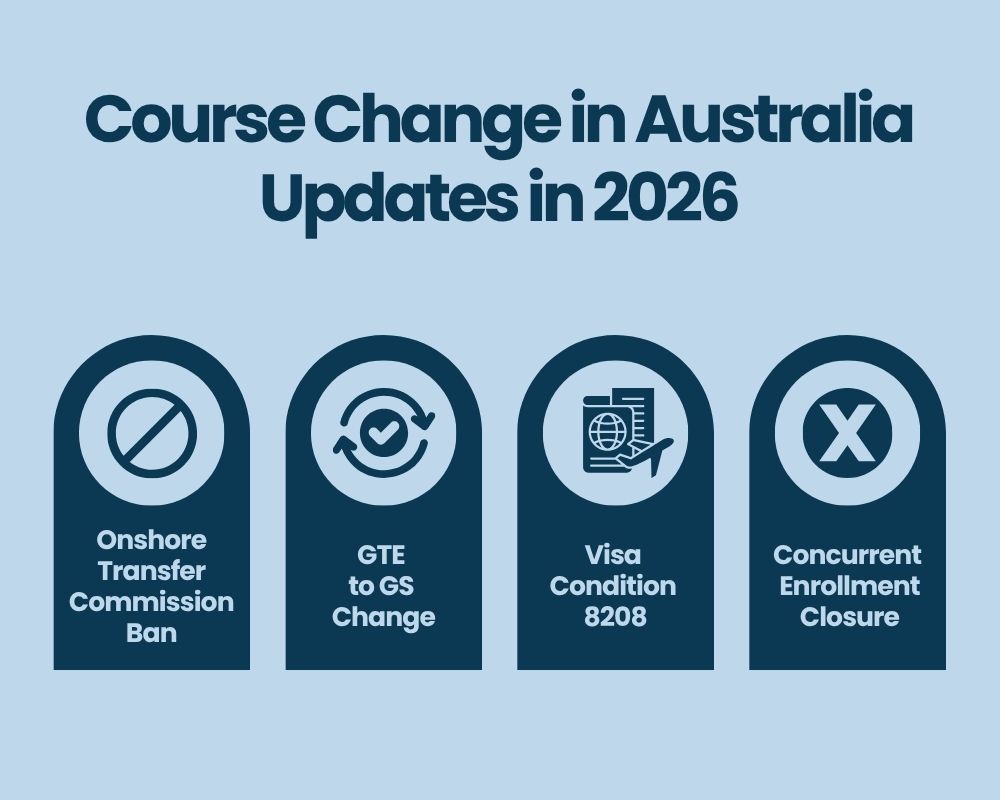
The Onshore Transfer Commission Ban
According to the new law implemented by the Australian government on course change in Australia, it specifically targets the financial incentives behind the course switching. As per the recent change, education agents are not allowed to receive commissions for the purpose of transferring students who haven’t completed their first 6 months of their principal course. With the introduction of this law, it now ensures that you as a student are now making a decision of Course change in Australia based on cheaper provider but making the choice as per your academic needs.
GTE to GS Change
With the recent transition from the Genuine Temporary Entrant (GTE) to Genuine Student (GS) requirement now being fully implemented in 2026, the DHA now uses a traffic light priority system for student visa programs. In case you decide to Course Change in Australia that moves you from a Level 1 University of Australia to a Level 3 University without proper and logical reasoning, your GS is questioned and flagged for integrity purpose.
Visa Condition 8208
According to this condition provided by the DHA, if you are someone who is a postgraduate student or a research student then in 2026, you are not allowed to change your course, thesis or research topic if it has anything to do with “Critical Technology” which includes fields like AI, robotics, or advanced biotechnology. You are allowed to Apply for course change in Australia only with a written approval from the Minister.
Concurrent Enrollment Closure
Before the law had been fully implemented, the students used “Concurrent Enrollment” to study cheaper vocational courses while still being enrolled in a university degree. With the implementation of the ESOS amendments in 2026, this loophole has been ceased. Hence, as a result you are no longer allowed to use concurrent enrollment to bypass the 6-month rule.
Eligibility Criteria for Institute and Course Change in Australia
As 2026 marks its start, navigating the process of course change in Australia or moving to a different institution requires you to satisfy certain eligibility criteria that are set by the DHA and the National Code 2018. To make sure that your transfer is genuine and not an attempt to exploit the loopholes, the eligibility criteria for the Course Change in Australia has been listed below:
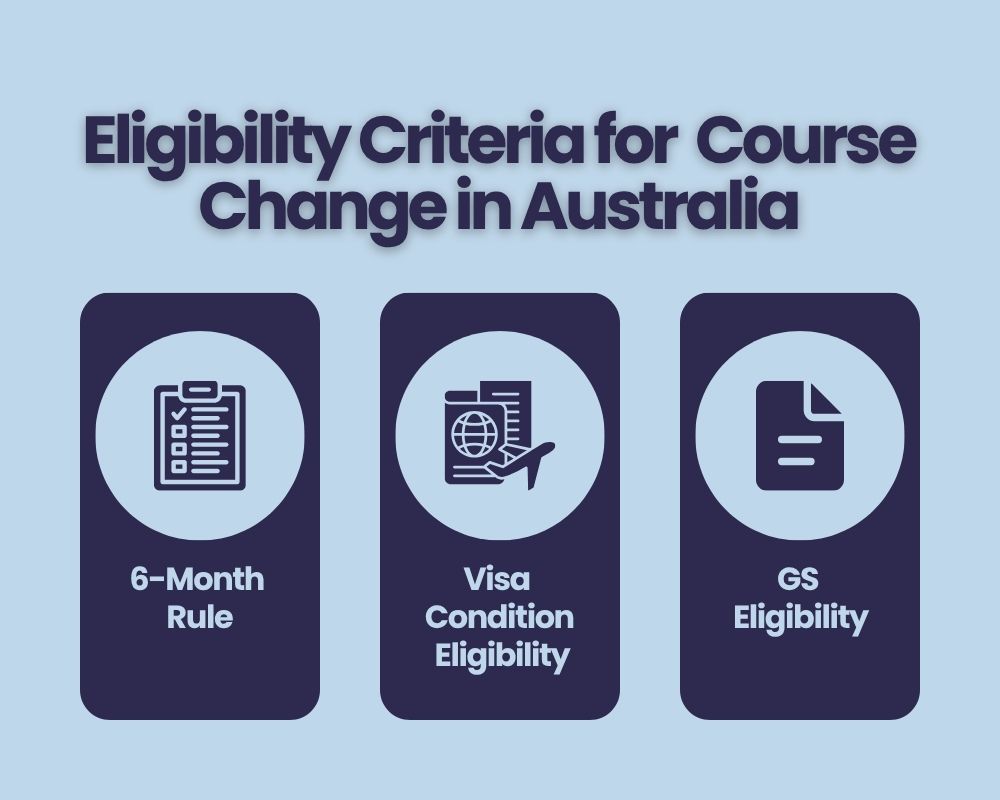
6-Month Rule
If you want to switch your institution or Course to a new one, then your status is basically defined by how long you have been enrolled in the given principal course.
In case you are enrolled in a specific course for more than 6 months then you are automatically eligible to Course Change in Australia or Institute change as well. In this case, you don’t need a Release Letter from your current school and simply require a new Letter of Offer and a new CoE.
Another case scenario where you have not completed the 6-month enrollment requirement, you will not be automatically eligible for the transition and are required to meet certain requirements or criteria to receive a Letter of Release. For the Letter of Release, you need evidence that shows that the course or institution is not the best choice for your career path.
Visa Condition Eligibility
During a Course Change in Australia, you must adhere to certain grant conditions and maintain your visa eligibility.
Condition 8202: This condition is all about academic progress. In order to be eligible for a Course Change in Australia, you need to be academically sound. You need to make sure that factors like attendance and progress reports are not hampered. In case that you are currently being reported for not having a good attendance record or being reported for failing, you may not be eligible to transfer until that matter has been resolved.
Condition 8208: This condition puts emphasis on the critical technology sector of Australia. If you are a postgraduate or a research student, then you are typically not eligible to change course in Australia without the written approval of the Ministerial department.
AQF Level: In case that you move to a course at the same or higher AQF level then you are eligible to stay on the same visa but if you are moving to a lower level (e.g. Masters to Diploma) then you are not able to hold your current visa and are required to apply for a new visa.
GS Eligibility
With the change of the GTE replacing the GS requirement, being eligible for visa programs is not just about the rules but about your intentions behind your Course Change in Australia. Your eligibility to change courses or institution depends on the following:
- Does your new course align with your previous studies?
- Is the Course Change in Australia necessary for your future in your profession?
- Do you have sufficient funds (AUD $29,710 for living plus tuition) to support the entirety of the new course duration.
| Change Type | Eligibility Requirement | New Visa Needed? |
|---|---|---|
| Same Provider / Same Level | Meet entry requirements for the new course. | No |
| New Provider / > 6 Months | Active CoE from new provider. | No |
| New Provider / < 6 Months | Letter of Release + New CoE. | No |
| Lower AQF Level | Proof of "Academic Difficulty" or Career Change. | Yes ($2,000 fee) |
| Critical Tech Course | Ministerial Approval (Condition 8208). | Likely |
Step-by-Step Process to Change Your Course and Institution
If are looking for a Course Change in Australia or Institution, you need to know that it is a multi-layered process which include various legal complexities. In order to flag inconsistencies in your application, DHA has currently integrated an AI-driven system. To ensure that your transition is compliant with the eligibility requirements follow the given steps with precision.
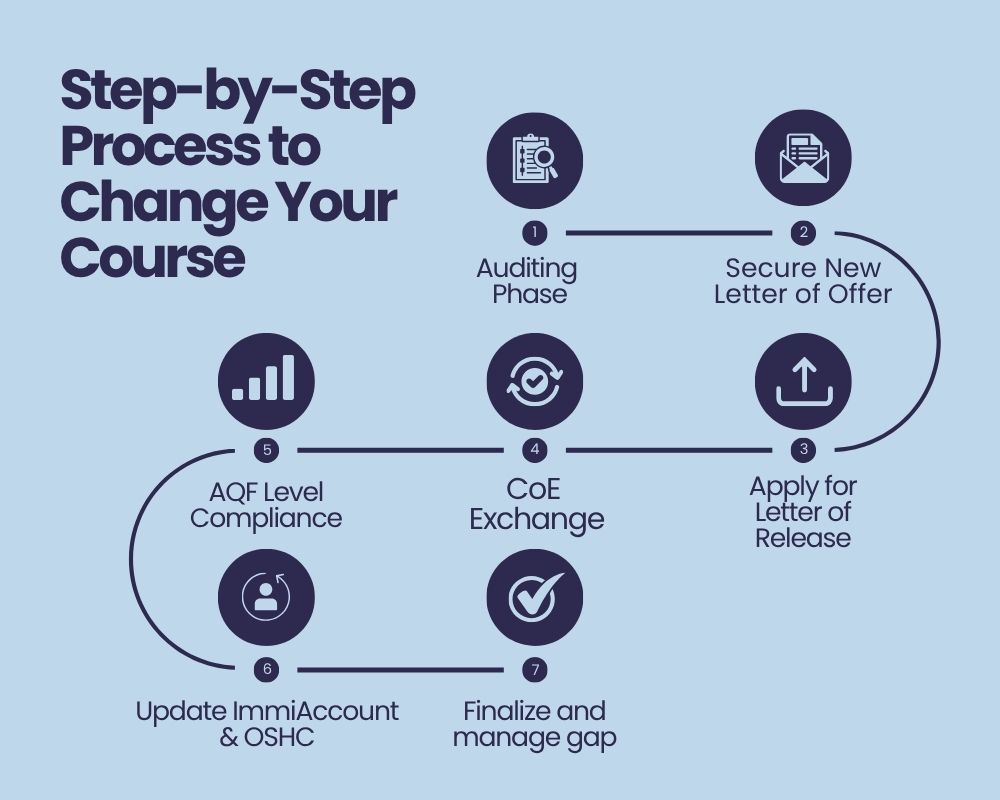
Step 1: Auditing
Before you start your application, make sure to audit your current scenario and make sure that you are not in the “restricted period”. Under the standard 7 of the National code, you are not eligible for Course Change in Australia until you have completed 6 months of your principal course.
Step 2: Secure a New Letter of Offer
You generally cannot apply for a transfer or release without having a destination in sight. In order to apply for Course Change in Australia, you need to first apply to your new Institution and once you have successfully met the academic and English Requirement, they will then issue a Letter of Offer.
Step 3: Apply for a Formal Letter of Release (if applicable)
If you are transitioning to a new course before you have completed the 6 months milestone in your current course, then you are required to submit a written request to your current provider requesting for release. In order to secure this, you are required to provide your new Letter of Offer and a statement of Circumstances why you want to apply for the Course Change in Australia. under the current ESOS Standards in 2026, providers are required to respond to it within 10 working days.
Step 4: The CoE Exchange
Once you have secured your letter of release or have completed the 6-month mark in your principal course, you can now officially accept your new offer and transition to a new course or institution. After paying the required tuition fees and deposits, the new institution will then issue a new eCoE.
Step 5: AQF Level Compliance & New Visa Assessment
If you are looking for Course Change in Australia, then this step is an essential step in your visa safety. You are required to check the AQF level of your new course.
If you are someone who is changing course from Level 10 to Level 9 it generally doesn’t require you to apply for a new visa program.
Incase, you are lowering you AQF level too much like master’s degree (Level 9) to Diploma (Level 5) then you are required to apply for a new Student Visa Subclass 500 and are required to pay the AUD $2,000 fee.
Step 6: Update ImmiAccount & OSHC
In this step, you are now required to update your ImmiAccount portal and your Health Insurance. You then need to log in to your ImmiAccount portal and upload your new CoE with your current visa application records so that the DHA data doesn’t have any deviations. Another requirement that needs to be fulfilled is to make sure that your OSHC is extended or adjusted to match the end date of your new course.
Step 7: Finalize Withdrawal and Manage the Gap
Make sure to formally withdraw from the old course and make sure that you aren’t marked as “Absent” in the previous course. Additionally, make sure that your new course starts within the 8 weeks of your old course ending as more gaps can trigger for a Notice of Intention to Consider Cancellation (NOICC) from the DHA.
Common Pitfalls and Solutions to Course Change in Australia
As of March 2026, navigating through a Course Change in Australia or transition to a new institution requires utmost precision to help you avoid your visa conditions being breached. Due to the DHA now enforcing stricter rules and compliance checks via the PRISMS system, even making a small mistake can be a risky move.
Hence, the pitfalls that are commonly seen in a Course Change in Australia is given below with their solutions.
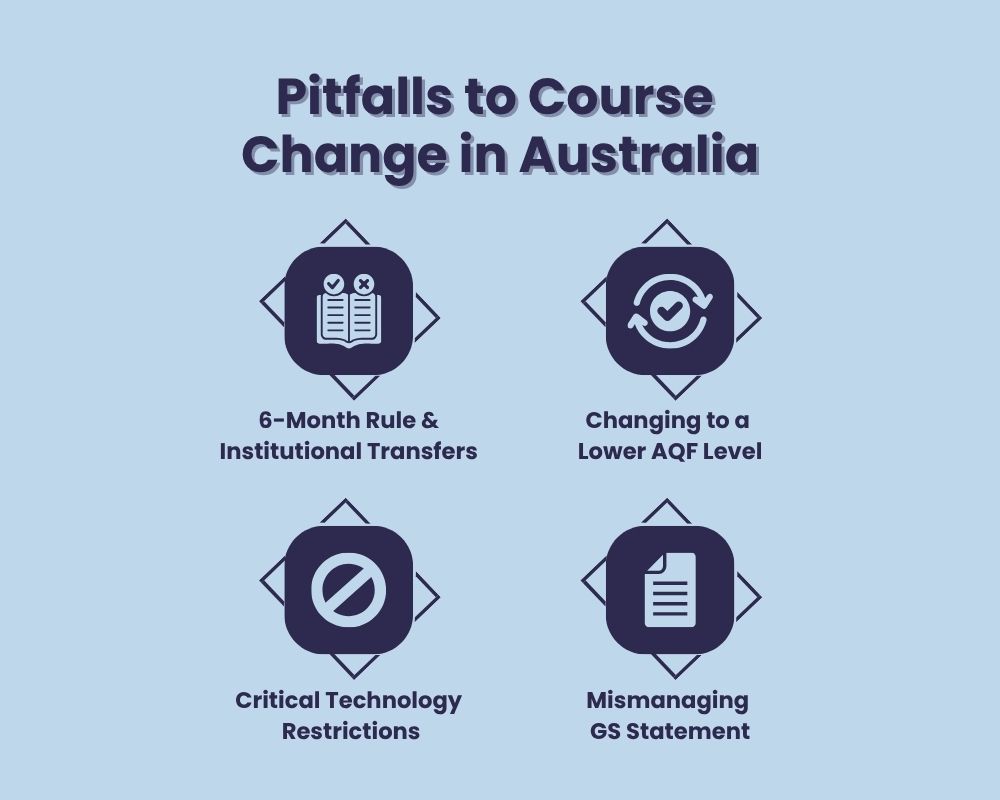
6-Month Rule and Institutional Transfers
Pitfall: In case you are trying to switch your course or an educational provider before you complete the first six months of your principal course without a formal release letter then it may be a huge pitfall. Many students tend to think that just by getting a new Letter of Offer, they are eligible to leave their current school and transition to a new one.
Solution: Under Standard 7 of the National Code 2018, you are required to obtain a Letter of Release from your current provider if you have not completed the 6 months duration in your principal course.
Changing to a Lower AQF Level
Pitfall: Moving from a higher-level qualification to a lower-level vocational course (moving from master’s degree to Diploma) without applying for a new visa program. As per Visa Condition 8202, you are required to maintain enrollment on a course at the same or higher AQF level for which your visa was granted.
Solution: In case you downgrade your studies from higher to lower then you are required to lodge a new student visa subclass 500 application and pay the fees of AUD $2,000 as of March 2026.
Critical Technology Restrictions
Pitfall: As of 2026, you are not allowed to switch course or research topics if you are a postgraduate or research student in a Critical Technology field like AI, Robotics without receiving consent from the government.
Solution: Under the Visa Condition 8208, you are required to obtain a written approval from the Authorities concerned before you commence a change with these fields.
Mismanaging the GS Statement
Pitfall: While you write a GS Statement for the Course Change in Australia, citing keywords like “cheaper tuition” or “easier PR pathway” as reasons for a course change in Australia can be a factor that could be flagged by the DHA.
Solution: As the new GS requirement is strictly academic, you must have your primary focus on academic logic and how the course better aligns with your current goals instead of mentioning keywords that may harm your GS statement.
FAQs
Yes, you are eligible for Course Change in Australia within the first 6 months but under the standard 7 of the National Code, you are not eligible to switch without a formal Letter of Release from you current Education Provider.
Yes. If you want to Change Course in Australia while you are on a Bridging Visa then it is possible but has a high-risk factor with the recent changes in the migration scenes of Australia. As a bridging visa is a temporary bridge between two visa programs, your eligibility depends on the visa conditions that you are holding and the visa you are applying for.
The answer to this question basically depends on the AQF level of your current course and the new course that you are applying for.
Incase you are applying for a same or higher AQF level then you generally don’t need to apply for a new visa program and continue with the current visa if it hasn’t expired.
However, if you are applying for a lower AQF level then you need to apply for a new Student Visa subclass 500 and pay the AUD $2,100 fee.
You must continue to enroll on a registered course in accordance with Visa Condition 8202. A break of more than two months between classes, outside of regular holidays, is seen as a violation of your visa. The DHA will utilize automated monitoring in 2026 to identify these gaps, so it’s critical that your commencement and withdrawal dates line up precisely.

Why BJay?
Proven Expertise: With 13 years of experience in Visa services in Australia, we here at BJay Education & Visa Services have been providing tailored services to help you navigate through the complex migration scenes of Australia.
Expertise Team: Led by Mr. Jay Oli (MARN: 1570827), we have an exceptional team that is there to solve any queries and help you with your application. The team is well trained to provide the services that you may require assistance with.
Global Presence & Local Support: With offices present in multiple locations throughout Nepal (Putalisadak and Birtamode) and a head office in Sydney, BJay provides you with seamless support you may require whether you are in your home country or already in the turf of Australia.
End-to-End Career Support: We here at BJay provide you with the service that ranges from the starting of your career as a Chef in Australia to your final Permanent Residency (PR) Grant making sure no obstacles cause your application to be rejected.
AQF & Visa Mapping: We here at BJay provide expert help on your transition from a course to another and help you with your AQF and Visa Mapping.
Don’t let a mistake in Course Change in Australia destroy your Australian Dream? Book a Free Consultation with BJay!
Course Change in Australia is a hot topic that has been discussed in 2026. It is a complex matter that requires a high level of planning and execution to ensure that your course change in Australia is valid and within the Australia course change rules. Whether you have realized that your current course or institute doesn’t aligns with your goals or have better alternatives, course change in Australia requires you to adhere strictly to the regulations and National Code provided by the Department of Home Affairs (DHA).
With more than 13 years of experience in providing education and Visa Services, BJay Education & Visa Services have helped numerous clients in their migration journey. With the 2026 migration scene of Australia becoming more and more scrutinized, BJay Education has meticulously drafted this article on Course Change in Australia to help you along the way.
Course Change in Australia Updates in 2026
With major changes in the current migration scenes of Australia, one of the most frequent questions that is there is “Can international students in Australia cannot change courses under new law?” To clarify this question, there is not a certain restriction on course change in Australia for international students, but the Australian government has recently introduced structural changes on January 1,2026 to prevent visa violations.
The Onshore Transfer Commission Ban
According to the new law implemented by the Australian government on course change in Australia, it specifically targets the financial incentives behind the course switching. As per the recent change, education agents are not allowed to receive commissions for the purpose of transferring students who haven’t completed their first 6 months of their principal course. With the introduction of this law, it now ensures that you as a student are now making a decision of Course change in Australia based on cheaper provider but making the choice as per your academic needs.
GTE to GS Change
With the recent transition from the Genuine Temporary Entrant (GTE) to Genuine Student (GS) requirement now being fully implemented in 2026, the DHA now uses a traffic light priority system for student visa programs. In case you decide to Course Change in Australia that moves you from a Level 1 University of Australia to a Level 3 University without proper and logical reasoning, your GS is questioned and flagged for integrity purpose.
Visa Condition 8208
According to this condition provided by the DHA, if you are someone who is a postgraduate student or a research student then in 2026, you are not allowed to change your course, thesis or research topic if it has anything to do with “Critical Technology” which includes fields like AI, robotics, or advanced biotechnology. You are allowed to Apply for course change in Australia only with a written approval from the Minister.
Concurrent Enrollment Closure
Before the law had been fully implemented, the students used “Concurrent Enrollment” to study cheaper vocational courses while still being enrolled in a university degree. With the implementation of the ESOS amendments in 2026, this loophole has been ceased. Hence, as a result you are no longer allowed to use concurrent enrollment to bypass the 6-month rule.
Eligibility Criteria for Institute and Course Change in Australia
As 2026 marks its start, navigating the process of course change in Australia or moving to a different institution requires you to satisfy certain eligibility criteria that are set by the DHA and the National Code 2018. To make sure that your transfer is genuine and not an attempt to exploit the loopholes, the eligibility criteria for the Course Change in Australia has been listed below:
6-Month Rule
If you want to switch your institution or Course to a new one, then your status is basically defined by how long you have been enrolled in the given principal course.
In case you are enrolled in a specific course for more than 6 months then you are automatically eligible to Course Change in Australia or Institute change as well. In this case, you don’t need a Release Letter from your current school and simply require a new Letter of Offer and a new CoE.
Another case scenario where you have not completed the 6-month enrollment requirement, you will not be automatically eligible for the transition and are required to meet certain requirements or criteria to receive a Letter of Release. For the Letter of Release, you need evidence that shows that the course or institution is not the best choice for your career path.
Visa Condition Eligibility
During a Course Change in Australia, you must adhere to certain grant conditions and maintain your visa eligibility.
Condition 8202: This condition is all about academic progress. In order to be eligible for a Course Change in Australia, you need to be academically sound. You need to make sure that factors like attendance and progress reports are not hampered. In case that you are currently being reported for not having a good attendance record or being reported for failing, you may not be eligible to transfer until that matter has been resolved.
Condition 8208: This condition puts emphasis on the critical technology sector of Australia. If you are a postgraduate or a research student, then you are typically not eligible to change course in Australia without the written approval of the Ministerial department.
AQF Level: In case that you move to a course at the same or higher AQF level then you are eligible to stay on the same visa but if you are moving to a lower level (e.g. Masters to Diploma) then you are not able to hold your current visa and are required to apply for a new visa.
GS Eligibility
With the change of the GTE replacing the GS requirement, being eligible for visa programs is not just about the rules but about your intentions behind your Course Change in Australia. Your eligibility to change courses or institution depends on the following:
- Does your new course align with your previous studies?
- Is the Course Change in Australia necessary for your future in your profession?
- Do you have sufficient funds (AUD $29,710 for living plus tuition) to support the entirety of the new course duration.
| Change Type | Eligibility Requirement | New Visa Needed? |
|---|---|---|
| Same Provider / Same Level | Meet entry requirements for the new course. | No |
| New Provider / > 6 Months | Active CoE from new provider. | No |
| New Provider / < 6 Months | Letter of Release + New CoE. | No |
| Lower AQF Level | Proof of "Academic Difficulty" or Career Change. | Yes ($2,000 fee) |
| Critical Tech Course | Ministerial Approval (Condition 8208). | Likely |
Step-by-Step Process to Change Your Course and Institution
If are looking for a Course Change in Australia or Institution, you need to know that it is a multi-layered process which include various legal complexities. In order to flag inconsistencies in your application, DHA has currently integrated an AI-driven system. To ensure that your transition is compliant with the eligibility requirements follow the given steps with precision.
Step 1: Auditing
Before you start your application, make sure to audit your current scenario and make sure that you are not in the “restricted period”. Under the standard 7 of the National code, you are not eligible for Course Change in Australia until you have completed 6 months of your principal course.
Step 2: Secure a New Letter of Offer
You generally cannot apply for a transfer or release without having a destination in sight. In order to apply for Course Change in Australia, you need to first apply to your new Institution and once you have successfully met the academic and English Requirement, they will then issue a Letter of Offer.
Step 3: Apply for a Formal Letter of Release (if applicable)
If you are transitioning to a new course before you have completed the 6 months milestone in your current course, then you are required to submit a written request to your current provider requesting for release. In order to secure this, you are required to provide your new Letter of Offer and a statement of Circumstances why you want to apply for the Course Change in Australia. under the current ESOS Standards in 2026, providers are required to respond to it within 10 working days.
Step 4: The CoE Exchange
Once you have secured your letter of release or have completed the 6-month mark in your principal course, you can now officially accept your new offer and transition to a new course or institution. After paying the required tuition fees and deposits, the new institution will then issue a new eCoE.
Step 5: AQF Level Compliance & New Visa Assessment
If you are looking for Course Change in Australia, then this step is an essential step in your visa safety. You are required to check the AQF level of your new course.
If you are someone who is changing course from Level 10 to Level 9 it generally doesn’t require you to apply for a new visa program.
Incase, you are lowering you AQF level too much like master’s degree (Level 9) to Diploma (Level 5) then you are required to apply for a new Student Visa Subclass 500 and are required to pay the AUD $2,000 fee.
Step 6: Update ImmiAccount & OSHC
In this step, you are now required to update your ImmiAccount portal and your Health Insurance. You then need to log in to your ImmiAccount portal and upload your new CoE with your current visa application records so that the DHA data doesn’t have any deviations. Another requirement that needs to be fulfilled is to make sure that your OSHC is extended or adjusted to match the end date of your new course.
Step 7: Finalize Withdrawal and Manage the Gap
Make sure to formally withdraw from the old course and make sure that you aren’t marked as “Absent” in the previous course. Additionally, make sure that your new course starts within the 8 weeks of your old course ending as more gaps can trigger for a Notice of Intention to Consider Cancellation (NOICC) from the DHA.
Common Pitfalls and Solutions to Course Change in Australia
As of March 2026, navigating through a Course Change in Australia or transition to a new institution requires utmost precision to help you avoid your visa conditions being breached. Due to the DHA now enforcing stricter rules and compliance checks via the PRISMS system, even making a small mistake can be a risky move.
Hence, the pitfalls that are commonly seen in a Course Change in Australia is given below with their solutions.
6-Month Rule and Institutional Transfers
Pitfall: In case you are trying to switch your course or an educational provider before you complete the first six months of your principal course without a formal release letter then it may be a huge pitfall. Many students tend to think that just by getting a new Letter of Offer, they are eligible to leave their current school and transition to a new one.
Solution: Under Standard 7 of the National Code 2018, you are required to obtain a Letter of Release from your current provider if you have not completed the 6 months duration in your principal course.
Changing to a Lower AQF Level
Pitfall: Moving from a higher-level qualification to a lower-level vocational course (moving from master’s degree to Diploma) without applying for a new visa program. As per Visa Condition 8202, you are required to maintain enrollment on a course at the same or higher AQF level for which your visa was granted.
Solution: In case you downgrade your studies from higher to lower then you are required to lodge a new student visa subclass 500 application and pay the fees of AUD $2,000 as of March 2026.
Critical Technology Restrictions
Pitfall: As of 2026, you are not allowed to switch course or research topics if you are a postgraduate or research student in a Critical Technology field like AI, Robotics without receiving consent from the government.
Solution: Under the Visa Condition 8208, you are required to obtain a written approval from the Authorities concerned before you commence a change with these fields.
Mismanaging the GS Statement
Pitfall: While you write a GS Statement for the Course Change in Australia, citing keywords like “cheaper tuition” or “easier PR pathway” as reasons for a course change in Australia can be a factor that could be flagged by the DHA.
Solution: As the new GS requirement is strictly academic, you must have your primary focus on academic logic and how the course better aligns with your current goals instead of mentioning keywords that may harm your GS statement.
FAQs
Yes, you are eligible for Course Change in Australia within the first 6 months but under the standard 7 of the National Code, you are not eligible to switch without a formal Letter of Release from you current Education Provider.
Yes. If you want to Change Course in Australia while you are on a Bridging Visa then it is possible but has a high-risk factor with the recent changes in the migration scenes of Australia. As a bridging visa is a temporary bridge between two visa programs, your eligibility depends on the visa conditions that you are holding and the visa you are applying for.
The answer to this question basically depends on the AQF level of your current course and the new course that you are applying for.
Incase you are applying for a same or higher AQF level then you generally don’t need to apply for a new visa program and continue with the current visa if it hasn’t expired.
However, if you are applying for a lower AQF level then you need to apply for a new Student Visa subclass 500 and pay the AUD $2,100 fee.
You must continue to enroll on a registered course in accordance with Visa Condition 8202. A break of more than two months between classes, outside of regular holidays, is seen as a violation of your visa. The DHA will utilize automated monitoring in 2026 to identify these gaps, so it’s critical that your commencement and withdrawal dates line up precisely.
Why BJay?
Proven Expertise: With 13 years of experience in Visa services in Australia, we here at BJay Education & Visa Services have been providing tailored services to help you navigate through the complex migration scenes of Australia.
Expertise Team: Led by Mr. Jay Oli (MARN: 1570827), we have an exceptional team that is there to solve any queries and help you with your application. The team is well trained to provide the services that you may require assistance with.
Global Presence & Local Support: With offices present in multiple locations throughout Nepal (Putalisadak and Birtamode) and a head office in Sydney, BJay provides you with seamless support you may require whether you are in your home country or already in the turf of Australia.
End-to-End Career Support: We here at BJay provide you with the service that ranges from the starting of your career as a Chef in Australia to your final Permanent Residency (PR) Grant making sure no obstacles cause your application to be rejected.
AQF & Visa Mapping: We here at BJay provide expert help on your transition from a course to another and help you with your AQF and Visa Mapping.
Don’t let a mistake in Course Change in Australia destroy your Australian Dream? Book a Free Consultation with BJay!