
Commercial Cookery in 2026 is still regarded as the powerhouse for international students who are seeking for a stable pathway which has high growth and leads to Permanent Residency (PR) in Australia. As the hospitality industry in Australia always faces a critical shortage of qualified cookery graduates, the government of Australia has introduced a Chef position (ANZSCO 351311) which is available on the Medium and Long-term Strategic Skills List (MLTSSL).
With more than 13 years of experience in visa services, BJay Education & Visa Services has meticulously drafted this guide on Commercial Cookery Australia which gives you a deeper dive into every part of this trade course. To ensure that you get the latest and correct data, we have drafted this guide with the data provided by the Department of Home Affairs (DHA) and Trades Recognition Australia (TRA).
Commercial Cookery
With the fast-paced and regulated environment of Australia, Commercial Cookery is a vocational qualification under the Trade course in Australia is a course which teaches you large-scale food production, menu planning, and kitchen operations under the standard that are set by the Australian government. In a general term “Cooking” refers to the art of preparing food whereas the term commercial cookery refers to skills that is required to operate within the hospitality sector, including restaurants, lodging facilities, medical facilities, and catering businesses.
Why Commercial Cookery?
If you are confused about whether you should pursue Commercial Cookery in 2026, you need to understand that it is a trade course of Australia which has a high-demand and also includes creative passion for cookery. As this course curriculum has become more and more popular you should know about this course well.
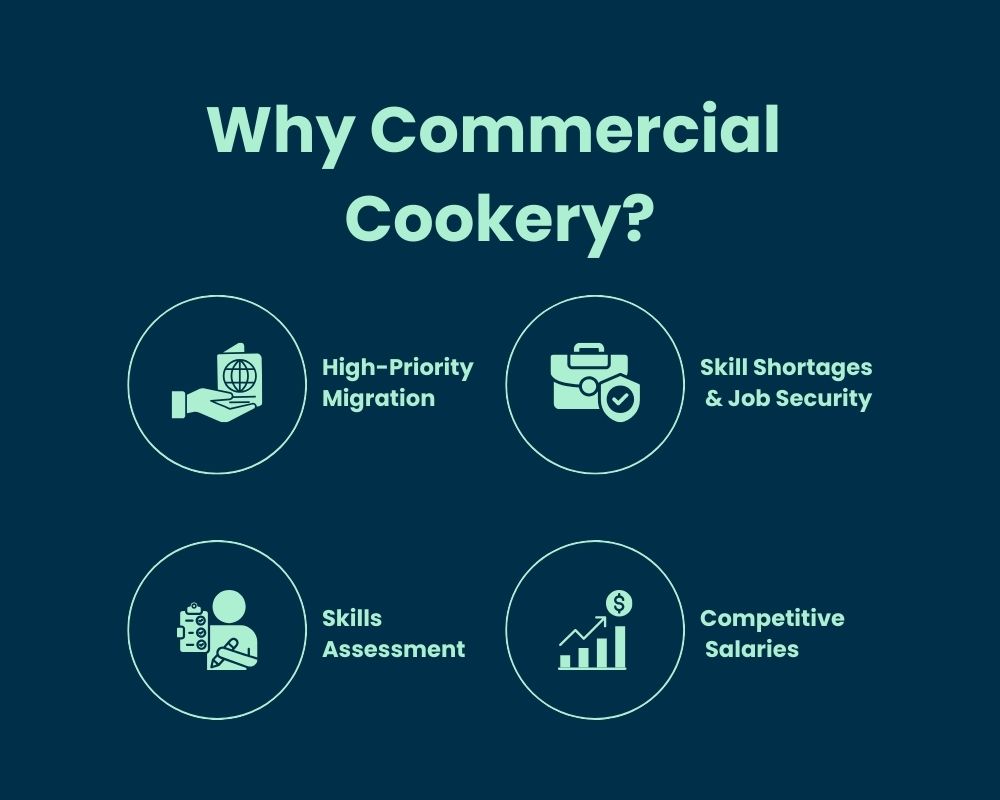
A High-Priority Migration Pathway
One of the reasons that individuals choose Commercial cookery in Australia is that this trade course is available on the MTSSL list provided by the Australian government. While many occupations are removed or moved to the short-term list, the role of Chef under this course with ANZSCO code 351311 remains as an essential course in the Australian economy. Due to the high demand for this course, applicants often receive invitations for Subclass 190 and 491 with more competitive visa points available as compared to other visa programs.
Critical Skill Shortages & Job Security
As the Australian hospitality industry has been facing a critical shortage of skilled migrants, the commercial cookery course under trade courses in Australia has high demands and provides high level of job security due to its high demand.
Practical, Objective Skills Assessment
As compared to various academic degrees which relies mainly on subjective points, commercial cookery under the trade courses in Australia uses the Job Ready Program (JRP). If you are someone who is able to work and complete all the hours required in the JRP, you get the assessment.
Competitive Global Salaries
As this course has high demand in Australia, the commercial cookery course in Australia is regarded as one of the most highly paid trade occupations in Australia. A qualified Chef or Sous Chef is able to earn salaries ranging from AUD $75,000 to $95,000+, often with additional benefits and overtime pay.
Popular Commercial Cookery Courses
In the competitive market of Trade courses in Australia, the pathway to becoming a qualified chef or a hospitality Manager requires you to go through cooking courses which then equips you to be ready for the two-year Australian Study Requirement, which is a prerequisite for the Subclass 485 Temporary Graduate Visa.
There are few popular Commercial Cookery Courses that are widely pursued:
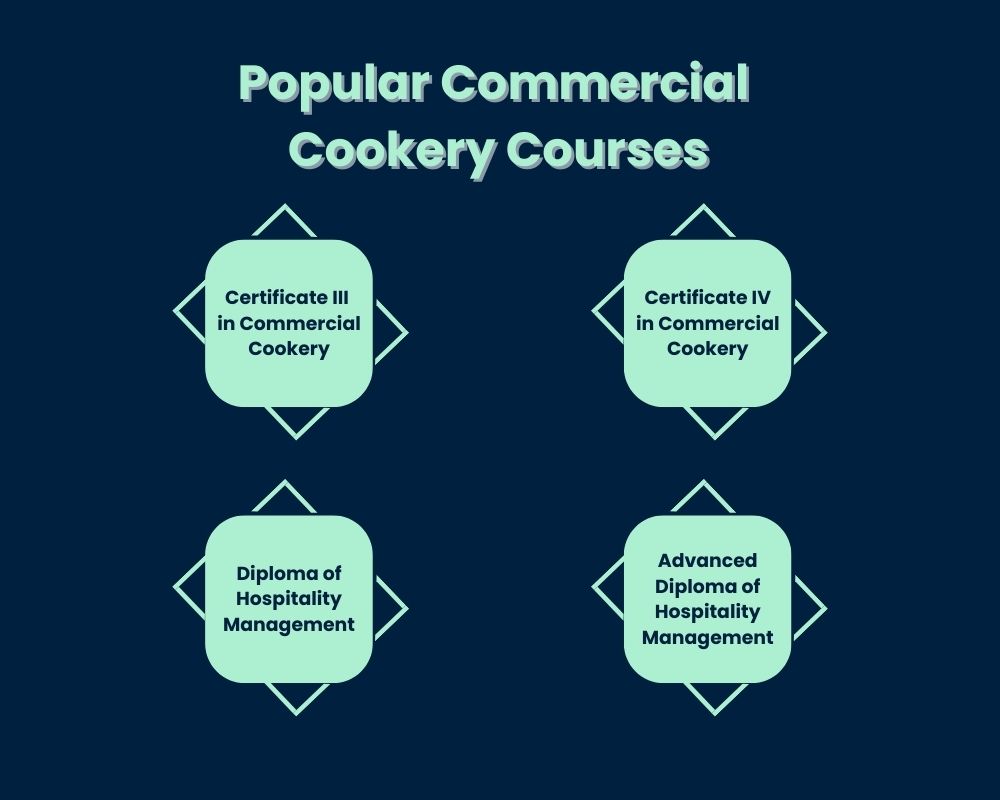
Certificate III in Commercial Cookery
This course is regarded as the foundational qualification if anyone is looking to enter the professional kitchen. This course is mainly based on the fundamental and technical skills that are required to work as a commercial cook who can work as per the requirements and standards set by the government of Australia. The basic objective of this course is to make sure that the individual pursuing this course is able to master the basic cookery methods, food safety, and kitchen operations.
The critical component for this course is that you need to complete the mandatory 360 hours or 48 service periods duration of work placement in a real world and professional kitchen. This experience is essential for your journey in this industry as it is required for your Provisional Skills Assessment (PSA) through TRA. And as a result of completion of this course, you will be given the title of a qualified cook and will learn to prepare appetizers, salads, stocks, sauces, soups, and dishes involving meat, poultry, seafood, and vegetables.
Certificate IV in Commercial Cookery
In the current year of 2026, the SIT40521 is updated and formally titled Certificate IV in Kitchen Management. This course acts as a bridge between being a cook and chef. The main objective of this course is to equip an individual with skills that are beyond advanced cooking techniques and will equip you with the study of menu planning, food safety programs, Workplace Health and Safety (WHS) management, and staff rostering. The Certificate IV in Commercial cookery is usually assessed under the chef occupation with the ANZSCO code 351311 for pathway to PR in Australia.
After the completion of this course, you are expected to have a career outcome of being a Chef, Chef de Partie, or Sous Chef.
Diploma of Hospitality Management
The diploma of hospitality Management is a qualification that acts as a bridge between your in-house kitchen skills to a broader view of the entire hospitality establishment. This course seeks to equip its students with the managerial skills that are required to coordinate diverse operations that are related to hospitality. This course is usually taken as an additional course to your cookery certificates which has a total duration of 6 months.
After the competition of this course, you will be entitled as a Restaurant Manager, Café Manager, or Motel Manager and will learn skills involving budgeting, legal compliance, customer service tactics, and financial management. It enables multi-skilling, which means you can learn how to run restaurants, bars, and hotel front desks in addition to kitchens.
Advanced Diploma of Hospitality Management
The advance diploma of Hospitality Management is regarded as the highest vocational level of certification under the hospitality industry. It is specifically designed for the individuals who are aiming for executive or business ownership roles. The main objective of this course is to make sure that you master strategic business management and high-level operational planning. This course is regarded as a pathway that is used as a direct credit pathway into the second or third year of a Bachelor of Business (Hospitality Management).
After completion of this course, you will be entitled as an Operations Manager, Executive Chef, or Business Owner and will be equipped with the core skills that include strategic marketing, organizational finance, physical asset management, and business plan development. It emphasizes a great deal of autonomy and the capacity to make important business decisions.
| Course Level | Average Total Cost | Course Duration (Estimated) |
|---|---|---|
| Certificate III in Commercial Cookery | AUD $13,100 – AUD $16,500 | 12 Months (52 Weeks) |
| Certificate IV in Kitchen Management | AUD $21,500 – AUD $25,000 | 18 – 24 Months |
| Diploma of Hospitality Management | AUD $14,000 – AUD $18,200 | 12 – 18 Months |
| Advanced Diploma of Hospitality | AUD $18,500 – AUD $26,000 | 18 – 24 Months |
Entry Requirements for Commercial Cookery
If you are someone who is looking to enter the field of commercial cookery then to make sure that you secure your seat in 2026, you need to be able to satisfy the different requirements that are given below:
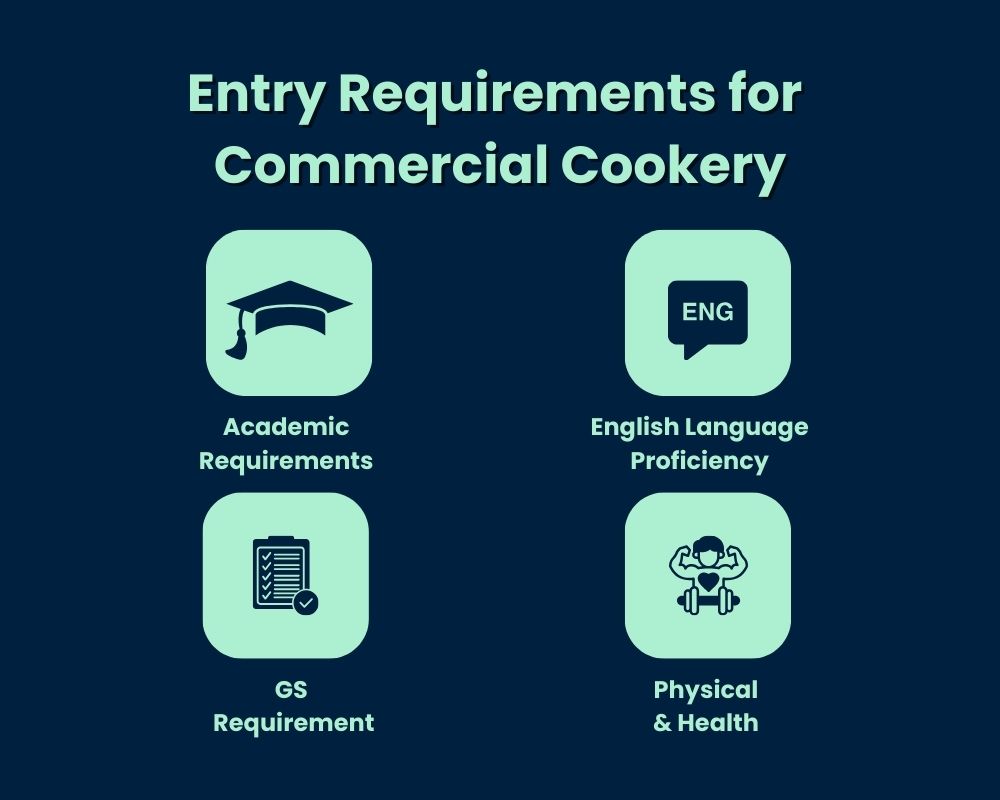
Academic Requirements
The academic requirements between both the certificate level and diploma level differ with each other:
- Certificate III/IV Course: For most Registered Training Organizations (RTOs) the requirement standard set is that they are required to successfully complete Australian Year 10 or 11 (or the international equivalent, such as High School completion).
- Diploma/ Advanced Diploma: If you want to enroll for the diploma/advanced diploma, you are typically required to have completed the Australian Year 12 or a relevant Certificate III/IV qualification.
- In case you are a student who has gaps in your timelines, you can use Recognition of Prior Learning (RPL) or evidence showing experience to justify the gaps.
English Language Proficiency
As of 2026 the DHA has implemented strict English Requirements for students who are trying to enroll for the commercial cookery course in Australia. For you to be an eligible individual you are required to provide an English Proficiency test that is approved by the DHA like IELTS, PTE, TOEFL etc. The requirements for the English test are as follows along with the requirements with ELICOS included.
| English Test | Standard Minimum Score | With 10-20 Weeks ELICOS |
|---|---|---|
| IELTS Academic | 6.0 (no band less than 5.5) | 5.0 – 5.5 |
| PTE Academic | 50 (no band less than 42) | 38 – 45 |
| TOEFL iBT | 60 – 67 | 46 – 51 |
The Genuine Student (GS) Requirement
In the current scenario of Australia’s workforce, the old GTE system has been replaced by the Genuine Student (GS) Requirement which is a critical component that can change the direction of your visa application. In order to satisfy the GS Requirement, you are required to demonstrate the following:
- Give a logical processing on why a commercial cookery course can give you an edge in your career or education stepping forward.
- Provide an in-depth knowledge about the commercial cookery course, the location and why you choose Australia for this course instead of pursing it in your home country.
- You need to provide future value on how the skills you learn in this course will benefit your career and acknowledge how you may develop the required skills the economy of Australia needs in the future migration pathway.
Physical & Health Requirements
As the commercial cookery industry requires individuals to perform in an extremely high-pressure environment, most colleges require a self-declaration that you are able to satisfy the physical & health requirements given by the DHA.
- You are required to demonstrate that you are physically fit and are able to stand for a longer period of time and can lift heavy pots that are required in a professional kitchen.
- You are required to prove to the required authorities that you are able to handle diverse foods and are comfortable handling all food types like pork, beef, seafood, nuts and are not allergic or resistant to any food types.
- You must be ready to adhere to the safety concerns that the Australian government has on food hygiene and safe work practices.
Career Prospect with Commercial Cookery in Australia
As Commercial Cooking pathway falls under the hospitality sector, it has been a career pathway that has been sought by many international and domestic students all over the whole. With the shortage of skilled individuals in the field, the demand for commercial cookery graduates is at an all-time high.
The following table shows the career prospects with their qualifications, and salary that graduates can enjoy in the field of Commercial Cookery in Australia.
| Professional Role | Typical Qualification | Avg. Annual Salary |
|---|---|---|
| Chef | Certificate 3 in Commercial Cookery | AUD $60,000 – $70,000 |
| Chef de Partie | Certificate 4 in Commercial Cookery | AUD $75,000 – $85,000 |
| Sous Chef | Diploma of Hospitality Management | AUD $85,000 – $105,000 |
| Head Chef | Advanced Diploma of Hospitality | AUD $110,000 – $140,000+ |
PR Pathway with Commercial Cookery
If you are an international student who is looking to gain a PR in Australia, then Commercial Cookery is one of the most reliable and structured pathways used in 2026. The Occupation of Chef is embedded with the ANZSCO code 351311 and is on the Medium and Long-term Strategic Skills List (MLTSSL) which makes it a viable option that qualifies for various visa options in the migration system of Australia.
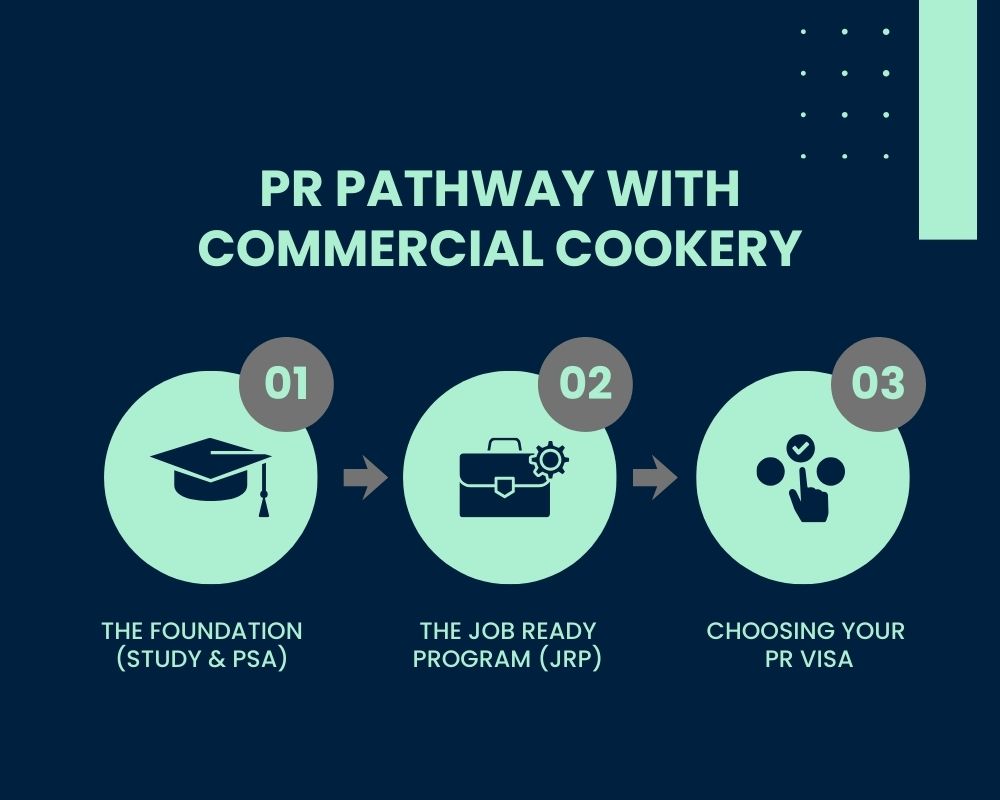
Stage 1: The Foundation (Study & PSA)
- Your journey to PR in Australia with the Commercial cookery begins while you are a student pursuing the course. For you to be ready for PR, you are required to complete the requirement of being enrolled in a CRICOS-registered course for at least a duration of 92 weeks.
- After you have completed your study, you are required to apply for a Provisional Skills Assessment (PSA) through the official portal of TRA. For the PSA, you are required to provide proof of your qualifications and 360 hours of vocational placement or paid kitchen work.
- After you have completed the PSA successfully, you are now required to apply for the 485 visa which allows you to have unlimited rights to live and work in the turf of Australia.
Stage 2: The Job Ready Program (JRP)
After you have completed stage 1 of PR pathways with commercial cookery then the next stage is the Job Ready Program (JRP). If you want to be invited for PR in Australia as a Chef, you need to prove that you are Job Ready in the current market scenario of Australia.
Job Ready Employment (JRE): You need to make sure that you satisfy the work requirement of 1,725 hours which is approximately 12 months in a TRA approved workplace.
Job Ready Workplace Assessment (JRWA): After you have completed the JRE step in the course program, you will have to satisfy the JRWA requirement where an assessor approved by TRA visits your workplace to make sure that your tasks are being performed as per requirements.
Job Ready Final Assessment (JRFA): Once you have completed the requirement for the JRWA, the last phase in JRP is the JRFA. Once this is successfully completed, you will then receive Full Skills Assessment, which is your golden ticket to apply for permanent visas.
Stage 3: Choosing Your PR Visa
The last step before you gets your PR in Australia is to choose a visa program that is eligible to provide points for your PR. After successful completion of a Cookery course, you are required to gain Full skills assessment and 65 PR points, you can lodge an Expression of Interest (EOI).
| Visa Subclass | Type | Why it suits Chefs in 2026 |
|---|---|---|
| Subclass 189 | Skilled Independent | High points requirement and very competitive but grants direct PR anywhere in Australia. |
| Subclass 190 | Skilled Nominated | State-sponsored PR. States like NSW, VIC, and WA often prioritize Chefs. Adds 5 points to your total. |
| Subclass 491 | Skilled Regional | Most Popular. Requires living in a regional area (e.g., Gold Coast, Perth, Adelaide). Add 15 points to your score. |
| Subclass 186 | Employer Nomination | If a restaurant sponsors you directly after you have 3 years of experience. |
FAQs
If you want to enroll in the Certificate III in Commercial Cookery, then this course is specifically designed to cater beginners. Before diving into more complicated dish preparation, it begins with basic skills like knife handling and food safety. Professional experience is not necessary, but a passion for cuisine is.
In the current migration scene of Australia, both the occupations cook and chef are treated as 2 distinct occupations with different ANZSCO codes.
- Cook (ANZSCO 351411): Typically requires a Certificate III. This occupation is often on the Short-term Skilled Occupation List, limiting PR options.
- Chef (ANZSCO 351311): Requires a Certificate IV (Kitchen Management) and involves supervisory duties. It is on the MLTSSL, offering much stronger pathways to Permanent Residency via 189, 190, and 491 visas.
Yes. If you are someone who wants to apply for the General Skilled Migration (PR) in Australia, then you are required to satisfy the 4-step process that proves to the concerned authorities that you have completed your required work of at least 1,725 hours over 12 months.

If you are someone who wants to choose a commercial cookery in 2026, it is not just an educational choice but a strategic investment in your future in Australia. With all time high demand for trade courses in Australia, there has never been a better time to turn your culinary passion into a permanent career.
Why BJay?
Proven Expertise: With 13 years of experience in Visa services in Australia, we here at BJay Education & Visa Services have been providing tailored services to help you navigate through the complex migration scenes of Australia.
Expertise Team: Led by Mr. Jay Oli (MARN: 1570827), we have an exceptional team that is there to solve any queries and help you with your application. The team is well trained to provide the services that you may require assistance with.
Global Presence & Local Support: With offices present in multiple locations throughout Nepal (Putalisadak and Birtamode) and a head office in Sydney, BJay provides you with seamless support you may require whether you are in your home country or already in the turf of Australia.
End-to-End Security: From the initial process of form lodgment to your final visa grant, we manage everything from start to end and manage everything on your behalf.
Want to pursue Commercial cookery in Australia? Join a free nonobligatory consultation with BJay!