Humanitarian Visa in 2026 has now become a pathway that provides hope for thousands of individuals who are seeking safety in Australia. With 2026 in effect, the migration scene of Australia has gone through its most significant transformation over the past decade. The Humanitarian Visa Australia provides a critical protection to you if you are someone who is escaping the persecution, discrimination, or human abuses. This visa grants you with a Permanent Residency (PR) in Australia and provides you a chance to start your life fresh in Australia.
With over 13 years of experience in providing visa services, we here at BJay Education & Visa Services have guided numerous clients through their Humanitarian Visa process, making sure that the application is decision ready and has a positive outcome. This detailed guide has been drafted with the latest data from Department of Home Affairs (DHA) to make sure your application is on par with the standards set by the DHA. In this guide, you will get to know about the humanitarian visa, its types, eligibility, costs, processing times and the steps to a flawless application.
Humanitarian Visa
A Humanitarian visa is a visa under the various visa programs provided by the Australian government. This visa is a PR visa that is issued to the individuals under the Australia’s refugee and Humanitarian program. This specific visa program is designed to cater for the individuals who are outside their home country and are in some kind of persecution or substantial discrimination amounting to gross violations of their human rights.
With 2026 in effect, this visa program has 2 different and distinct streams that are provided by the Humanitarian visa Australia:
Refugee Stream: There are several subclasses under the humanitarian visa, including Subclasses 200, 201, 203, and 204. The people that are considered as refugees in Australia by the United Nations High Commissioner for Refugees (UNHCR) are the main users of this stream.
Special Humanitarian Initiative: The humanitarian visa program’s Special Humanitarian Program, also known as Subclass 202, is a particular stream intended for those individuals who are proposed by an Australian citizen, PR holder in Australia, or an organization in Australia.
Subclasses of Humanitarian Visa
There are various subclasses under the Humanitarian visa provided by the Australian government, and it is essential to understand and navigate through it as it requires you to identify the correct subclass under the Class XB category. You need to make sure that you choose the correct subclass according to your needs from the table below:
| Subclass | Visa Name | 2026 Primary Focus |
|---|---|---|
| 200 | Refugee | Resettlement for those referred by the UNHCR. |
| 201 | In-country Special Humanitarian | For those facing persecution while still in their home country. |
| 202 | Global Special Humanitarian | The "Proposer" visa for family and community-backed applicants. |
| 203 | Emergency Rescue | Urgent processing for immediate threats to life or liberty. |
| 204 | Woman at Risk | Specifically for women and children without male protection. |
Humanitarian Visa Benefits
With the Humanitarian Visa you are able to receive far more benefits than just the legal protection it provides. A permanent Humanitarian Visa in Australia includes a full range of rights and settlements that helps you to rebuild your life with respect in Australia. As compared to other visa programs, this visa program provides the facility of PR which then guarantees them the stability and access to Australia’ s social security net.
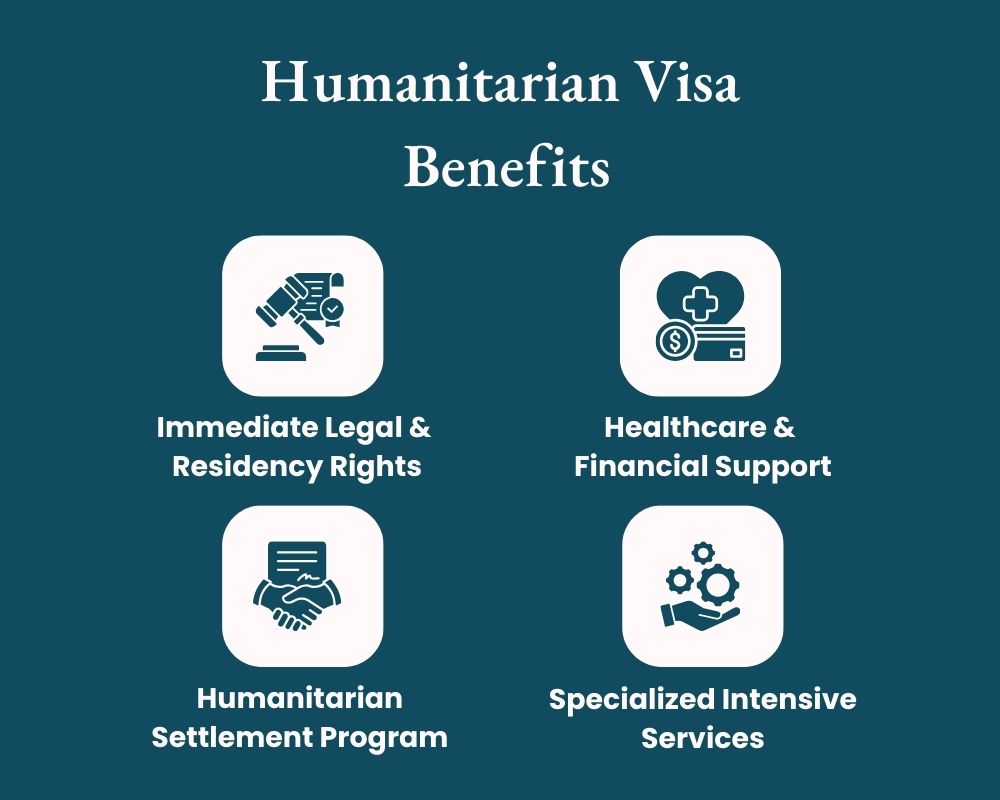
As of March 2026, individuals having the humanitarian visa with subclasses 200, 201, 202, 203 and 204 are eligible to receive the following benefits:
Immediate Legal & Residency Rights
- You are eligible to receive full rights to live in the turf of Australia
- You are eligible to have unlimited rights to work and study in Australia.
- After you have met the standard 4-year residency requirement with at least 12 months in a PR visa then you are eligible to apply for the Australian Citizenship.
- You can propose immediate family members like partner or dependent children for resettlement in Australia. For this your application needs to be under the “split family” provisions, which typically receives a higher processing priority.
Healthcare & Financial Support
- Medicare Access: After you have received the Humanitarian visa, you are now eligible to enroll in Australia’s public healthcare system which is Medicare under the services tab of the services Australia.
- Centrelink Eligibility: Under the Humanitarian visa, most of these visa programs are exempt from the standard newly arrived residents waiting period. This means you may have immediate access to income support payments, Family Tax Benefit, and Child Care Subsidy under the Centrelink services to assist with the cost of living.
The Humanitarian Settlement Program (HSP): For the duration of the first 6-12 months post-arrival, the Australian government seeks to provide specialized assistance though the Humanitarian Settlement Program (HSP).
- On-arrival Reception: Transportation to the first lodging and assistance at the airport.
- Orientation: hands-on instruction on Australian finance, healthcare, law, and culture.
- Housing Support: Assistance in locating and obtaining long-term rentals.
- The Adult Migrant English Program (AMEP) offers limitless free English language instruction to assist you achieve “functional English” proficiency for social and professional integration.
Specialized Intensive Services (SIS)
If you are someone who has complex needs like those needs which need you to deal with severe traumas, disabilities or complex health issues, then Specialized and Intensive Services (SIS) are available to you under the Humanitarian visa up to 5 years of post-arrival. This guarantees that during their integration process, the most vulnerable entrants are not left behind.
Humanitarian Visa Eligibility
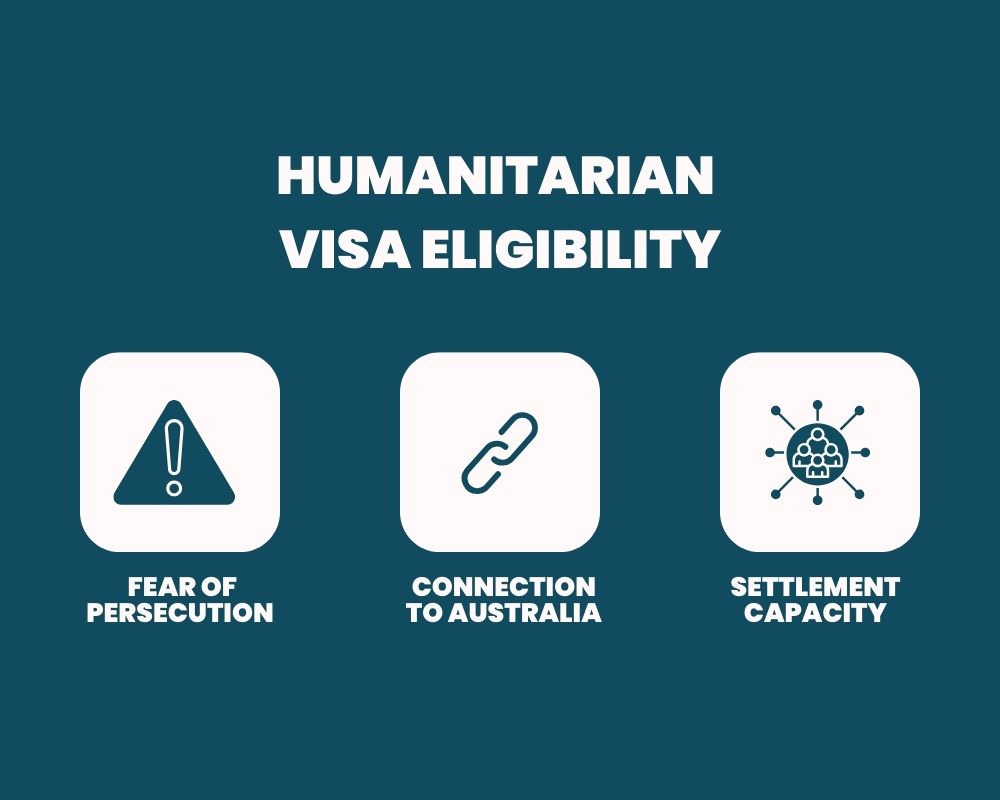
If you are someone who is looking to secure a Humanitarian visa, then you are required to satisfy the “Compelling Reasons” test. In 2026 there are 3 major criteria according to which case officers from concerned authorities are directed to prioritize applications.
Well-Founded Fear of Persecution
In this criterion under the Humanitarian Visa program, you are required to prove to the concerned authorities that you are truly facing a real risk of harm based on different factors like race, religion, nationality, membership in a particular social group, or in any political scenario.
Connection to Australia
While it is not mandatory that you are required to but having a proposer like a friend or a family member who is an Australian citizen, a PR holder increases the success rate for the humanitarian visa under the current planning levels in 2026.
Settlement Capacity
In 2026, with limited resources available, the DHA assesses whether Australia has the required resources that can help you support your resettlement in Australia. Due to the limitation of limited resources, the DHA prioritizes “Decision-ready” applications so make sure your application is up to date with all the required documents.
Humanitarian Visa Costs
As before you plan for anything it is crucial to understand the financial aspect of it. Similarly, you need to have a clear understanding of the cost related to the Humanitarian visa.
Below is the total cost related to the Humanitarian Visa:
| Cost Type | Subclasses 200, 201, 204 | Subclass 202 (SHP) | Community Support Program (CSP) |
|---|---|---|---|
| Visa Application Charge (VAC) | $0 (Nil) | $0 (Nil) | AUD $7,840 (Total) |
| Airfare/Travel | Paid by Australian Govt | Paid by Proposer/Applicant | Paid by Proposer/Sponsor |
| Medical Exams | Paid by Australian Govt | Paid by Applicant | Paid by Applicant |
Humanitarian Visa Processing Time
Due to a huge demand for this visa program worldwide, which greatly exceeds the annual allotment of available positions, the processing time for an Australian humanitarian visa has always been lengthy. However, beginning of March 6, 2026, the Department of Home Affairs (DHA) has undertaken a significant Processing Overhaul, which includes a digital tracking system and established standards to increase transparency and lessen administrative bottlenecks for applications that are ready for decision-making.
The estimated processing timelines for several humanitarian streams as of March 2026 are shown in the following table:
| Humanitarian Visa Stream | 75% of Applications | 90% of Applications |
|---|---|---|
| Emergency Rescue (Subclass 203) | 21 Days | 45 Days |
| Split Family (Subclass 202 Priority) | 12 Months | 18 Months |
| Global Special Humanitarian (Subclass 202) | 24 Months | 48 Months |
| Refugee Category (Subclasses 200, 201, 204) | Variable* | 4+ Years |
Humanitarian Visa Application Process
If you want to apply for the humanitarian visa in 2026 then you are required to follow the protocols that are set by the DHA. In 2026, the DHA has now shifted towards a mandatory digital-first approach due to which more offshore applicants and the proposers are now required to use the ImmiAccount Portal to make sure that real-time tracking and faster processing is done.
Make sure to follow the verified steps given below to make sure you lodge a decision-ready application
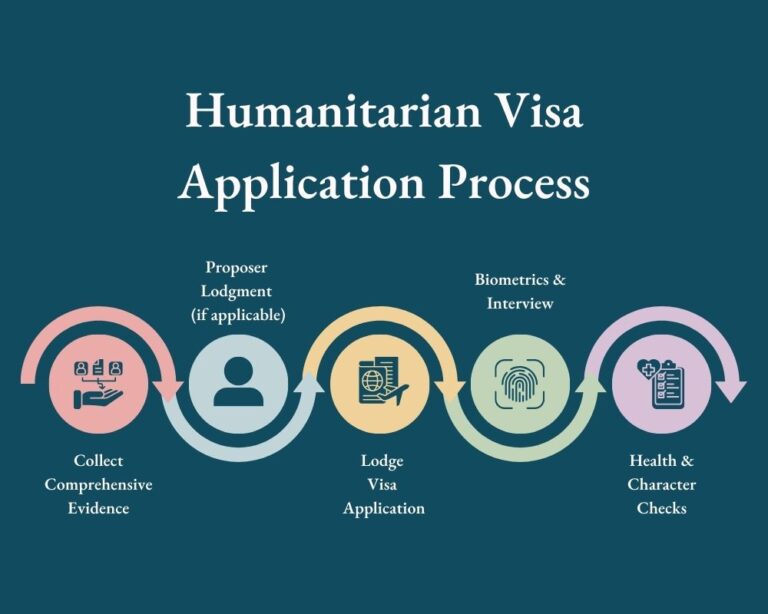
Step 1: Collect Comprehensive Evidence
In the first step of Humanitarian Visa, you are required to firstly gather high-quality color scans of all identity documents like passports, birth certificates. Make sure that you also include the “Proof of Persecution” which is the document that contains a detailed personal statement in English, UNHCR registration documents, and any resources that can help you support your claims of human right violations.
Step 2: Proposer Lodgment (If Applicable)
If you are someone who is applying under the Special Humanitarian Program which is the Subclass 202 then you must begin the process with having a proposer in Australia. You are required to lodge Form 681 digitally via ImmiAccount. After you have submitted the form, you will then receive a Transaction Reference Number (TRN).
Step 3: Lodge Visa Application
After you have successfully collected all the required documents that are required then you are required to lodge your visa application via ImmiAccount. In the portal you are required to select “New Application” > “Refugee & Humanitarian” > “Offshore Humanitarian Visa”. Then you are required to enter the TRN provided by the proposer to link both the forms together. In 2026, the DHA replaced the application for paper-based for the Humanitarian visa, so make sure that you lodge your visa online through ImmiAccount.
Step 4: Biometrics and Interview
In the fourth step of Humanitarian Visa, you will be requested to provide biometrics (photo & fingerprints) after your application has been received by the DHA. In some cases, you may be required to attend an interview at an Australian diplomatic mission or an Australian Visa Application Centre (AVAC) where your claims will be further discussed in detail.
Step 5: Health and Character Checks
After the biometrics have been submitted successfully, you will then receive a notification that you need to undergo medical examinations and provide the required police certificates that provide proof of your character. With 2026 in effect, the Departure Health Checks (DHC) are strictly applied before you travel making sure that you meet the Health Standards set by Australia.
Documents Checklist for Humanitarian Visa
If you are someone who is looking to apply for the Humanitarian Visa then to make sure that your visa application meets the standards set by the DHA, you are required to provide the required documents which are to be submitted via ImmiAccount. Additionally, all the documents are required to be English translated.
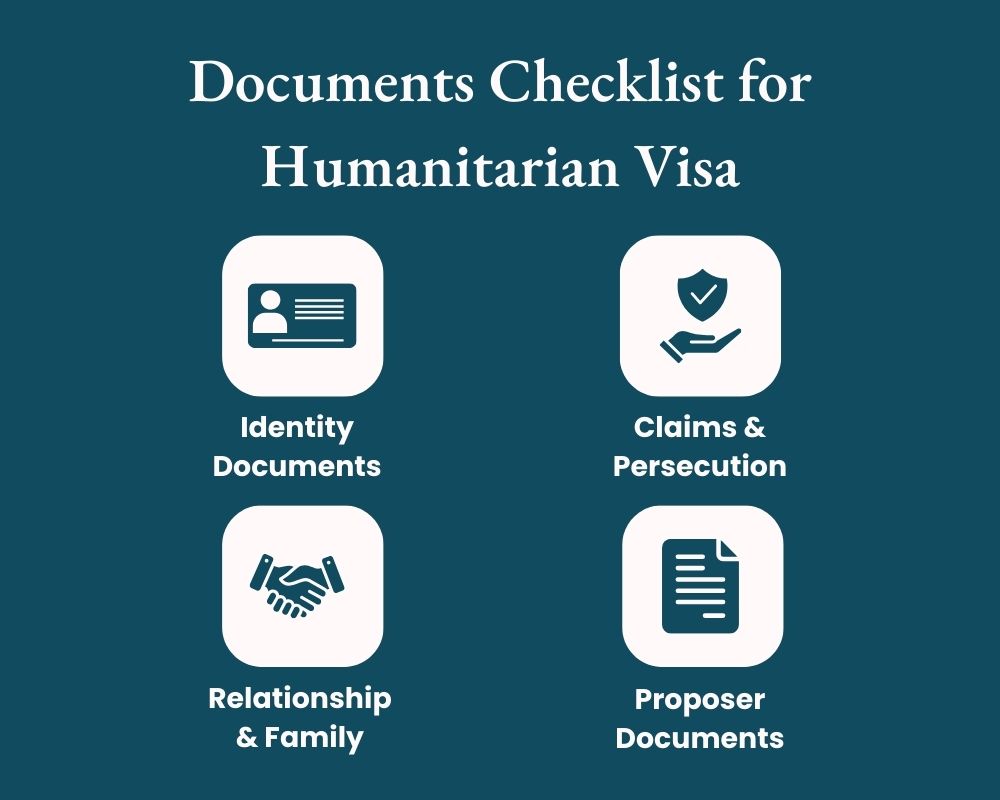
Identity Documents
- You are required to submit high-resolution color scans of your current valid passport.
- You are required to submit National ID cards (if applicable).
- You are required to submit passport sized photograph of the dimension 45mm x 35 mm that is to be taken against a plain background.
- You are required to provide any changes that have been incurred.
Humanitarian Claims & Persecution Evidence
- Personal Statement: This is a signed English declaration which describes your legitimate fear of persecution or risks. This document needs to be detailed and needs to include details like specific incidents, dates, and why you are not able to return to your home country.
- UNHCR Documentation: In this document, you are required to provide Proof of registration (such as a Resettlement Registration Form or Refugee Mandate Certificate) with the UNHCR or any other international refugee organization.
- Supporting Evidence: You are required to submit supporting evidence that backs up your claims. This supporting evidence can be media clippings or news reports, official documents like court orders, warrants; medical or psychological reports showing and confirming you had past traumas or injury due to the specific incident.
Relationship & Family Documents
- You are required to provide evidence of your current marital status. (if applicable)
- If there are children included in the application, then there should be a birth certificate showing both the names of the parents.
- For any individual above the age of 18 and who is dependent must provide evidence related to the financial or social dependency of the main applicant.
Proposer Documents (if applicable)
- Form 681: The proposer needs to provide a “Refugee and Special Humanitarian Proposal” which should then be submitted via ImmiAccount.
- Proof of Status: The proposer is required to provide a certified copy of their Australian passport, citizenship, or PR visa as a proof that they are eligible to be proposer.
- Relationship with Applicant: The Proposer is required to provide evidence that there is a family or a community link between them and the applicant.
FAQs
For most of the visa programs under the Humanitarian Visa program, there are no visa charges. However, if you are someone who is applying through the Community Support Program (CSP) through an Approved Proposing Organization then there is a significant cost of AUD $7,840. As for Subclass 202, the visa is free, the proposer is generally responsible for airfares and initial medical exam costs.
Yes, but only for specific reasons and you are only eligible for the Subclass 201(In-Country Special Humanitarian Visa). This visa program is specifically designed for you if you are someone who is still in your home country and are facing persecutions and are unable to leave the turf of Australia. Unlike this specific visa program, other humanitarian visa programs require you to be outside your country.
Yes. As the Humanitarian visa program is a PR Visa, it includes a 5-years travel facility. After the 5-year duration has been completed and if you not yet obtained the Australian citizenship then you are required to apply for a Resident Return Visa (Subclass 155) in order to return to Australia after five years. Just a Reminder that returning to the nation where you sought refuge from may affect your ability to apply for citizenship or residency in the future.
As there are many subclasses under the Humanitarian visa program, if you receive refusals in subclasses like 200 or 202 then these refusals are not eligible to be appealed to the Administrative Review Tribunal (ART). Because of this, the initial application and the supporting documentation submitted at the time of filing are crucial. Always look for any special privileges or other options in your refusal notice.
The recent changes in the Australian migration scene as of March 6,2026 has made the digital applications standard and the paper forms are no longer applicable. All the Proposers and applicants applying for this visa program must use the ImmiAccount portal to lodge their application.

In 2026, applying for a humanitarian visa has become more difficult than ever, requiring a flawless fusion of digital compliance and legal accuracy. Years of preventable delays can result from a single missing document or a poorly written statement. Don’t risk your family’s safety.
Why BJay?
Proven Expertise: With 13 years of experience in Visa services in Australia, we here at BJay Education & Visa Services have been providing tailored services to help you navigate through the complex migration scenes of Australia.
Expertise Team: Led by Mr. Jay Oli (MARN: 1570827), we have an exceptional team that is there to solve any queries and help you with your application. The team is well trained to provide the services that you may require assistance with.
Global Presence & Local Support: With offices present in multiple locations throughout Nepal (Putalisadak and Birtamode) and a head office in Sydney, BJay provides you with seamless support you may require whether you are in your home country or already in the turf of Australia.
Document Audit: Our 20-point check guarantees that your identity and relationship evidence meets strict automated verification standards.
Need Help with Humanitarian Visa in 2026? Book a Free Nonobligatory Consultation with BJay!