
Visa refusal Australia is a certain phrase that has been significantly heard worldwide with the recent changes in the migration scene of Australia. Whether you are trying to apply for Australia or someone who has had an unexpected result and has a fear of visa refusal Australia, understanding the reasons and mechanics of refusals is the first step you can take towards a successful outcome.
Your life plans may seem to come to an unexpected halt when you receive a visa refusal Australia notification. The impact is substantial whether your goal was a long-term education, a career change, or your ideal vacation in the turf of Australia. With the Department of Home Affairs (DHA) using new “Genuine Student” (GS) criteria and advanced integrity checks, the Australian migration scene has grown more complex in 2026 leading to visa refusal Australia.
We here at BJay Education & Visa Services, have navigated the complex immigration scene of Australia for more than a decade. With an experienced team led by Mr. Jay Oli (MARN: 1570827), we know that refusals can be frustrating, but a visa refusal Australia is always not the end of your path to your Australian dream. Hence, this Meticulously drafted guide seeks to provide a deeper dive into the 2026 refusal environment, verified data on costs, and strategic pathways to recover that are verified against the DHA data and the Ministerial Direction 115 (MD115).
Common Reasons for Visa Refusal Australia
With the recent changes in the Australian immigration scenes that has been implemented in the starting of January 2026, the DHA has made it harder to enter Australia with new policies and integrity reasons. The only way you can safeguard your application from being refused is to understand the common reasons that could trigger the Visa Refusal Australia. Therefore, below are the five common reasons that are frequent for a Visa Refusal Australia against the DHA and the MD 115.
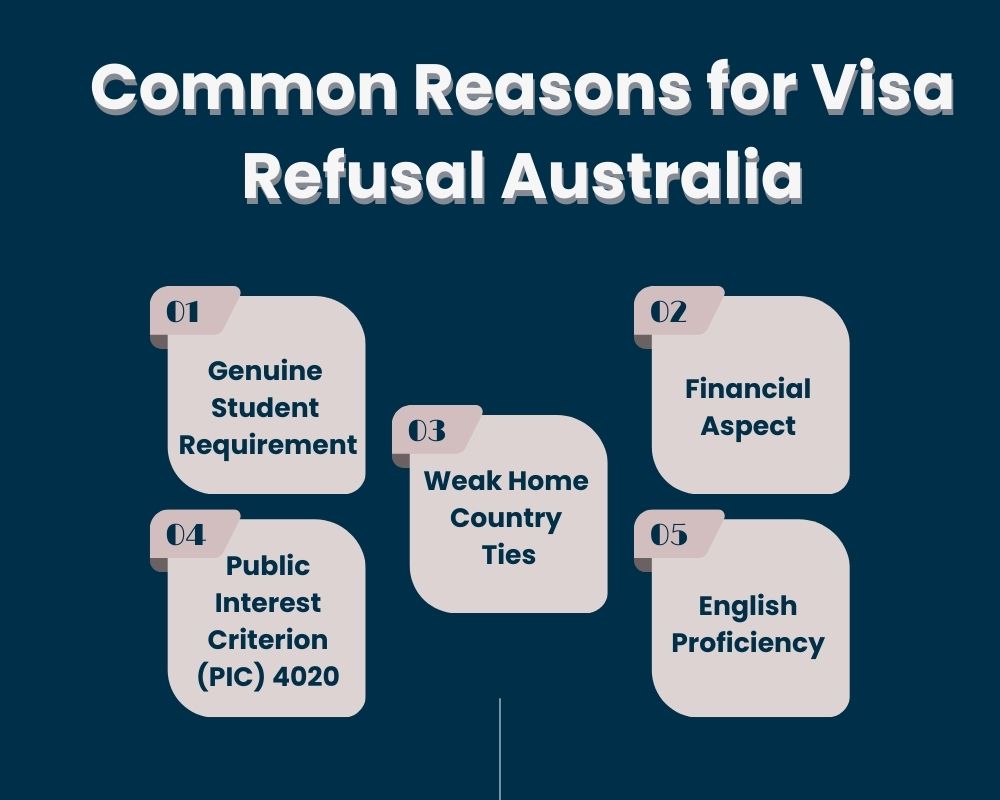
Genuine Student (GS) Requirement
Recently, there has been a lot of changes in Australian migration scene which could lead to visa refusal Australia, one of them being the change from the previous Genuine Temporary Entrant (GTE) requirement to the newly formed GS requirement. With this change, currently authorized case officers don’t look for your intent to return to your home country but rather evaluate the value of your study.
With the change, the Visa refusal Australia rate of student visas have increased substantially as the DHA will consider you a “non-genuine” student seeking a career route rather than study if your GS statement is ambiguous, generic, or artificial intelligence (AI) created. So, make sure that your GS is not vague, generic or AI generated.
Financial Aspect
With 2026 in effect, DHA has increased the financial threshold of individuals applying for visa programs in order to reflect the inflation that has been inflected in Australia in recent days. This aspect is one of the primary reasons of refusals in Visitor Visas as a lack of transparency in financials could lead to Visa Refusals Australia. In 2026, you are required to shows a fund of at least AUD $29,710 For living Expenses, plus tuition fees and return travel costs.
Another Major change that has affected the financial aspect is the change of Evidence level 3 change. On January 8, 2026, Australia kept countries like India, Nepal and Bangladesh in the Evidence Level 3 category which means that now immigrants from theses countries now required to show a mandatory 3-month bank history.
Public Interest Criterion (PIC) 4020
This is the most dangerous category that causes visa refusals Australia. PIC 4020 gives the DHA the authority to deny a visa if they discover even one “bogus document” or false assertion. The penalty is a 10-year ban for identity fraud and a 3-year ban for providing incorrect information.
PIC 4020 can be triggered by even inadvertent mistakes, such as an incorrect employment date or an undeclared prior visa refusal in Australia. So, make sure to avoid this as much as possible as it can cause in a 10-year ban.
Weak Home Country Ties
This reason is the main cause that causes Tourist Visa Refusal Australia. For you to successfully get a visitor visa in 2026, the assessing officer needs to be satisfied and convinced that you truly are a “Genuine Temporary Entrant”. Having Weak ties to your home country or being unemployed in-home country, having no proper assets or having more family members in Australia than any other countries may lead to refusals.
English Proficiency
With 2026 changes, DHA has now tightened the English Proficiency flexibility and made it more scrutinized. If you don’t provide an approved test result from the list of English Proficiency test approved by the DHA like IELTS, PTE, TOEFL, etc. at the time of lodgment or your scores are not on par as per the new requirements then your application could face visa refusal Australia.
| Reason for Refusal | Subclass Affected | 2026 Survival Strategy |
|---|---|---|
| Weak GS Statement | Student (500) | Link course to a 20% salary increases in your home country. |
| Sudden Deposits | All Subclasses | Provide 3-6 months of bank history + Tax Returns. |
| PIC 4020 (False Info) | All Subclasses | Disclose every previous refusal (even for USA/UK/Canada). |
| No "Ties" to Home | Visitor (600) | Submit property deeds or a "Letter of Approved Leave." |
| Substandard English | Student / Skilled | Retake PTE/IELTS until you hit the "Superior" bracket. |
Pathways after Visa Refusal Australia
Are you someone who has recently received a Visa Refusal Australia? When your Australian visa is refused in 2026, the DHA now issues a formal “Decision record” to you. This document is the deciding factor that outlines exactly why your visa was denied and crucially whether you have the rights to review or not.
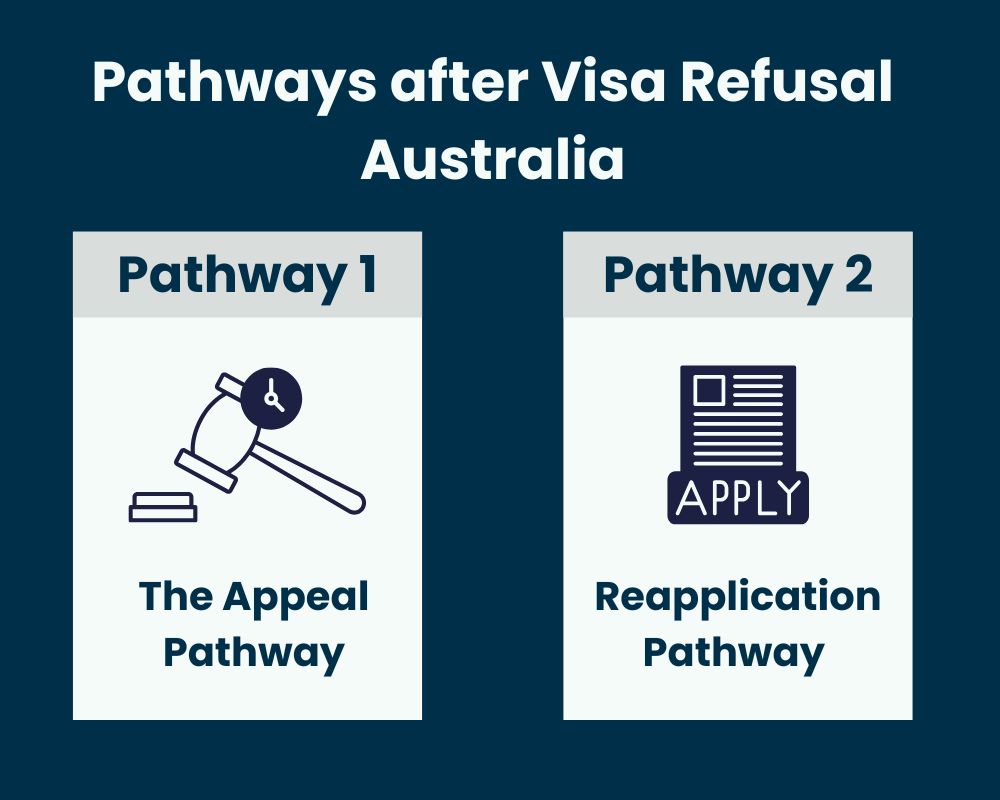
In 2026, there are 2 major pathways you can choose from after you receive a visa refusal Australia i.e.
- Pathway 1: Appeal Pathway
- Pathway 2: Reapplication Pathway
Pathway 1: The Appeal Pathway
After you have received a visa refusal Australia, your first pathway can be the Appeal pathway. If your refusal letter just came in, then make sure to check if the letter has review rights in it. After that, you can challenge the Administrative Review Tribunal (ART) to review your visa application. The ART is an independent body that conducts a merits review where you can challenge the decision made by the DHA.
How the Appeal Works:
- Deadline: Within 21 to 28 days after the date, you are deemed to have received the letter, you normally have an extremely tight window. You forfeit your right to appeal permanently if you miss this by even a single day.
- Cost: The typical application fee for an ART review is $3,580 AUD as of 2026. The ART will compensate half of this cost if you prevail in your case.
- Bridging Visa: When you file a valid ART appeal while onshore (in Australia), you typically receive a Bridging Visa, which lets you remain in the nation with your prior employment or study privileges while you await a hearing.
- Hearing: Eventually, a Tribunal Member will question you during a hearing, which may be either in person or by video. Here, you can present fresh evidence that wasn’t included in your initial submission.
Appeal Costs and Processing time
| Case Category | ART Application Fee (AUD) | Estimated Processing Time (50% of cases) | Success Refund Policy |
|---|---|---|---|
| Student Visa Refusal | AUD $3,580 | 12 – 16 Months | 50% Refunded if you win |
| Visitor Visa Refusal | AUD $3,580 | 12 – 15 Months | 50% Refunded if you win |
| Partner / Family Visa | AUD $3,580 | 22 – 29 Months | 50% Refunded if you win |
| Skilled / Work Visa | AUD $3,580 | 12 – 24 Months | 50% Refunded if you win |
| Bridging Visa Refusal | AUD $3,580 | 10 Days – 5 Months | 50% Refunded if you win |
| Protection Visa | AUD $0 (Upfront) | 3 – 5 Years | AUD $2,203 fee only if you lose |
| Character Refusal | AUD $1,148 | 6 – 12 Months | AUD $100 Concessional fee available |
Pathway 2: The Reapplication Pathway
After visa refusal Australia, the another pathway is the Reapplication pathway. If a trivial error or missing document leads to rejection, reapplying is frequently the quicker option. But it necessitates a “clean slate” approach.
How Reapplying Works:
- No Waiting Period: There is no legal waiting period for the majority of offshore applicants, such as those requesting a Subclass 600 Visitor Visa. You can apply again right now.
- The “Section 48” Bar: Onshore individuals who do not possess a substantive visa (such as those on bridging visas) may be “Section 48 barred.” This implies that you must leave Australia to submit a fresh application for a visa since you are unable to apply for the majority of other visas while you are there.
- Addressing the “Reason for Refusal”: The same papers will be rejected for “copy paste” if they are submitted. In your response, you must specifically address the Case Officer’s earlier concerns (for example, by presenting more convincing evidence of “Home Country Ties” or seasoned bank statements).
- Full Disclosure: Your prior rejection must be stated in the new application. A three-year suspension may result from failing to comply, which is deemed “providing misleading information” (PIC 4020).
| Feature | Appeal Pathway (ART) | Reapplication Pathway |
|---|---|---|
| Best For | Complex cases where the DHA made a legal error or you need to stay onshore. | Simple mistakes, missing documents, or when you have no review rights. |
| Typical Cost | $3,580 AUD (High) | Standard Visa Application Charge (Varies) |
| Processing Time | 12 – 24 Months (Slow) | Standard processing times (Fast) |
| New Evidence | Allowed and encouraged. | Mandatory to address previous refusal. |
| Onshore Status | Usually grants a Bridging Visa to stay. | Subject to Section 48 bar (may have to leave). |
| Outcome | Decision can be "Remitted" (Overturned). | A brand-new decision is made. |
How to Fix a Visa Refusal
After a Visa refusal Australia, you might be wondering “what can I do to fix my visa refusal?” Fixing a visa rejection in Australia in 2026 involves more than just “trying again.” It is a technical reconstruction of your profile to satisfy the elevated “Integrity” standards set by the DHA. To prevent a second (and frequently irreversible) rejection, you must adhere to a certain recovery plan after being rejected.
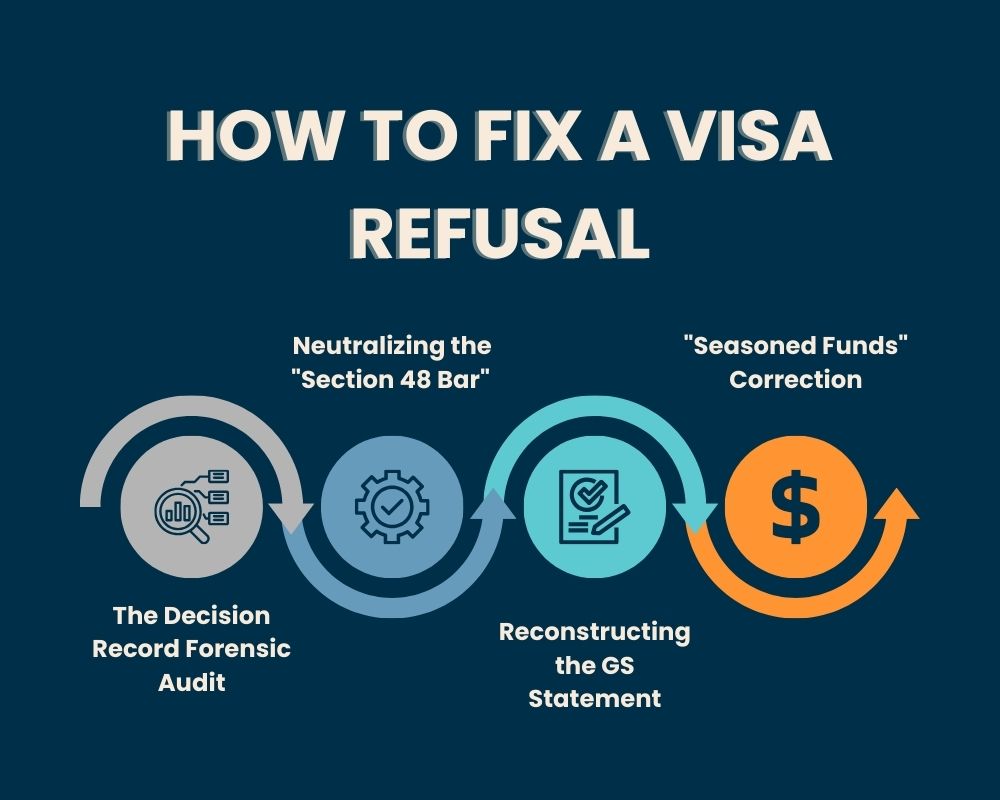
Step 1: The “Decision Record” Forensic Audit
Every visa refusal Australia comes with a “Decision Record.” You must look beyond the standard rejection text and identify the specific Legislative Instrument or Criteria you failed (e.g., Clause 600.211 for Visitors or the GS Criterion for Students).
- Identify the “Trigger”: Was it a lack of “Home Country Ties”? Was it “Unexplained Wealth”?
- Check for PIC 4020: If your letter mentions Public Interest Criterion 4020, you are being accused of providing false information. This requires an immediate legal response to avoid a 3-year ban.
Step 2: Neutralizing the “Section 48 Bar” (For Onshore Applicants)
If you are currently in Australia on a Bridging Visa and receive a visa refusal Australia, you are likely Section 48 Barred. This means you cannot apply for another substantive visa while staying in the country.
- The Strategy: Often, the only “fix” is to depart Australia, “cleansing” your record of the bar, and reapplying from offshore.
- The Exception: You can still apply for a Partner Visa or a Protection Visa even if you are Section 48 barred.
Step 3: Reconstructing the “Genuine Student” (GS) Statement
If your student visa was rejected under the 2026 GS criteria, your re-application must be a “Forensic Document.”
- Address the Refusal Head-On: Your new GS statement must start by acknowledging the previous visa refusal Australia and explaining with new evidence and why those concerns are now resolved.
- Logical Progression: If the DHA said your course choice didn’t make sense, provide a Letter of Intent from a future employer in your home country stating that this specific Australian qualification will result in a guaranteed promotion or a specific salary increase (e.g., 20-30%).
Step 4: The “Seasoned Funds” Correction
If your visa application has received visa refusal Australia for financial-based decisions, the 2026 DHA standard requires Transparency over Totals.
- The 3-Month Rule: Do not just show a balance. Provide 90 days of transaction history.
- The “Source” Affidavit: If a family member gifted you money, provide their tax returns and a legal affidavit explaining the source of their wealth. Unexplained large deposits are the #1 reason for visitor visa refusal Australia in 2026.
FAQs

If your Australian Visa is refused, you then receive a decision record that consists of the reason that causes the refusal. If you are currently in Australia, you have 21 days to appeal to the ART or must depart within 35 days. If you aren’t then you can either reapply or appeal (if review rights exist).
There is no legal limit on the number of Australian visa denials, and each one is permanently documented. As a result, an applicant’s “risk profile” in the Department of Home Affairs (DHA) system rises with each denial. Future visa applications are made far more difficult to obtain due to this elevated risk profile, unless the applicant’s circumstances drastically change.
In 2026, the focus is on “High Integrity.” Common triggers include:
- Non-genuine career paths or AI-generated SOPs causing GS Failures.
- Financial Doubts that arise due to unexplained “sudden deposits” or lack of 3-month bank history.
- Ties to Home issue & Insufficient proof of employment or assets in your home country.
- Inadequate English Proficiency scores to satisfy certain visa program requirements.
- Offshore: You can reapply immediately, provided you have new evidence to present to the Department of Home Affairs (DHA).
- Onshore: You are likely Section 48 barred, which basically means that you must leave Australia before lodging a new application (except for Partner or Protection visas).
In order for you to continue with your application, you need to disclose any previous rejection and make a brand-new application, particularly addressing the concerns you received for the letter of denial. There are severe consequences if you fail to disclose any previous rejection, such as a 10-year suspension under PIC 4020.

If you are someone that is having problems with navigating visa denials in Australia, then the Visa Refusal Australia process requires you for strategic collaboration and knowledge of immigration regulations. With more than ten years of experience, BJay Education & Visa Services, led by Jaya Prakash Oli (Registered Migration Agent, MARN: 1570827), can help you combine legal knowledge with empathy as a former foreign student to succeed with your applications.
Why BJay?
- Proven Track Record: Since 2011, we here at BJay education & visa Services have assisted over numerous clients from various countries in securing university enrolments, work visas, and Permanent Residency.
- Refusal Recovery Specialists: If you are facing a visa refusal Australia, our team is highly experienced in representing clients at the Administrative Review Tribunal (ART) to overturn unfair decisions.
- Dual-Shore Support: With physical offices in Sydney, Kathmandu, and Birtamod, we provide seamless end-to-end support—from your initial visa in Nepal to your PR grant in Australia.
- Integrity-First Approach: We operate under a strict professional code of conduct. Our “Forensic Document Audit” ensures your Genuine Student (GS) statement is 100% compliant with 2026 DHA standards, minimizing your risk of rejection.
Have you faced a Visa Refusal Australia? Don’t worry! Let us help you to turn the application into a positive outcome. Book a Free Consultation with BJay!