Genuine Student Requirement also know as the GS requirement is one of the most important factors for any foreign student seeking a subclass 500 student visa in 2026. With the Change in migration scene of Australia, the Department of Home Affairs (DHA) has changed how it evaluates application by implementing the transaction and replacing the previous Genuine Temporary Entrant (GTE) criterion with the genuine student requirement. The new Genuine Student Requirement framework emphasizes that students can gain skills Australia needs and potentially pursue permanent residency, as long as their primary goal for admission remains high-quality education, whereas the previous system only considered your intention to return home.
We at BJay education & Visa Services have handled and examined numerous cases to make sure our clients have no problem handling the Genuine Student Requirement. Hence, we have compiled a meticulously drafted guide outlining the Genuine Statement Requirements and helping you with your application.
Genuine Student Requirement
The Genuine Student Requirement is a mandatory requirement that is used in order to verify that an applicant who is applying for a student visa is an authentic student who plans to finish their studies and is aware of the conditions of living in Australia. As compared to the previous based system, the 2026 genuine student requirement is organized as a set of focused questions within the online ImmiAccount portal.
Transition from GTE to GS
The greatest shift in Australian student visa policy in ten years is the switch from the GTE to the Genuine Student Requirement. With complete implementation in 2026, this shift modifies the focus from “intent to return” to “intent to study.”
The goal of the transition process was to clean up the confusions and misunderstanding in the education sector of Australia. The previously used GTE statement was criticized for being excessively unclear and vague which ultimately resulted in students visa hopping. The students would basically stay in the country by enrolling in several inexpensive courses. With the major changes that occurred in 2026, the Genuine Student Requirement acts as a requirement that helps the concerned authorities to guarantee that only individuals who want to genuinely commit to their education are qualified rather than only obtaining a work permit are granted visas.
Changes in Genuine Student Requirement
The major shifts that happened in the Genuine Statement Requirement in 2026 are as follows:
- Dual Intent Revolution
- From “SOP” to Structured Questions
- Financial Forensic Scrutiny
Transition Table:
| Feature | Genuine Temporary Entrant (GTE) | Genuine Student Requirement (GS) |
|---|---|---|
| Primary Focus | Temporary Intent: "Do you plan to leave Australia after your studies?" | Academic Intent: "Is study your primary purpose for coming to Australia?" |
| Format | A single 300-word (or longer) Statement of Purpose (SOP). | Targeted, specific questions in the ImmiAccount portal. |
| Migration Intent | Mentioning a desire for Permanent Residency (PR) was often a ground for refusal. | "Dual Intent" is permitted. You can acknowledge PR goals as long as study is the main driver. |
| Assessment | Subjective and focused on "ties to home country." | Objective, focused on course relevance and Return on Investment (ROI). |
| Application Type | Applied to all temporary visas (Tourist, Student). | Exclusive to Student (Subclass 500) visa applicants. |
How to Write a Genuine Student Requirement Statement?
In 2026, writing a Genuine Student requirement demands a change from lengthy, subjective essays to a sequence of organized, fact-based answers. While you lodge your online ImmiAccount application, you will find four specific questions that you will be obliged to answer. Every answer has a word restriction of 150. Use this professional structure for each inquiry to make sure your statement satisfies the genuine student requirement.
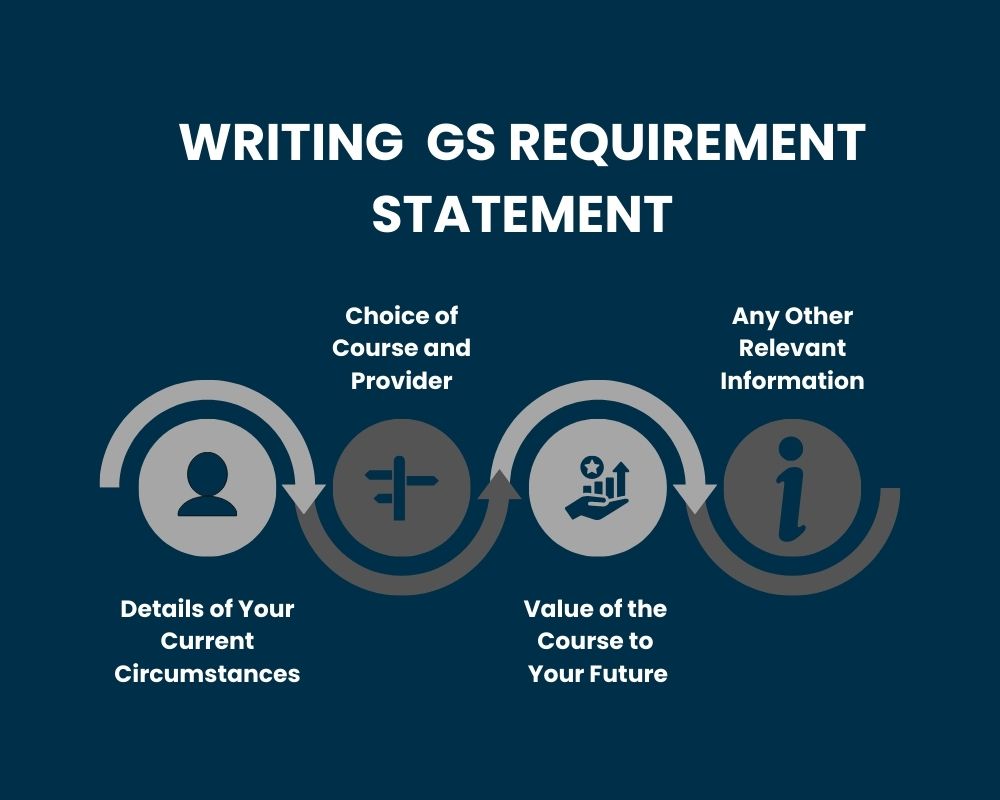
Step 1: Details of Your Current Circumstances
This section of writing a Genuine Student Requirement establishes your stability and anchors in your home country. You must prove that you have a life and a future worth returning to so that the concerned authorities are convinced that you are in Australia for the sole purpose of study.
- Family & Social Ties: You should briefly list your immediate family members and their occupations. Also mention any community roles or long-term social connections that you might have to make it stronger.
- Employment & Economic Situation: If you are currently working then you can state your company, role, salary, and how long you have been employed so that it can convince that you are not in Australia in search of work rather there for study.
- Assets: In this section, you must mention any property or family businesses that you or your family might have that shows linkage to your home country.
- Key Strategy: In case you are someone that has a study gap of more than 2 months then you need to explain it here (e.g., ” I worked as a professional intern at [Company Name] from July to December 2025 in order to obtain real-world IT experience. “).
Step 2: Choice of Course and Provider
For the second step of the genuine student requirement, visa officers use this to see if you have actually researched your education. Avoid vague praise like “Australia is a beautiful country.” You should answer the following questions in a brief and convincing way.
- Why this Course? For this specific question, you can name 2–3 specific modules or subjects and explain how this course can help you fill a gap in your current knowledge and make a contribution to your academics.
- Why this Provider? In order to show integrity, you need to bring up the university’s standing, industry collaborations, or distinctive campus perks when discussing the course. (e.g., “I chose RMIT for its Advanced Manufacturing Precinct, which is unavailable in my home city”).
- Comparison: For example, “The Australian AQF framework offers more practical, industry-integrated learning than the theoretical programs available in [ XYZ Country]” is one of the reasons you must explain why you wish to study in Australia instead of your home country or other countries like the UK or the USA.
Step 3: Value of the Course to Your Future
This is the “ROI” (Return on Investment) section. You have to demonstrate that investing in an Australian degree is a wise financial and professional choice.
- Future Job Role: You must be precise and specify the job you hope to have after graduation (e.g., “Senior Cybersecurity Analyst or Software Engineer”).
- Potential Employers: in this section you can name 2–3 companies that are reputed in your home country where this degree is highly valued and are seeking employees.
- Salary Growth: Compare your future earnings with the degree to your existing or anticipated wage without it. Make sure to use accurate market data.
Step 4: Any Other Relevant Information
In this step of writing a genuine student requirement statement, you need to address any possible red flags in your application in this “bonus” section. You need to be honest and transparent if there are any red flags or factors that might affect it.
- Visa History: In this step make sure that you state it clearly if you have ever been denied a visa by any nation, be truthful about it and describe how your situation has altered since as transparency may lead to refusals.
- Military/Civil Service: In this part, you are required to explain the detailed timeline by mentioning any required service or special community activity.
- Dual Intent (Optional): As long as you specify that studying is your main objective, you can admit that your course may lead to post-study employment pathways (Subclass 485).
Pillars of Genuine Student Requirement Evaluation
To meet the genuine student requirement, visa officers assess a student’s “authenticity” based on five pillars outlined in Ministerial Direction 106. These pillars serve as an example for determining whether a top-notch education is the primary motivation for studying in Australia. It is easier to arrange evidence and written responses in a way that complies with the Department of Home Affairs’ (DHA) requirements when these pillars are clearly understood.
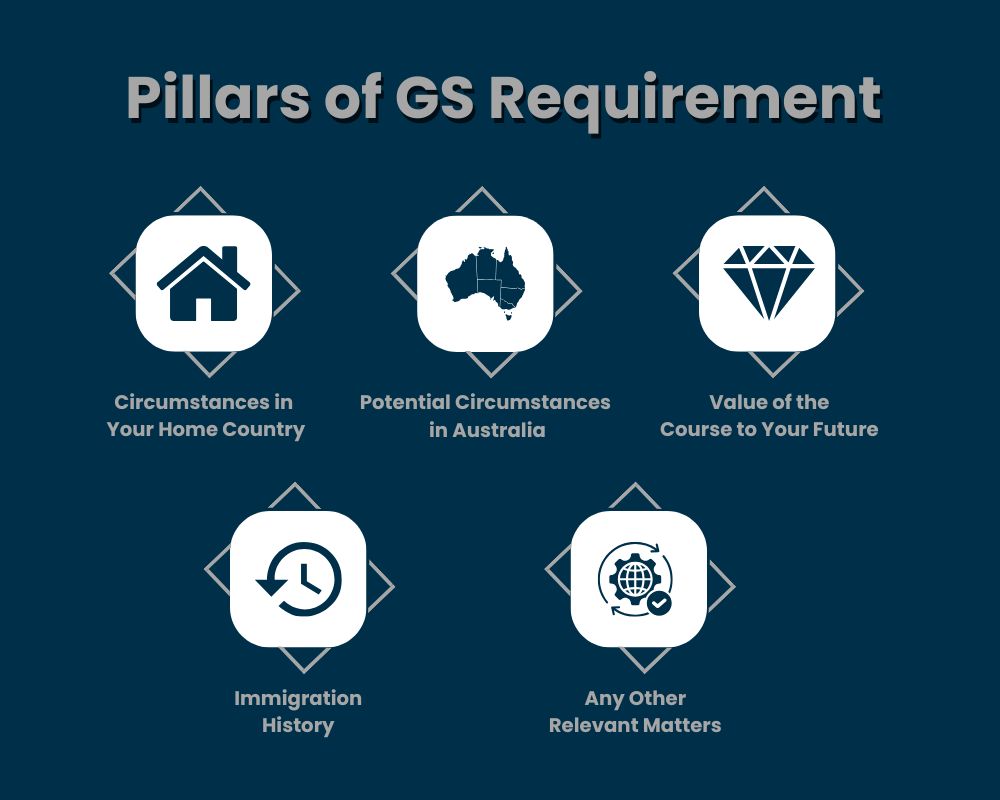
Circumstances in Your Home Country
The department examines your “push and pull” factors why you are leaving your home country and what ties will pull you back.
- Academic/Career Gap: If a similar course that you are applying for is available in your home country then you are required to explain why studying in Australia is a better option for your investment decision (e.g., “The Australian curriculum includes a 6-month industry internship not available locally”).
- Personal Ties: You are required to provide evidence of family members, community roles, or property ownership in this section.
- Economic Situation: Your sponsor’s income stability and your own employment history.
Potential Circumstances in Australia
This pillar of the genuine student requirement statement assesses your level of research and your understanding of the commitment you are making.
- Knowledge of Provider: You should know your campus location, facilities, and why you chose that specific institution over others in Sydney or Melbourne.
- Living Arrangements: You are required to demonstrate a proper and realistic plan for staying in Australia and a clear understanding of the $29,710 AUD annual living cost requirement that needs to meet successfully.
- Ties to Australia: If you are someone that has many family members in Australia, the DHA may scrutinize the process if your primary goal seems to be family reunification rather than study.
Value of the Course to Your Future
This is often considered the most critical pillar. You must prove a Financial Return on Investment (ROI).
- Salary Growth: You must be prepared to present particular data that shows the growth factor. For instance: “post-graduation, I expect my salary to increase from $10,000 to $25,000 AUD due to the specialized Australian certification.”
- Career Alignment: The course must be a logical step in your career. If you are a Nurse moving into a Master of Cybersecurity, you must provide a very strong justification for this pivot.
Immigration History
As your past behavior is a predictor of future compliance. All your past immigration history affects the result of this as well.
- Visa Compliance: A track record of obeying visa laws in Australia, the UK, the USA, or Canada is a significant plus.
- Visa Refusals: Any visa rejections that have been incurred before this application must be disclosed. Being dishonest is essential since concealing a rejection is seen as “visa fraud” and carries a 10-year suspension.
- “Visa Hopping”: In 2026, the DHA is strict about students who jump from one low-level course to another just to stay onshore.
Any Other Relevant Matters
This is the “catch-all” pillar where the case officer uses their discretion to look at the “big picture” of your application.
- Age and Gaps: While age is not a barrier, a 10-year study gap requires more evidence of professional development.
- Consistency: Every document—from your PTE score to your bank statement—must tell the same story.
Genuine Student Requirement Checklist
If you want to be eligible candidate for a Subclass 500 visa in 2026, with the changes in the migration scene of Australia, applicants now will need to submit a “decision-ready” file to the Department of Home Affairs (DHA). This file must contain genuine, high-resolution scanned documents with the required English translations. For an application to be successful, the given checklist is the gold standard.
| Category | Required Evidence |
|---|---|
| Identity | Valid Passport (6+ months validity) & National ID. |
| Academic | CoE, Transcripts, Degree Certificates, & Gaps explained with work certs. |
| English tests | IELTS (6.0+) or PTE (50+). Higher scores improve GS credibility. |
| Financial | 3 months of bank history showing $29,710+. Sudden deposits are flagged. |
| Employment | Payslips, Tax Returns (ITRs), and Reference Letters. |
| Health | Proof of OSHC for the entirety of your stay in Australia. |
| GS Evidence | Detailed Resume/CV, Employment Letters, Research Evidence |
Common Genuine Student Requirement Refusal Reasons
The Genuine Student requirement is a significant filter in 2026, particularly because the Department of Home Affairs (DHA) has elevated a number of nations to Evidence Level 3, which eliminates any possibility of error. The document discusses common grounds for Subclass 500 application denials and avoidance tactics based on 2026 refusal statistics.
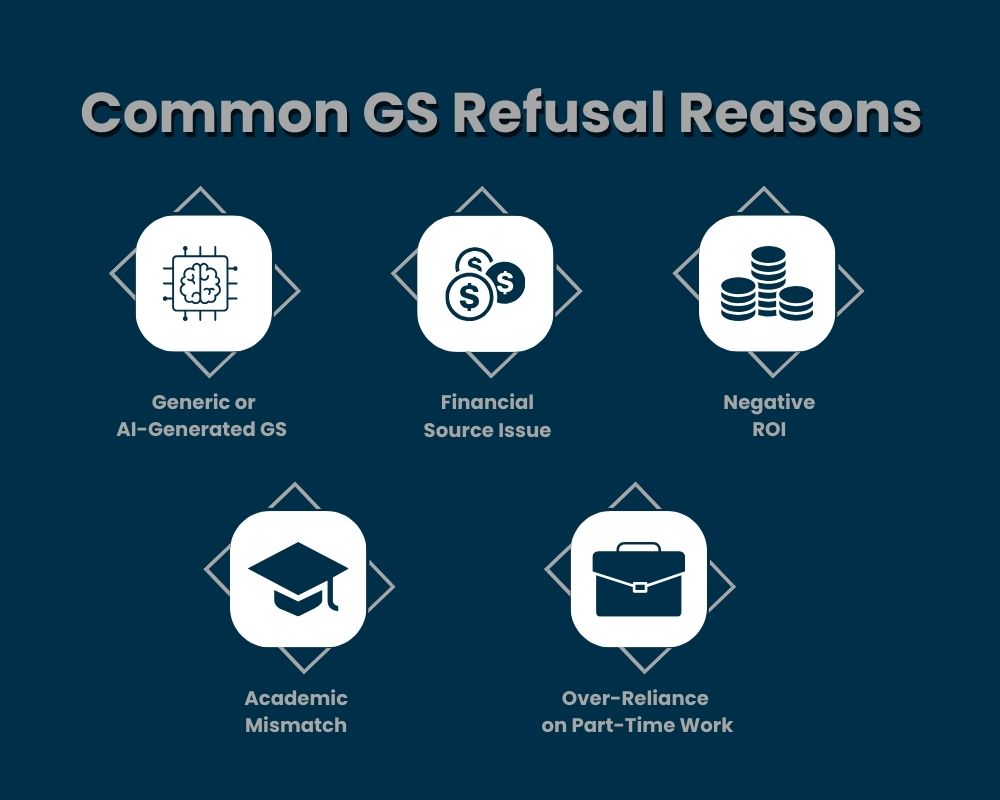
Generic or AI-Generated GS Statements
DHA now uses advanced linguistic software to detect plagiarism and AI-generated content (like ChatGPT).
The Refusal: “The applicant provided a generic statement that does not reflect their individual circumstances.”
The Fix: Ensure your 150-word responses are highly personalized. Mention specific subjects, local companies you want to work for, and unique personal motivations.
Financial “Sudden Deposits” & Source Issues
Showing $29,710 AUD is not enough; you must prove the Source of Wealth.
The Refusal: “The department is not satisfied that the funds shown are genuinely available to the student due to recent, unexplained large deposits.”
The Fix: Funds should be “seasoned” (held for 3–6 months). If you sold property or took a loan, you must provide the legal sale deeds or a bank-sanctioned loan letter.
Negative ROI (Return on Investment)
A major 2026 refusal trigger is an “Illogical Economic Path.”
The Refusal: “The cost of the course significantly outweighs the potential salary increase in the applicant’s home country.”
The Fix: You must provide a “Value of Course” justification. Show that spending $60,000 on an Australian degree is logical because it will move your salary from, for example, $8,000 to $20,000 USD annually.
Academic Mismatch (The “Down-Grading” Trap)
If you already hold a Master’s degree and apply for a Diploma, your visa will likely be refused under the Genuine Statement requirement.
The Refusal: “The applicant is seeking a qualification at a lower level than their existing studies without a cogent career justification.”
The Fix: Always aim for Academic Progression (Bachelor’s → Master’s). If you are changing fields, you must explain how the new skills complement your previous background.
Over-Reliance on Part-Time Work
If your statement or interview suggests you need to work to pay your tuition, you will be flagged as a “non-genuine” student.
The Refusal: “The applicant’s primary motivation appears to be access to the Australian labor market rather than academic achievement.”
The Fix: Emphasize that your funds are fully covered by your sponsors and that work is merely for “cultural exposure” or extra pocket money.
Therefore these are common reasons that could lead to a Genuine Student Requirement Refusals so make sure you go though them carefully and make sure apply the fix if applicable as well.
FAQs on Genuine Student Requirement

Genuine Student Requirement (GSR) is a 2026 evaluation system that ensures that the main reason why an applicant visits Australia is to undertake education. The framework will direct the applicant to fill out four organized questions in the online visa request form, which will deal with the education history of the applicant, the relevance of the future course to their future goals, and the relationship of the applicant to his mother country.
To write a successful statement, it should be focused on the accuracy of the facts and their conciseness. The four questions have limitations of 150 words each. Applicants should also prove Academic Progression- the way the course is developed based on the previous course-work- and Return on Investment- the way the course is expected to improve the income of the applicant in his country of residence. The use of generic templates must also be avoided because the Department of Home Affairs (DHA) has AI detection systems that it uses to detect plagiarized data.
Genuine Temporary Entrant (GTE) requirement requires the applicant to prove that their stay in Australia is going to be temporary. The GSR is academic Sincerity oriented. The GSR is more objective in its decision in 2026, considering whether the chosen course is a logical step in the career path toward which the chosen applicant is heading. The format of the assessment is in the form of a set of question-answer entries instead of an essay.
The legal annual living cost of a single student is AUD 29,710 as of February 2026. The applicant will need to deposit an extra AUD 10394 with their partner, an extra AUD 4449 per child. The applicants should also prove that they have enough money to cover the first-year tuition fees as well as the trip home and back, which is estimated to be about AUD 2500.
On 8 January 2026, the DHA re-evaluated a number of countries, such as India, Nepal, and Bangladesh, to the level of Evidence Level3. As a result, bank statements, employment and academic transcripts of applicants in these regions are further subjected to manual checks with an aim to curb fraud.

As it is a very difficult task to comply with the Genuine Student (GS) standard in 2026, more than just basic and traditional paperwork is needed. BJay Education & Visa Services, led by Jaya Prakash Oli (Registered Migration Agent, MARN: 1570827), is committed to aligning academic objectives with Australian legal requirements and here to help you with your application process.
Why BJay?
- Verified Expertise: Since 2011, we here at BJay Education & Visa Services have successfully assisted over 10,000 clients. Our team includes experienced and top-notch migration agents, education counselors, and legal experts who understand the difficulty and changes of the 2026 “Integrity Reset.”
- The “GS Statement” Specialists: We assist you in creating clear, 150-word answers that meet the “Academic Purpose” and “Return on Investment” (ROI) requirements in light of DHA’s shift to question-based exams.
- Global Reach, Local Support: With offices in Sydney, Kathmandu, and Birtamod, we offer a “dual-shore” service. We assist with initial applications overseas and provide ongoing onshore support, including airport pick-up, accommodation help, and resume reviews for the Australian job market.
- Zero-Defect Documentation: For students in Evidence Level 3 countries (India, Nepal, etc.), our Financial Forensic Review ensures your bank history meets the 3-month stability rule before your visa is even lodged.
Looking for someone to Guide you through your Genuine Student Requirements? Start a Free Non-obligatory Consultation with BJay!