Bridging Visa A(BVA) which is also known as the subclass 010 is a critical safety net for you if you are looking to transition between visas within the strict Australian migration system in 2026. With the Department of Home Affairs (DHA) enforcing stricter rules and regulations in the current Migration scenario in Australia, navigating the transition between visas in Australia can feel like a burden and tiresome. The “integrity-first” protocols make it critical to understand your Bridging Visa A status which can make the difference between remaining a lawful resident and facing accidental deportation.
This comprehensive 2026 guide on Bridging Visa A is meticulously by BJay Education and Visa Services. With the leadership of Mr. Jay Oli (MARN: 1570827), this guide strives to provides an in-depth analysis of the Bridging Visa A, its conditions, BVA work rights, and the latest shifts in migration scenes of Australia that is sourced directly from DHA data.
Bridging Visa A
A Bridging Visa A or the BVA is a type of Bridging Visa that is temporary. It is a Visa that lets you to lawfully stay in the turf of Australia while your application for Main visa is being processed after your substantive visa (like a Student visa, Visitor visa, or 482 visa) expires. There are many kinds of Bridging Visas available among which Bridging Visa A is a widely used Australian Visa program.
How does Bridging Visa A work?
In most cases (95% cases), the grant for the BVA is automatic which basically means that when you lodge your onshore visa application through the portal of Immiaccount, Bridging Visa A is automatically Granted instantly. The BVA is granted while your current visa under a specific program is still valid but only comes into action or is activated once your main visa is expired and you apply for another visa program under the Australian Migration schemes. The BVA currently (as of March 2026) doesn’t have any costs in it when it is applied alongside the main substantive visa.
Difference Between Bridging Visa A, B & C
While there are various Bridging Visas available in the current Australian migration program, there is always a question “What is the difference between bridging visa A and B and C?” To simply answer that question the various bridging Visa serves different purposes and to further clarify the question, you can check the comparison table below:
| Feature | Bridging Visa A | Bridging Visa B | Bridging Visa C |
|---|---|---|---|
| Granted Time | Onshore substantive application while visa valid | Apply when there is a travel need on BVA | Apply after visa expiry |
| Eligibility | Held a valid visa when applying. | Current BVA holders need travel. | Held NO valid visa when applying. |
| Travel | Not Permitted to Travel | Permitted To Travel | Not Permitted. |
| Cost | AUD $0 | AUD $190 | AUD $0 |
| Work Rights | Inherited or Full Work Rights | Inherited or Full Work Rights | Usually No Work. |
BVA Conditions & 2026 Restrictions
The Bridging Visa A Conditions actually mirror the Conditions that are present on your visa that you have held before it. Basically, to understand the BVA visa conditions and the restrictions that are implemented after the major change in the migration scene in 2026, you must understand the visa activation concept of DHA. The Bridging Visa A conditions and restrictions you must know are listed below:
The Visa Phase: The most common confusion that arises in this context is when does Bridging Visa A become active? Simply said, a BVA does not start the day it is granted it has 2 different phases which can be seen below:
- Dormant Phase: The BVA is “dormant” from the day you apply for your new visa until your current visa expires. You are bound by the conditions of your existing visa.
- Active Phase: The BVA “activates” when your present visa expires (for example, at midnight on its expiration date), at which point you are required to comply with the BVA’s requirements.
Travel Restrictions: The Travel Restriction also known as the “BVA Trap” is the most severe restricted that needs to be complied with in the year 2026. This restriction states that while you are on a Bridging Visa A you are not allowed to travel outside of Australia with the no re-entry rule abiding.
- Rule: If you are on A BVA, you are not allowed to travel outside of Australia. Incase, you leave without a BVB you are not allowed to return back to Australia.
- Consequence: If you leave the turf of Australia while you are on a Bridging Visa A, the visa ceases immediately and you may be stuck offshore and you may need to stay outside of Australia until your main visa has been granted.
- Fix: Before you plan to apply for travel, you must apply for the BVB and with the current timelines, the DHA recommends applying for the BVB at least 3 weeks prior to traveling.
Bridging Visa A Work Rights: The “Visa Stream” you enter in 2026 will affect your job rights on a BVA. In contrast to prior years, DHA now uses automated data matching to guarantee compliance with these particular requirements:
- Inherited Conditions: this is the general rule in the visa program where if you are moving between similar visa programs (e.g., Student to another Student visa), your BVA usually inherits the same restrictions as your previous visa (e.g., 48 hours per fortnight).
- Automatic Full Work Rights: If you are Somone who is applying for visa programs like Subclass 485, subclass 820/801, subclass 189,190, 491 then the DHA provide you with unrestricted Work rights automatically.
- No Work Condition: The No work condition or the Condition 8101 is a condition where if your Bridging Visa A is granted with it then you are not allowed to work in Australia.
Bridging Visa A Processing Time
Even though the Bridging Visa A Processing Time is immediate, some situations require direct intervention in order to be handled correctly. The most recent data from DHA as of March 2026 provides information on the different processing times connected to these cautions. However, the material presented lacked information regarding the length of time and situations that call for manual review.
| Application Method | 2026 Processing Time |
|---|---|
| Online via ImmiAccount | Instant (95%) to 3 Business Days |
| Paper-based / Complex Cases | 14 to 28 Business Days |
| Variation of Conditions (Work Rights) | 7 to 14 Business Days |
Bridging Visa A Eligibility
If you want to qualify for a BVA in 2026, you are required to meet the four given Eligibility criteria that are provided by the DHA. Even a one-day lapse in your lawful status will disqualify you from a BVA and force you onto a more restrictive Bridging Visa C making your application process harder and more scrutinized.
Eligibility Checklist:
- Onshore Status: You need to be in the turf of Australia both the times when you apply and when you receive the BVA grant.
- Substantive Link: When you submit your new application for your BVA, you have a valid substantive visa that is active (such as a student 500, Visitor 600, or TSS 482).
- Valid Application: Your new application must be “validly lodged” (all fees paid and forms completed).
- No Cancellation: You must not have had a visa cancelled or refused since your last entry into Australia (otherwise, Section 48 Bar rules apply).
| Criteria | Exact Requirement |
|---|---|
| Current Visa | Must hold a valid substantive visa (Student, 482, Visitor, etc.). |
| Timing | Application must be lodged before your current visa expires. |
| Location | You must be physically in Australia at lodgment and grant. |
| Lodgment | Application must be valid (fees paid, all forms complete). |
| History | No current visa cancellations or unlawful gaps. |
Bridging Visa A Application Process
If you are looking to lodge your BVA Application, then filling out just a form doesn’t guarantee positive outcomes. Hence, you need to understand the correct order of operations from lodgment to verify your work and travel rights. Here are the exact steps you need to follow if you want a positive outcome in your application:
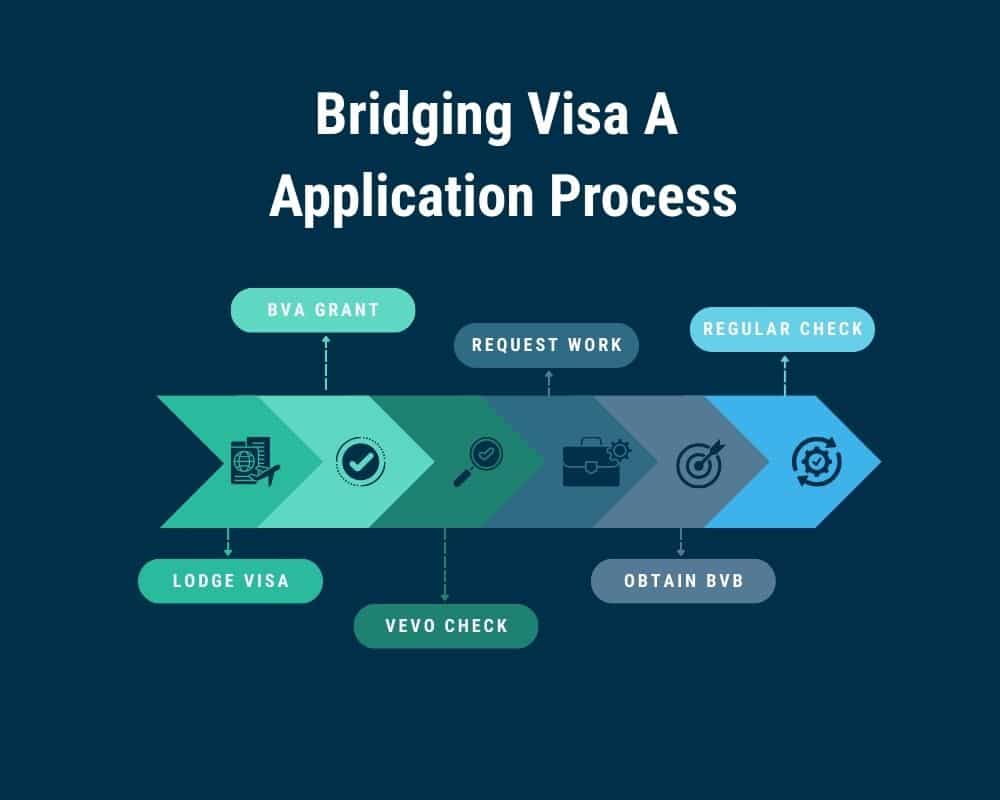
Step 1: Lodge Your Main Visa via ImmiAccount
Step 2: Automatic BVA Grant verification to make sure it has been granted
Step 3: Verify the confirm your BVA activation with VEVO check.
Step 4: Request for Bridging Visa A Work Rights if your visa inherits a no work condition
Step 5: If you want to travel then you must secure your Travel Rights by obtaining a BVB
Step 6: Check your Immiaccount and VEVO check regularly to track your status
Pitfalls And Solution of Bridging Visa A
Navigating through the Current Australian migration system can be tricky and can lead to a Bridging Visa A refusal, so to make sure that your application has a positive outcome you should avoid the following pitfalls and make sure to implement the solutions if there is an error in your application.
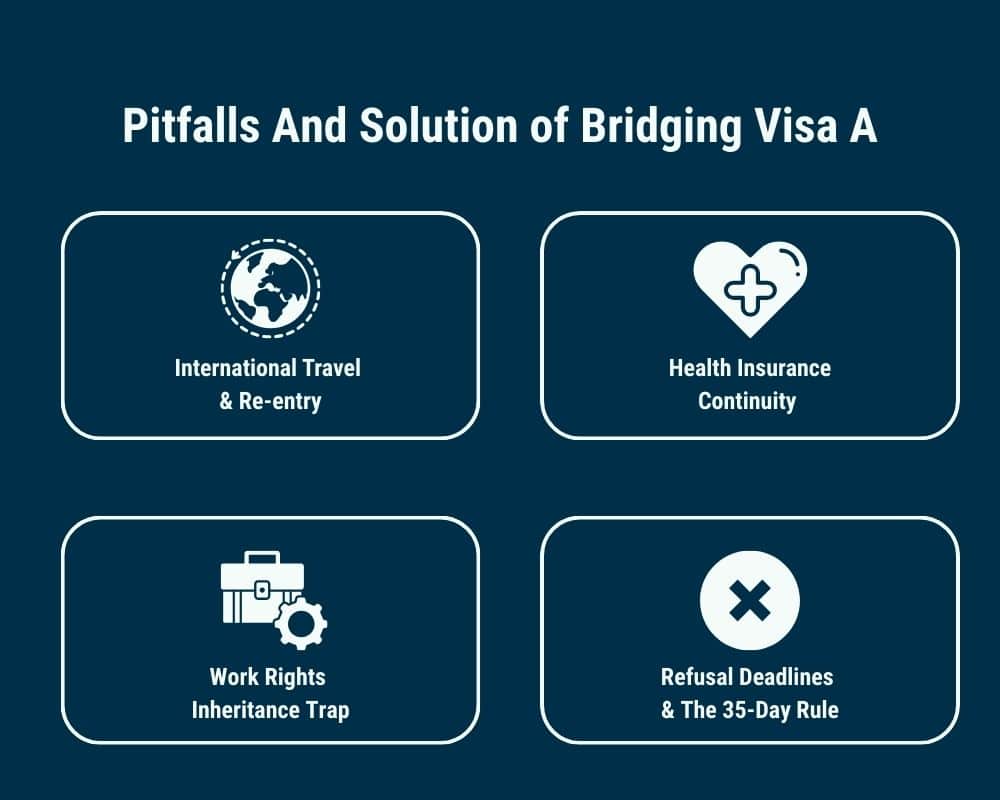
International Travel & Re-entry
Leaving Australia with only a Bridging Visa A. Many applicants mistakenly think that they can travel for holidays or family visits since they have an active BVA grant.
Solution: Before you depart, you must apply for and be granted Bridging Visa B (Subclass 020). In 2026, the DHA suggests applying via ImmiAccount at least 3 weeks before your departure.
Health Insurance Continuity (Condition 8501)
Expiration of your health insurance (OSHC or OVHC) while awaiting a PR ruling or after completing a course.
Solution: Don’t expect that Medicare will cover you just yet. Until your permanent visa is approved or you have a Medicare card, keep your OVHC (Overseas Visitor Health Cover) or OSHC.
The Work Rights Inheritance Trap
Assuming that you have full work rights just because you apply for a 485 Graduate or 190 Skilled visa.
Solution: VEVO (Visa Entitlement Verification Online) should always be checked. Never begin a full-time position unless VEVO clearly indicates that “No Work Restrictions” or “Condition 8104” have been lifted.
Refusal Deadlines & The 35-Day Rule
Waiting too long to act after your substantive visa is refused.
Solution: Your BVA cannot be extended if you miss the ART deadline. To avoid becoming an “unlawful non-citizen,” which would harm your chances of obtaining a visa anywhere in the world, you must depart Australia by the 35th day.
Travel Pathway with Bridging Visa A to B
If you are someone who currently holds a valid BVA and want to travel outside Australia, then without the BVB your visa is ceases at the point of departure and you will not be able to return back to Australia. Hence, if you want to travel outside of Australia while you are on a Bridging Visa A then you need to apply for the BVB and be granted with it before you leave. Once the BVB is granted, it replaces the BVA and provides you with a definite travel period of 3-12 months.
Note: With the Current Processing time to Transition from Bridging Visa A to B, we recommend you apply for the BVB 3 weeks prior to your travel day.
Requirements:
- If you want to transition from a Bridging Visa A to BVB then you must be eligible and have these standards or requirements:
You must have a BVA that is valid or have a BVB that is already active (about to expire) - You are required to provide a strong reason that you need to travel. This needs you to include proof like family or medical emergencies, business or work commitments, significant personal events (weddings, funerals)
- You must be inside Australia while your BVB lodge and grant with your current Bridging Visa A.
Transition Process:
If you want to apply for the BVB with a BVA then you should follow the below given steps to make sure your application has a positive outcome.
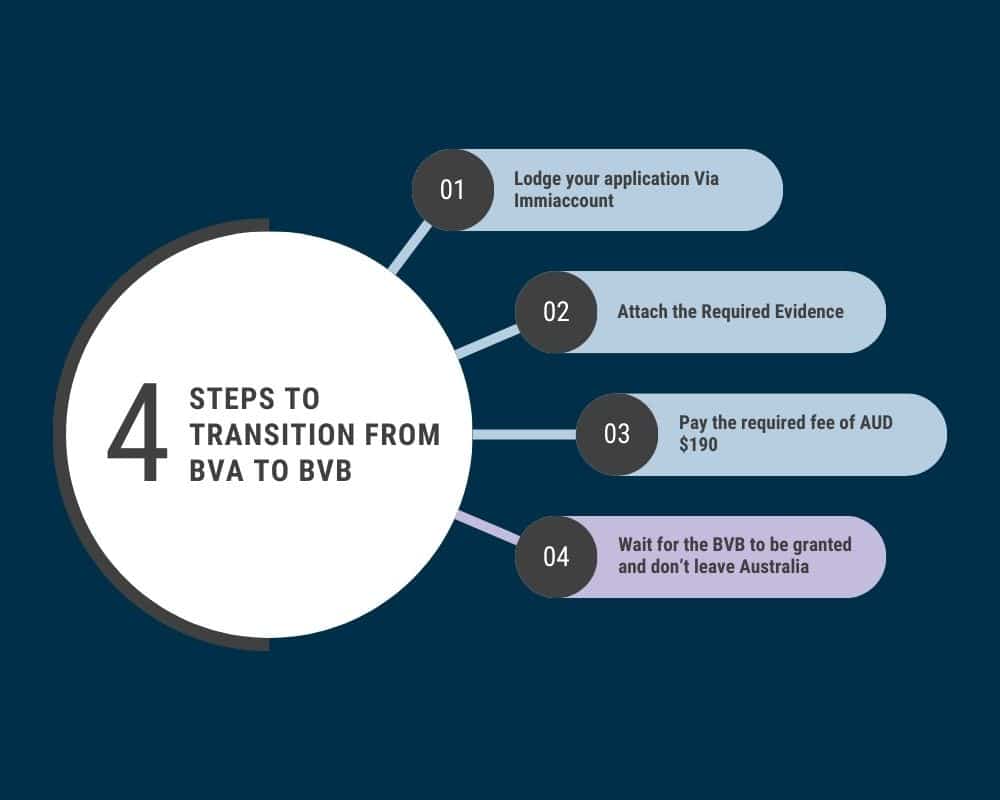
Step 1: Lodge your application Via Immiaccount
Step 2: Attach the Required Evidence like the statement of purpose, flight itineraries (if applicable) or business/medical proofs.
Step 3: Pay the required fee of AUD $190
Step 4: Wait for the BVB to be granted and don’t leave Australia until it is granted
Refusal Pathway for Bridging Visa A
In case your BVA visa was rejected, the DHA provides you with a Grace Period of 35 calendar days during which you must lodge a review application to the Administrative Review Tribunal (ART). During this period while your application is being reviewed by the ART, you remain lawful and can reside in Australia.
Note: As of late 2024, the AAT has been replaced by the ART, so make sure to lodge you review applications to ART.
Steps to Manage Refusal
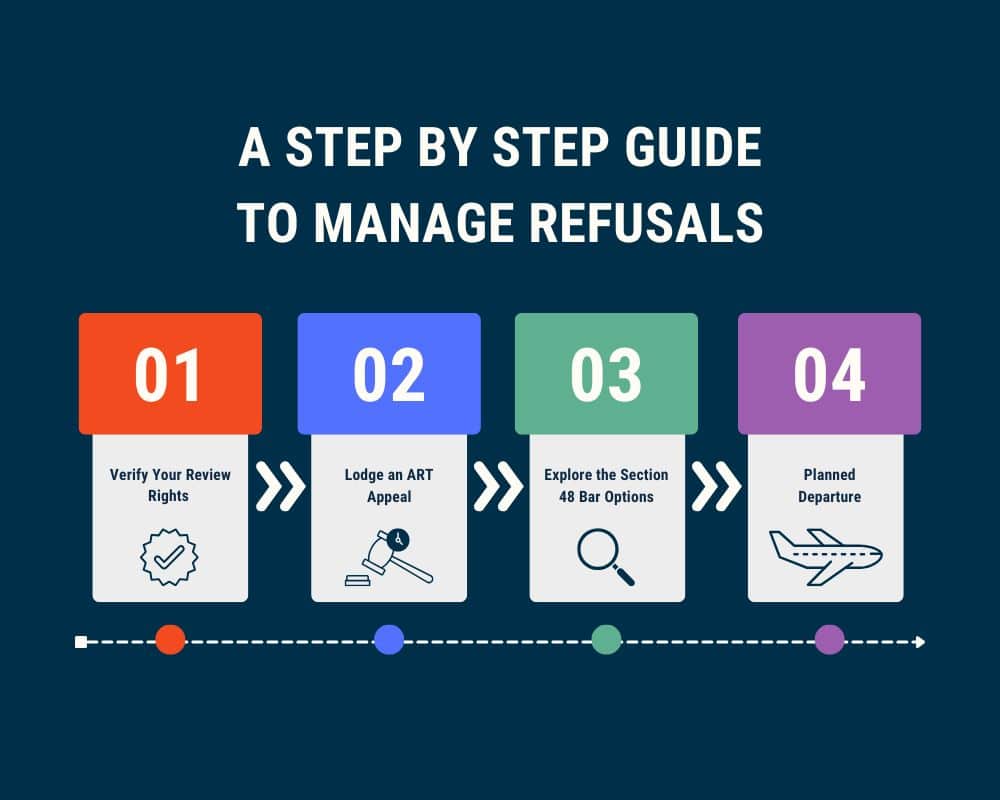
Step 1: Verify Your Review Rights (The 21-28 Day Window)
Step 2: Lodge an ART Appeal
Step 3: Explore the Section 48 Bar Options
Step 4: Planned Departure
Note: With the Changes in the migration scenes of Australia in the late 2024/25, the ART has officially replaced the AAT so make sure that you lodge your application through the ART portal as 2026 refusal appeals should be lodged there.
FAQs

A bridging visa is a short-term, transitory visa that lets you stay in Australia legally while your immigration status is being worked out. Its main goal as the name suggests is to bridge the time between the expiration of your current substantive visa and the outcome of your new visa application. You would become an unlawful non-citizen” as soon as your present visa expires without it.
Your particular grant notification will determine this. The following categories often apply to employment rights on a BVA in 2026:
- Automatic Rights: You frequently get full work rights immediately if you apply for specific visas (such as the 485 Graduate or Partner 820).
- Inherited Rights: The BVA has the same terms as your prior visa for a large number of applicants.
- Requesting Rights: You can apply for a new BVA with work rights by filing Form 1005 if your current BVA has a “No Work” condition, but you are experiencing financial difficulties.
In order to be eligible for a BVA (Subclass 010) in 2026, you have to fulfill three strict requirements:
- When you apply, you have to be in Australia.
- When you submit your new visa application, you must be in possession of a valid substantive visa (such as a student, visitor, or 482).
- Before your current visa expires, you must submit your new application. You will probably be transferred to a Bridging Visa C (BVC) if you apply after it expires.
No. The fact that a BVA lacks a re-entry facility is a crucial rule. If you depart Australia while your BVA is in effect, it will expire right away, and you won’t be able to come back until your new visa is approved (which might take months abroad). Before you leave, you must apply for and be granted a Bridging Visa B (BVB) in order to travel and return.
Yes, but only if your BVA is connected to an application for Permanent Residency (PR) (such a Skilled Independent 189/190 or Partner Visa).
- Eligibility: The “Acknowledgement of Application” for your PR visa and your BVA grant notice are required.
- Requirement: You must either have a spouse, parent, or child who is an Australian citizen or permanent resident, or you must have employment privileges on your visa.
- Exclusion: BVA holders are typically ineligible for Medicare if they are awaiting strictly temporary visas, such as a student or visitor visa.

In 2026, managing a Bridging Visa A demands more than just filling out a form, it also demands a solid application against the recent policies implemented by the Department of Home Affairs. We at BJay Education and Visa Services create migration pathways that safeguard your ability to live, work, and travel in Australia rather than simply filing your applications.
Why BJay?
- Decade Long Experience: With more than 13 years of experience in migration and visa services, BJay education and Visa Services provide you with the help you require.
- Verified Expertise: With a team led by Jaya Prakash Oli (MARN: 1570827), a Registered Migration Agent and Qualified Education Agent Counsellor with deep roots in both the Sydney and Nepalese communities, BJay has an expert team that can help you.
- Zero-Gap Compliance: To guarantee a smooth BVA activation and avoid any illegal gaps that can result in a three-year re-entry ban, we employ sophisticated VEVO monitoring.
- Global Presence: Regardless of your time zone, we offer round-the-clock assistance from our specialized offices in Sydney, Kathmandu, and Birtamod.
Start your Bridging Visa A application process and take a Step forward towards your Australian Dream. Book a Free non-obligatory Consultation with BJay!