
Labour Market Testing (LMT) has been impacted significantly with the adoption of an Integrity-First strategy by Australia’s migration system in 2026 for businesses, transforming it from a formality into a thorough examination. Nomination rejections have increased as a result of small advertising technicality. The requirements for nomination approval by the Department of Home Affairs (DHA) are described in this given guide by BJay Education & Visa Services.
With a 94% acceptance rate for different visa categories and a wealth of experience overseeing labor market testing for over 2,500 business nominations, the guide by BJay education & Visa Services offers crucial LMT standards, exclusions, deadlines, and efficient advertising tactics for compliance. For 73% of first-time nominators, the obligatory requirement that firms show efforts to hire local workers presents difficulties.
Labour Market Testing (LMT)
Labor market testing is the process where a company has to demonstrate that it has made its sincere effort to hire an employee for the required posts from their local community or Permanent residents before looking for sponsoring an overseas worker. The company needs to convince the DHA that they sincerely tired but failed to hire locally with accordance with the Migration Act of 1958.
Core Purpose of the Labour Market Testing:
- Verify genuine skills shortages
- Protecting local employment opportunities
- Validate TSMIT compliance ($76,515 CSIT 2026)
- Support employer nomination credibility
Applicable Visas for the Labour Market Testing
There are certain Applicable visas that are eligible for the Labour Market Testing.
Labour Market Testing Requirements
The program’s regulations have been updated significantly, especially in late 2023, and they have been further improved for the 2026 program year. The removal of the required Workforce Australia advertisement, which reduces the overall requirement from three legitimate advertisements to two, is a significant change.
The Two-Advertisement Rule
For the Labour Market Testing Requirements, if you are a company owner then you are required to conduct 2 different advertisements for the specific job. The Advertisement can be given in the following platforms:
- On a well-known, nationally available professional recruitment website (such SEEK, indeed, LinkedIn, or Jora).
- If the sponsor is an Approved Sponsor, it can be seen on the company’s website.
- Either on national radio or in national print media.
The 28-Day Duration
For the Labour Market Testing Requirements, the company has to have had the advertised advertisement for at least 28 days calendar days before sponsoring an overseas employee for the work.
The 4-Month Validity Window
Labour Market Testing (LMT) must be completed within the given duration of 4 months immediately prior to lodging the nomination. If your ads were placed 5 months ago, they are legally expired, and the nomination will be refused.
Mandatory Content for Advertisements
To be valid for advertising in the specific visa subclasses nomination, the ad must have the following to be considered as a valid advertisement qualified for the Labour Market Testing:
- Your Ad must be in English language.
- Have a clear description of the position role in the title
- Have a clear sponsor name or the name of the recruitment agency used.
- The advertisement needs to have a clear and detailed list of the skills and experiences that are required for the specific post.
Salary
For the Labour Market Testing, it is required that the pay or salary range for the position be clearly stated in the job post when yearly earnings are less than AUD $96,400. For interested applicants, this requirement guarantees compensation transparency.
| Requirement | Details | Evidence |
|---|---|---|
|
2 Advertisements |
SEEK + Job active OR 2 recruitment platforms |
Screenshots + URLs |
|
Minimum Duration |
4 weeks total (non-consecutive OK) |
Start/end dates |
|
Timing Window |
Within 4 months of nomination lodgment |
Timestamps |
|
Content |
Position title, skills, salary, sponsor name |
Exact ad copies |
|
Salary |
Market rate ≥ AUD $76,515 CSIT 2026 |
Advertised range |
Labour Market Testing Timeline
Knowledge of the LMT timetable is important to ensure that the timeline of your recruitment process satisfies the specific requirements of the Department of Home Affairs in order to guarantee a successful nomination in 2026.
In light of the entry to the Skills in Demand Subclass 482 visa program, sponsors now need to pledge a specific 4 month validity period and a nominated 28-day advertising period to avoid automatic refusal.
| Stage | Timeline/Duration | 2026 Compliance Note |
|---|---|---|
|
Ad Placement |
Day 1 |
Ads must include the company name and salary (if < AUD $96,400). |
|
Live Period |
28 Consecutive Days |
Do not count the day the ad is posted as Day 1; start from the next full day. |
|
Applications |
Minimum 28 Days |
You must be able to prove you accepted applications for full duration. |
|
Review & Interviews |
Days 29 to 40 |
Keep detailed notes on why local applicants were “not suitable.” |
|
Nomination Window |
Max 4 Months |
The 4-month clock starts from the start of the first ad. |
|
Visa Decision |
2 to 5 Months |
Priority is given to regional (494) and “Accredited” sponsors. |
A typical compliant workflow for a Skills in Demand nomination looks like this:
| Week Timeline | Description | Note |
|---|---|---|
|
Week 1-4 |
Seek AD Live |
Ensure the ad runs continuously without interruption. |
|
Week 2-5 |
Job active AD live |
Overlapping ads are permitted, provided at least one meets the 28-day rule. |
|
Week 5 |
Collect screenshots + applicant CVs |
Save time stamped screenshots, receipts, and a summary of all applicant CVs |
|
Week 6 |
Lodge Nomination |
Submit the nomination while the evidence is fresh and within the 4-month validity window. |
Labour Market Testing (LMT) Exemptions
Labour Market Testing (LMT) exemptions in 2026 will make life easier for Australian sponsors by speeding up nomination processing and cutting administrative expenses.
Australia complies with a number of International Trade Obligations (ITOs) that permit some qualified Skills in Demand (Subclass 482) candidates to completely avoid job adverts, even though LMT normally safeguards local jobs. As of January 2026, the document lists the primary types of employer exemptions from the 28-day advertisement rule.
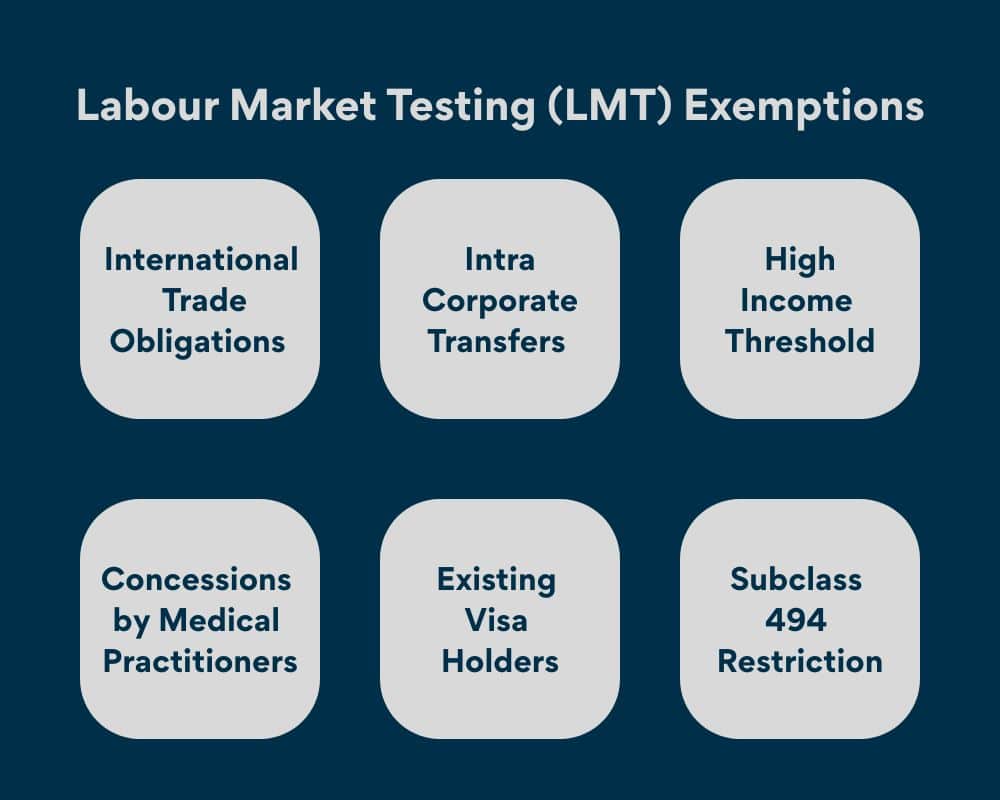
International Trade Obligations (ITO): The sponsors will be exempted of Labor Market Testing (LMT) as long as the nominee is a citizen or national of a country that has a qualifying trade treaty, such as the United Kingdom, China, Japan or the more recent UAE CEPA, which came into effect at the end of 2025.
Intra-Corporate Transfers (ICT): Top-level personnel such as the Executives and Senior Managers can be moved to an Australian company without necessarily advertising locally as long as they are natives of a member country of the WTO.
High‑Income Threshold: Salary Job titles with a specified annual salary of AUD 250,000 or higher (or 382,247.56 in certain high-end sectors) are automatically eligible to avoid the normal evidence in recruitment.
Concessions by Medical Practitioners: A huge majority of medical experts and ambulance personnel are covered by an exemption on an occupation basis, with no denying the fact that there is a chronic lack of staff in the Australian healthcare sector.
Existing Visa Holders: Another nomination of a person bearing a 482 or 457 visa does not have to generate new LMT, in case the only change is a restructuring of the business or a pay rise, as long as the position is the same.
Subclass 494 Restriction: Employers should understand that although there are many waivers with the 482 visa, the Subclass 494 (Regional) visa typically has no exemptions of LMT provided even under the international trade treaties.
Labour Market Testing Evidence Checklist
For successful nomination in 2026 for Skills in Demand (Subclass 482) or Subclass 494 nomination, it is critical to have an excellent evidentiary dossier. After abolition of Workforce Australia, there has been an increased focus of the Department of Home Affairs on the advertisement of genuine nomination purposes and nomination outcomes. A checklist for “Submission-Ready” compliance with the 2026 “Integrity-First” standards is provided.
- Advertisement Verification: The mandatory evidence that should be presented in the form of clear and dated screenshots of at least two specific advertisements and should be posted on national job sites, including SEEK and LinkedIn. The adverts should also be displayed as seen by the masses and not in an employer dashboard.
- Duration and link Verification: It has to prove that the ad was live for at least 28 consecutive days. This will be supported by the archived URLs or even receipts of payments which clearly state the date of initiation and end of the campaign.
- Recruitment Summary Report: An appropriately signed summary report is to be provided containing the total number of applications that are received and express, non-discriminatory causes of any decision that Australian citizens or permanent residents were unsuitable to the position.
- Salary and Detail Consistency: In cases that have remuneration lower than 96,400, then the advert should clearly indicate the amount of money or range that is exactly the same as the figures shown in the recruitment and the employment contract.
- Entity Identification: The advertisement should include the name of the Approved Sponsor or the recruitment agency acting on behalf of the entity, and this should be made completely transparent as to which agency hires the hiring.
- Currency of Evidence: All the recruitment processes must have occurred within the four months before the nomination is submitted in order to be recognized as valid by the Home Affairs Department.
Labour Market Testing Pitfalls
An error in the nomination application form may automatically mean a nomination rejection in the challenging environment of the 2026 migration scheme.
Nominators should be very precise in the details of their advertising campaigns because according to the data from the Department of Home Affairs, more than 73% of industry failures in nomination visa schemes are attributed to the violation of Labor Market Testing.
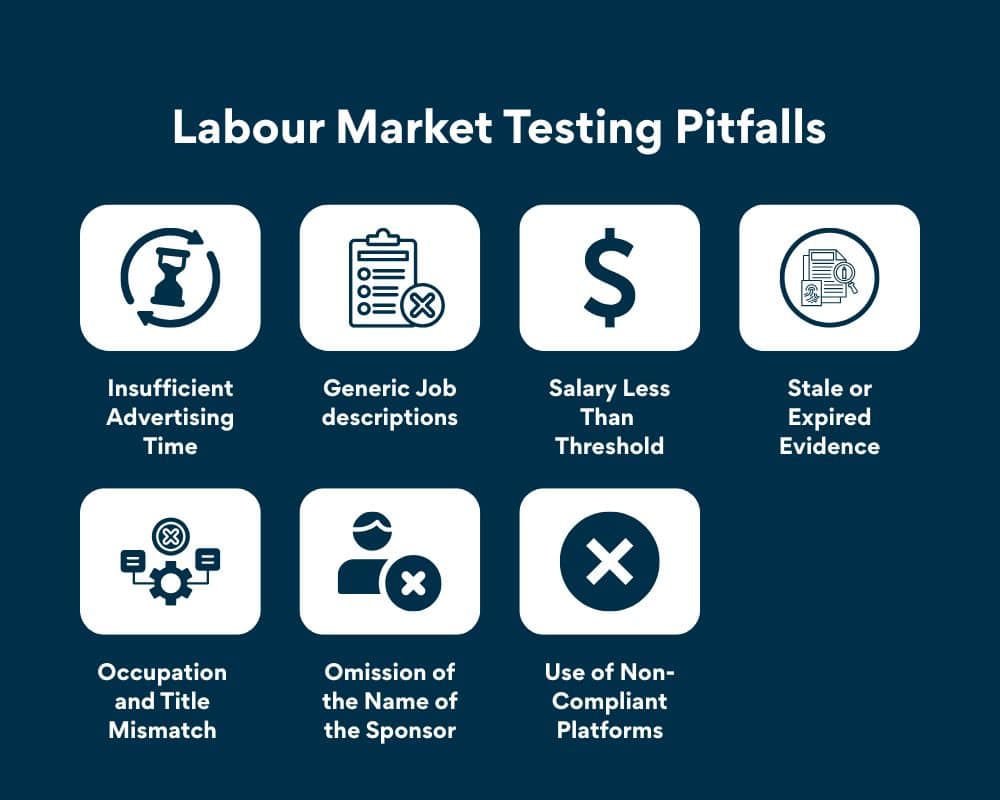
Insufficient Advertising Time: The advertising time of 27 days and below is an automatic ground for rejection and remedial action is not allowed since the number of 38 calendar days is mandatory.
Vague/Generic Job descriptions: The use of abstract job descriptions e.g. Experienced Professional without specifying specific tasks or required skills and qualifications will definitely lead to refusal as an advert has to outline clear competencies and requirements that can be matched with the relevant ANZSCO.
Salary Less Than Core Skills Income Threshold: Advertising compensation that is lower than the Core Skills Income Threshold (CSIT) of $76,515 (effective July 2025 – June 2026) is a common mistake that renders the recruitment effort invalid.
Stale or Expired Evidence: There are a lot of cases when the sponsor is using ads that ended over four months before nomination is submitted; it is not in accordance with the fact that Labour Market Test evidence cannot serve after 120 days.
Occupation and Title Mismatch: This is a frequent error as a job is being advertised under a particular occupation, like Chef, but a different occupation, e.g. Cook, is nominated. Case Officers severely punish this inconsistency.
Omission of the Name of the Sponsor: The failure to indicate the legal business name of the Approved Sponsor (or the approved recruitment agency) clearly does not pass the test of transparency that needs to be satisfied in order to create a bona fide vacancy.
Use of Non-Compliant Platforms: It is not acceptable to use only the social media notifications on websites like Facebook or Instagram, the DHA must use professional recruitment websites that are covered on a national level to place advertisements.
FAQs on Labour Market Testing

Labour Market Testing (LMT) is a mandatory compliance process in which an Australian employer must prove that there were genuine efforts to hire an Australian citizen or permanent resident before they sponsor someone overseas to work. In the case of the Skills in Demand subclass 482 and subclass 494 visa, it will involve placing at least two ads in national websites like SEEK or LinkedIn over a period of at least 28 days.
The minimum requirement as per the Labour Market Testing is 28 days’ active advertisement. However, we suggest a total of 35-40 days at BJay to have adequate time to collect evidence, go through CVs of applicants and prepare the obligatory Recruitment Summary Report before the 4-month validity period runs out
Labour Market Testing is technologically not a legislative condition to the subclass 186 Employer Nomination Scheme Direct Entry stream. However, a test of Genuine Need is still used by the Department of Home Affairs (DHA). In case a business does not provide any indications of local hiring, the case officer might decide that the job was designed with the sole purpose of migration, a fact that could lead to a lack of genuineness refusal.
Exemptions are usually created as part of International Trade Obligations (ITO). Advertising can be skipped in case the nominee is a citizen of one of the treaty countries (the United Kingdom, Japan, or the new United Arab Emirates CEPA). Additionally, transfers within the companies of top managers and high-income (over 250 000) employees tend not to be subjected to regular LMT.
Although Labor Market Testing is used with reference to the 28 days advertising of a solitary vacancy, a Labour Market Assessment is typically an industry report. Labour Agreements or regional concessions often demand such an assessment to show that there is systemic inadequacy of a specific ANZSCO occupation within the whole Australian economy.
The practice of setting and supporting the Annual Market Salary Rate (AMSR) of a particular post is known as market salary testing and is what ensures that an overseas employee is not getting lower pay than what is expected locally. Even in case the requirement of the TSMIT floor of 76,515 is fulfilled in 2026, labour-market outlook statistics or remuneration surveys results must be presented to show that an Australian member of the workforce would earn the same amount in the same geographical territory.
In case the remuneration in the Labour Market Testing advertisement is lower than in the AMSR, the nomination can be denied on the basis of the non-observance of the terms and conditions of the market in the AMSR.
The legal minimum of the Labour Market Testing is 28 days straight, but the whole process of the end-to-end process takes about five to six weeks. This time will include the initial advertisement, the mandatory four weeks live and the next stage, Review and Interviews and documents will be provided to illustrate why the local candidates were not selected. Any evidence can only last up to four months; after the nomination is not submitted within a period of four months the 28-day testing cycle should once again be repeated.

Choosing to sponsor a skilled worker or apply for a visa in 2026 is a significant life and business decision that requires a solid migration strategy beyond simple paperwork. Our focus at BJay Education & Visa Services is turning your sponsorship goals into a long-term future.
Why Choose BJay Education & Visa Services?
- MARA-Certified Migration Experts: Our team offers strong legal counseling. We make sure that every advertisement, residence day, and $76,515 TSMIT compliance check is precisely recorded in order to comply with the strict 2026 Skills in Demand (SID) requirements.
- Direct Industry Partnerships: For industries with significant demand, such as building, IT, and healthcare, we have priority access to resources. Our clients will benefit from faster turnaround times for Subclass 482 and 494 nominations as well as exclusive access to information on the most recent changes to the Core Skills Occupation List (CSOL).
- Onshore & Offshore Support: We are here for you at every stage, with offices located in Sydney, Kathmandu, and Birtamode. Our team is available to assist with everything from managing Labour Market Testing evidence to obtaining a successful “Genuine Student” (GS) or “Genuine Need” check.
- Proven Outcomes: Since 2011, we have successfully assisted more than 10,000 clients in navigating the Australian migration system. Hundreds of sponsors who correctly implemented Labour Market Testing and are now supported by long-term Australian Permanent Residents are among our success stories
Start your free non-obligatory Consultation with BJay today!