Parent visa 103 is the primary non-contributory permanent pathway for parents of Australian citizens, permanent residents, or eligible New Zealand citizens that is included in the Parents visa Australia program provided by the government of Australia. The Parent Visa 103 is the most cost-effective program within the Parent Visa Australia program which typically offers permanent residency without having to worry about the financial burden of high fees of the contributory streams.
This definitive guide provided to you by BJay Education & Visa Services, can be a perfect help for you to navigate the Parent Visa Australia system and programs, will discuss the eligibility criteria if you are eligible candidate or not, provide the latest visa fees according to the DHA data, and the also provide critical differences between the Subclass 103 and its alternatives making sure your family can make the right decision according to your specific needs that prioritizes financial planning and emotional well-being of the family.
What is the Parent Visa 103?
The Parent Visa 103 is a program under the Australian Parent Visa program that is designed to cater permanent visa for parents of settled Australian citizens, permanent residents (PR), or eligible New Zealand citizens. The parent visa 103 allows parents to live in Australia for indefinite period, provide Medicare access, and eventually lets the applicant apply for Australian citizenship, making it a true permanent parent visa Australia pathway.
The core defining feature of the parent visa 103 is its classification as a Non-Contributory visa. This means the government application fee (Visa Application Charge or VAC) is substantially lower than the fees for the Contributory Parent Visas (Subclass 143/864).
However, this affordability comes with an increase in the processing queue time, as the government limits the annual grants for this low-cost Parent Visa Australia category. The applications for the parent visa 103 can be lodged onshore or offshore but it requires departure before final grant of the Parent Visa.
Unlike aged parent visa subclasses needing pension eligibility, parent visa 103 welcomes parents of all ages within parent visa Australia allocations.
| Feature | Parent Visa 103 Details |
|---|---|
|
Visa Type |
Permanent (Offshore Grant) |
|
Parents Visa Australia Category |
Non-Contributory |
|
Location |
Onshore/Offshore Lodgment
(Offshore Grant)
|
|
Annual Cap |
1,700 places |
|
Rights |
Live, work, Medicare, citizenship |
|
Cost |
Low VAC |
|
Bridging Visa |
No (Generally) |
Source: DHA Subclass 103 Overview
Parent Visa 103 vs Other Parent Visas
If you are searching for the appropriate stream for your parents, then it is essential that you also select the appropriate visa option based on cost considerations and how urgently you require the visa. Below is the table of comparison that has been validated and updated for the 2025-2026 program year between the various programs provided:
- Contributory 143
- Aged Parent 804
- Sponsored 870
- Parent Visa 103
| Feature | Parent Visa 103 | Contributory 143 | Aged Parent 804 | Sponsored 870 |
|---|---|---|---|---|
|
Cost (Total) |
~AUD $7,345 + AoS |
~ AUD $48,640+ |
~ AUD $7,345 |
AUD $6,070 (3yr) / AUD $12,140 (5yr) |
|
Processing |
33+ years |
12–15 years* |
33+ years |
2–8 months |
|
BoFT Required |
Yes |
Yes |
Yes |
No |
|
Bridging Visa |
No |
No |
Yes(BVA) |
No |
|
Location |
Offshore grant |
On/Offshore grant |
Onshore grant |
Offshore grant |
|
Work Rights |
PR upon grant |
PR upon grant |
BVA during wait |
No |
|
Annual Cap |
~1,700 |
6,800 |
Part of non-contributory pool |
15,000 |
Document Checklist for Parent Visa 103 Application
If you want to make sure that your Subclass 103 application is moving smoothly through the heavy Department of Home Affairs backlogs, submitting a decision-ready file is usually the requirement for a successful outcome. By organizing these documents at the initial phase of lodgment, you can make sure your application has a positive result.
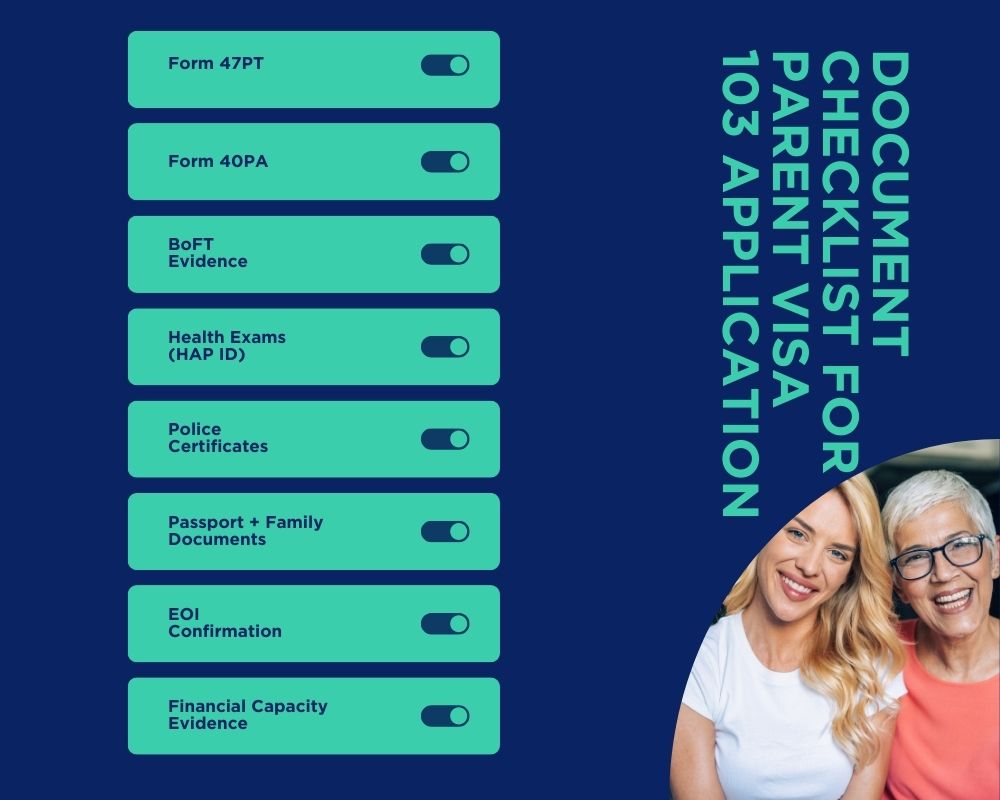
- Form 47PT (103 Application): If you are applying for the temporary contributory parent visa 103, you must submit this form as their main application.
- Form 40PA (Sponsorship): The required sponsorship agreement in which your Australian child formally agrees to provide for your initial stay.
- EOI Confirmation/Invitation: The official invitation from the Department of Home Affairs that is usually used to call you to lodge your full application.
- BoFT Evidence: To meet the strict standards of the Balance of Family Test, all children must have complete birth certificates and proof of residence.
- Health Exams (HAP ID): Medical results from a DHA-approved physician showing the applicant meets the “No Health Waiver” standards of the program.
- Police Certificates: Character clearances from every country where the parent has resided for 12+ months over the last 10 years.
- Passport + Family Documents: High-quality certified copies of valid passports, marriage certificates, and national ID cards to verify identity.
- Financial Capacity Evidence: Bank statements or income evidence proving the sponsor can financially support the parents during their two-year temporary residency.
Parent Visa 103 Eligibility
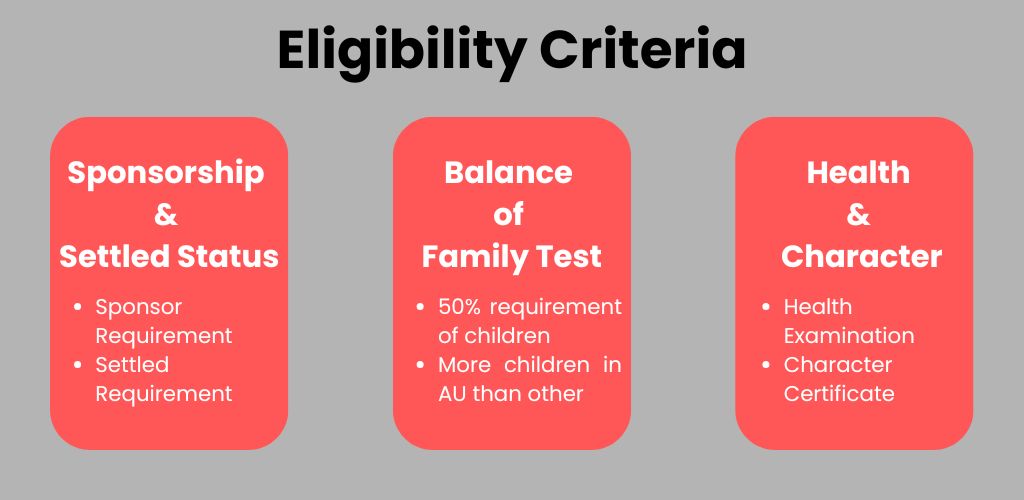
For you to be successful in your Parent Visa 103 application, you(applicant) and the sponsor should follow certain rules that are outlined by the DHA:
Sponsorship & Settled Status
- Sponsor Requirement: A qualifying kid who is either an Australian citizen, a permanent resident of Australia, or a qualified citizen of New Zealand must sponsor the application or sponsored individual.
- Settled Requirement: In order to obtain a visa, the applicant sponsor must demonstrate that they are “settled” in Australia. The sponsor must always confirm that they have been a lawful resident of Australia for at least two years.
“Balance of Family Test” (BOFT)
The Balance of Family Test confirms that the parents’ primary family ties are in Australia. One of the following conditions must be met by the applicant wishing to sponsor the visa:
- More of the candidate’s children reside in Australia than in any other country
- At least 50% of the applying children are citizens or permanent residents of Australia, or eligible citizens of New Zealand who regularly reside in Australia.
Health & Character
The following Australian standards for character and health must be met by all candidates and any accompanying family members:
- Health: To verify the applicant’s health, the required medical examinations must be performed by a DHA-approved physician.
- Character: Police clearance certificates from every nation where the applicant has resided for a minimum of 12 months during the previous ten years must be gathered in order to get insight into the applicant’s personality and circumstances.
Parent Visa 103 Full Cost Breakdown
As per the Data given by the DHA in their respective website, the parent visa 143 cost can be broken down into:
| Cost Component | Primary Applicant | Additional (18+) | Additional (<18) |
|---|---|---|---|
|
AUD $2,720 |
AUD $1,365 |
||
|
2nd installment |
|||
|
AoS Bond |
AUD $7,500 |
AUD $3,000 |
N/A |
|
Health Exams |
AUD $600-$900 |
AUD $600-$900 |
AUD $600-$900 |
|
Police Certificates |
AUD $200-400/country |
AUD $200-400/country |
AUD $200-400/country |
|
Total Estimate |
AUD $15,745 |
AUD $8,685 |
AUD $4,330 |
Source: DHA Visa Pricing Table & Services Australia AoS
Parent Visa 103 Processing Time
If you are someone who is considering the Parent Visa 103 pathway, the waiting time for the parent visa is the most significant factor that can influence the decision. The waiting time of it is extremely lengthy, main reason of the queue being the non-contributory stream (Subclasses 103 and 804) having an very low annual cap on visa grants, which ultimately leads in long processing times for the parent visa 103.
| Processing Milestone | Timeframe |
|---|---|
|
EOI → Queue Date |
4-8 weeks |
|
Parents Visa Australia Queue Wait |
Approx. 33 years |
|
Assessment |
6-12 months |
|
Health/Character/AoS |
3-6 months |
|
TOTAL |
33+ years |
Step-by-Step Parent Visa 103 Application in Parents Visa Australia
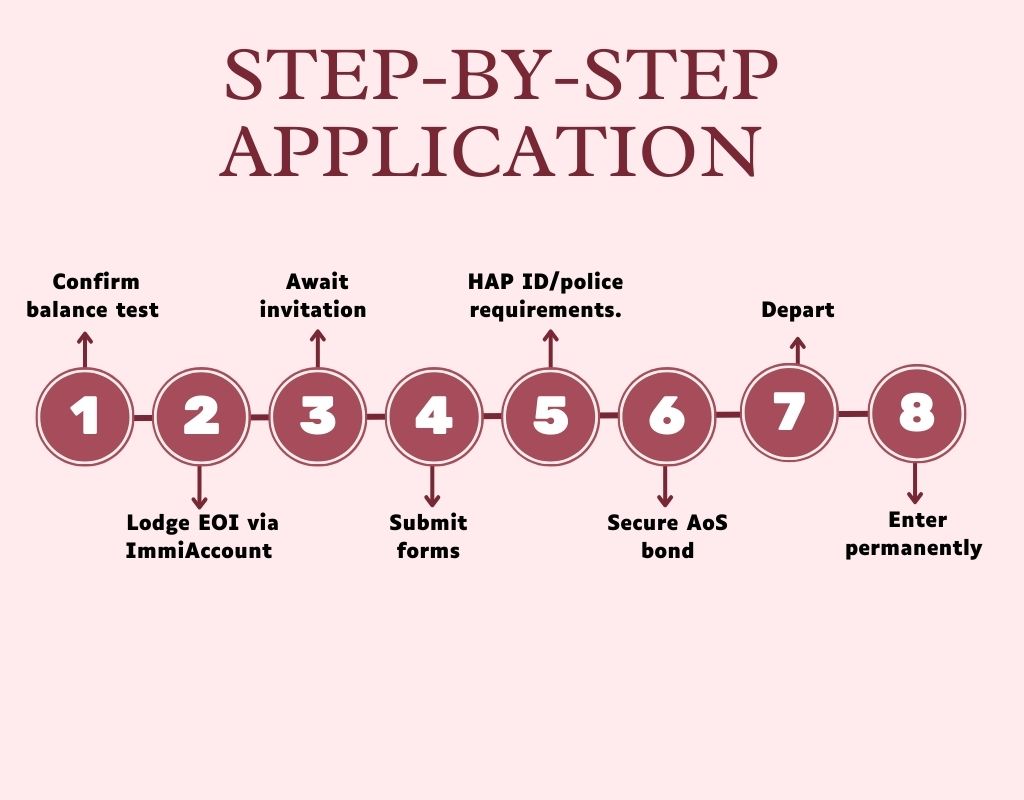
- Confirm balance test for parent visa subclass 103.
- Lodge EOI via ImmiAccount (parents visa Australia portal). (Since April 2025, applicants can import paper lodgments into ImmiAccount for better tracking.)
- Await invitation (approx. 33 years).
- Submit forms 47PA/40PA with aged parent visa-level proofs.
- Complete HAP ID/police requirements.
- Secure AoS bond (AUD $7,500 primary).
- Depart for offshore parent visa 103 grant.
- Enter permanently upon approval.
Common Pitfalls and solution for Parent Visa 103
If you want to succeed in the parent visa Australia program and get a Positive Parent Visa 103, you must look past the simple forms and understand the strict legal requirements that result in frequent rejections
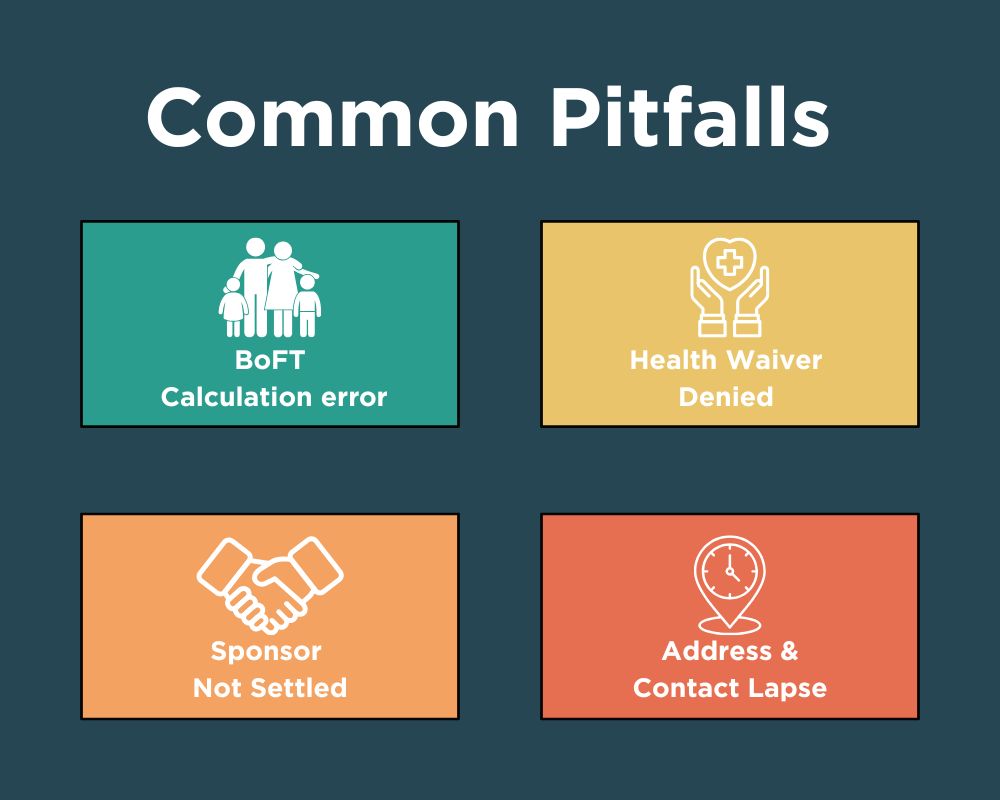
Pitfall: Balance of Family Test (BoFT) Calculation error
Your Parent Visa 103 requires at least 50% of your parent’s children live in Australia as citizens or PR holders. Before paying the non-refundable fees, make sure you fulfill the 50% ratio by conducting a family census that includes all biological and stepchildren.
Solution: Before paying the non-refundable fees, make sure you fulfill the 50% ratio by conducting a family census that includes all biological and stepchildren.
Pitfall: Health Waiver Denied (PIC 4005)
The contributory parent temporary visa subclass 173 is strictly governed by health criteria that do not allow for a waiver. If a parent is found to have a condition that may cost the Australian healthcare system more than $86,000, the application will be refused regardless of your family’s support.
Solution: Arrange for a private, comprehensive medical examination with a qualified physician before committing to the parent visa 173 cost. This allows you to assess potential risks early and decide if the contributory pathway is a viable long-term investment.
Pitfall: Sponsor Not Settled
A common reason for ineligibility is a sponsor who is an Australian PR or citizen but has not lived in the country for a continuous two-year period. If it comes to light that the child has been working abroad, the department can conclude that they are not settled, meaning the parent’s sponsorship will automatically be rejected.
Solution: You need to provide at least two Notice of Assessments from Australia and utility bills to prove your residency. However, if you have moved back to Australia, you have to wait until you can provide a clear residency document before proceeding with this process.
Pitfall : Address and Contact Lapse
Because the subclass 173 visa processing time can stretch over 15 years, many families forget to update their contact details as they move or change email addresses. If the Department sends a Request for Information (RFI) and it goes unanswered for 28 days, your application can be refused for non-compliance.
Solution: Log into your ImmiAccount annually to verify that all residential, postal, and digital contact information is current. This simple maintenance task ensures you never miss a critical update that could determine the success of your PR journey.
Parent Visa 103 FAQs

Parent visa 103 is a visa program under the Parent Visa Australia programs that strives to offer permanent residency (PR) to the eligible parents of Australia sponsors via 33+ year parents visa Australia queues at the affordable cost of AUD $5k, requiring offshore grant.
The core difference between the Aged parent visa 804 is that it stays onshore with bridging whereas the parent visa 103 needs offshore grant without bridging.
No. The subclass 103 requires offshore grant unlike aged parent visa onshore options.
The core difference between the 143 and the parent visa 103 is the cost and the processing time involved in it.143: 15yrs/AUD $48k contributory; parent visa 103: 33+ yrs/AUD $5k non-contributory.
The Processing time of the Parent Visa 103 is extremely backlogged and usually takes approx. 33years total. According to the DHA, it is currently processing June 2013 queues in parents visa Australia system.
Permanent parent visa Australia includes parent visa 103 (33+ years non-contributory), parent visa 143 (15 years contributory), and aged parent visa options granting indefinite residency rights.

Get your free Consultation with BJay
Starting your journey in Australia can be hard and overwhelming, when it comes to knowing the requirements of the skill assessment, visa eligibility and the documents required for the process. That’s why we BJay Education & Migration offer you a completely free, no-obligation consultation service so you can get all the support you need and boost the chances of studying or working in Australia.
Take the Free Consultation Today: Book your free consultation with BJay and let us guide you through every hurdle that comes in the path of you and a positive skill assessment in Australia.
Related: Sponsored Parent Visa 870, Parent Visa 173