
Skilled Occupation List is the list that the skilled migration program heavily depends upon which identifies the occupations eligible for various skilled visa subclasses. In the current transition period of the 2024-2025 program year, Australia is now introducing the Core Skills Occupation List (CSOL) which is likely to take the role of the scattered legacy occupation lists and hence can better align with the nation’s labour demands.
This guide on Skilled Occupation List Australia is brought to you by BJAY Education and Visa Services which aims to covers the latest happenings on CSOL, the continuing role of state-specific skilled occupation lists such as the NSW Skilled Occupation List, and key information for visa applicants navigating this evolving landscape.
What is Core Skills Occupation List (CSOL)?
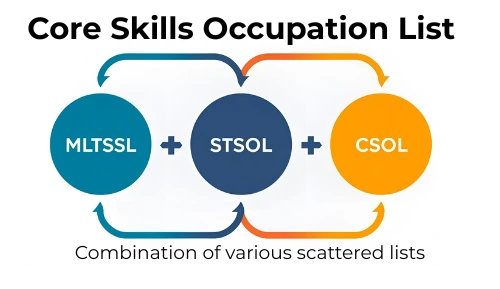
With various prior list like The Medium and Long-Term Strategic Skills List (MLTSSL), Short-Term Skilled Occupation List (STSOL), and Regional Occupation List (ROL) being scattered, the Australian government has decided to combine all these lists and form the Core Skills Occupation List which will be identified by Jobs and Skills in Australia. This list is specifically focused on high-demand occupations across all Australian regions and industries.
Although the CSOL is said to be fully implemented during the 2024-2025 program year, the exact dates for the implementation remain subject to change based on government announcements of Australia. The current skilled occupation lists remain valid until the CSOL is officially operational.
Key Occupations served by Core Skills Occupation List
CSOL emphasizes ANZSCO-coded roles eligible for multiple visas. The list of the eligible skilled occupations evolves rapidly. So, you are requested to check the official site for the CSOL list for the latest updates. CSOL supports the new Skills in Demand visa occupation list, bridging temporary and permanent pathways. Here’s a quick overview of the priority occupations.
| ANZSCO Code | Occupation | Visa Eligibility | Sector |
|---|---|---|---|
|
2544 |
Registered Nurses |
189, 190, 491 |
Healthcare |
|
2613 |
Software Programmers |
189, 190 |
Digital & ICT |
|
2332 |
Civil Engineering Professionals |
189, 190, 491 |
Construction |
|
3411 |
Electricians |
189, 190, 491 |
Energy |
|
2621 |
Cybersecurity Specialists |
189, 190 |
Digital |
Source: ANZSCO
While everything in a visa process and application is crucial, one of the most important and initial steps is selecting an eligible occupation according to the appropriate list.
Subclass 189 (Skilled Independent visa): Requires nomination of an occupation on the national skilled occupation list. Even though the minimum score required is 65 points, the requirements for in-demand occupations typically demand between 90 to 110+ points.
Subclass 190 (Skilled Nominated visa): The requirement is a nomination from a state using the corresponding skilled occupation list. While the minimum required score to obtain a skilled nominated visa is 65 points, competitive applicants commonly reach over 80 points. State nomination awards an additional 5 points.
Subclass 491 (Skilled Work Regional Provisional visa): the subclass 491 visa requires nomination by a designated regional area. Similar points requirements as subclass 190 apply with typically 70+ points needed for competitive occupations. This provisional visa can lead to permanent residency via Subclass 191 visa.
The points test for the Skilled Occupation List has a clear and transparent ranking order. When you optimize your application in all areas, you rank higher on the ranks on the Skill Select list.
- Age (Max 30 Points)
The age points are fixed at the time of receiving your Invitation to Apply (ITA) and not at the time your EOI is submitted. The age limit for it is as below:
- 18–24 years: 25 points
- 25–32 years: 30 points
- 33–39 years: 25 points
- 40–44 years: 15 points
- 45+ years: 0 points (Generally ineligible for GSM)
- English Language Proficiency (Max 20 Points grant)
In the point scoring criteria, English language proficiency is often the easiest variable that can help to boost your score. Hence, to boost your score you can check the scores and points linked below:
- Competent English Score of IELTS 6.0 / PTE 50: 0 points
- Proficient English Score of IELTS 7.0 / PTE 65: 10 points
- Superior English Score of IELTS 8.0 / PTE 79: 20 points (which is highly recommended for 189/190 visa applicants)
- Skilled Work Experience (Max 20 Points granted)
You can claim points about the experience you have gained in the last 10 years. Also remember that the total combined points for overseas and Australian experience cannot exceed 20. Hence, you can find the respective scores that you can gain below:
- Overseas experience of 3–5 years (5 pts)
- Overseas experience of 5–8 years (10 pts)
- Overseas experience of 8+ years (15 pts).
- Australian Experience of 1 year (5 pts)
- Australian Experience of 3 years (10 pts)
- Australian Experience of 5 years (15 pts)
- Australian Experience of 8+ years (20 pts).
- Educational Qualifications (Max 20 Points)
You can claim points about the educational qualification you have achieved in your lifetime. Hence, you can find the respective scores that you can gain below:
- PhD (Doctorate): 20 points
- Bachelor’s or master’s Degree: 15 points
- Diploma / Trade Qualification: 10 points
- Specialist Education (STEM): +10 points (For Australian Research Masters or PhDs in specific fields).
Current Occupation Lists Valid Until 2025
These older skilled occupation lists will remain effective during transition for the 2024-2025 program year. Applicants must continue to refer to the current lists of skilled occupations until the CSOL is fully applicable, after which time it will have the governing role over skilled migration nominations.
State Skilled Occupation List
State and territory governments continue to have their own set of skilled occupation lists, which then addresses the regional labour market needs. These lists complement the national CSOL and create important pathways for both Subclass 190 and 491 nominations.
New South Wales (NSW) Skilled Occupation List
The NSW Skilled Occupation List mostly provides emphasis on industries like healthcare, fintech, and infrastructure. NSW gives preference to applicants who already have work or study history in the state.
Key occupations of NSW include:
- Registered Nurses
- Software Programmers
- Civil Engineers
Learn more about the NSW Skilled Occupation List 2025
Victoria Skilled Occupation List
Victoria focuses on technological roles in Melbourne and critical healthcare occupations in regional areas. Candidates often need to commit to living and working in Victoria.
Key occupations of Victoria include:
- Software Engineers
- Registered Nurses
- ICT Managers
Learn more about the Victoria Skilled Occupation List 2025
Western Australia (WA) Skilled Occupation List
WA’s skilled occupation list leans towards trades and specialized roles in mining and energy, generally offering a less competitive migration pathway.
Key occupations of WA include:
- Mining Engineers
- Electricians
- Civil Engineering Draftspersons
Learn More about the Western Australia Skilled Occupation List 2025
South Australia (SA) Skilled Occupation List
South Australia provides various distinct pathways, including concessions through
Five Essential Success Steps on How to Apply
- Occupation Eligibility Check
- Skills Assessment
- Points Calculation
- Submit Expression of Interest (EOI)
- Invitation and Application
Skilled Occupation List Selection Roadmap
Choosing the right occupation has become the most crucial step in the immigration process to Australia in 2026. With the CSOL list introduction and the transition from the old 482 visa to the Skills in Demand framework, matching your daily duties to the correct ANZSCO code is now more difficult and under big scrutiny.
| Stage | Key Task | Authority / Tool | Est. Cost (AUD) |
|---|---|---|---|
|
Stage 1 |
ANZSCO Mapping |
ABS / Home Affairs |
Free (Self) |
|
Stage 2 |
Skilled Assessment |
VETASSESS, ACS, ACWA, etc. |
AUD $1,000 – $1,300 |
|
Stage 3 |
English Proficiency |
IELTS / PTE Academic |
AUD $475 |
|
Stage 4 |
EOI Lodgment |
SkillSelect |
Free |
|
Stage 5 |
Visa Lodgment |
ImmiAccount |
AUD $4,910 (Subclass 189/190) |
- Professional Skills Assessment (The Gatekeeper)
You need to apply for a Skilled Assessment for an occupation that matches your experience in the field. The entities functioning as gatekeepers in the year 202 are VETASSESS, TRA, ACS, and ACWA. You would also need to undergo a waiting period of between 12 and 16 weeks in this process.
The Concerned Authorities have started utilizing AI matching facilities in their process to make sure your “Statement of Duties” is a perfect match to the ANZSCO dictionary. Lack of a perfect match between the two elements causes a negative result that is not applicable to a visa.
- Occupation & List Verification
Not all jobs are eligible for the variety of all types of visas. So, as of 2026 it is necessary to check which occupation is on a range of lists and whether you are eligible or not. The Core Skills Occupation List (CSOL) is regarded as the “best” for the Employer-Sponsored visa (186/482) and the Skilled Independent visa (189).
State-Specific Lists: Every state has its own Requirements and most demanded job accordingly, as per NSW or VIC. Many occupations appear on the state lists only. Thus, one of your few options will be Subclass 190 or 491.
- SkillSelect EOI Submission
Once you attain a Positive Skilled Assessment result, you make your SkillSelect Profile. This is called an ‘Expression of Interest’ (EOI), not an application for visa approval.
Additionally, you are required to claim points for various sections like Experience, English (IELST/PTE), and Age. However, to stop fraudulent applications, DHA has introduced a MFA system so the applicants must now complete Multi-Factor Authentication prior to accessing SkillSelect as of 2025.
- Invitation Rounds & Priority Sectors
The Department of Home Affairs changed to a Quarterly Invitation Model in 2026.
The invitation system is not just about Highest Point Wins. The extent of the invitation system’s weightage has shifted overwhelmingly to priority sectors such as Healthcare, Education, Construction, and Green Energy.
High demand job titles such as “Software Engineer” or “Accountant” are pro-rated to avoid exhausting slots for the month.
- The 60-Day Deadline
When you are invited to apply for a visa, if it is an Invitation to Apply (ITA), you will have a total of 60 days to apply for your visa. There is no extension to this deadline at all so make sure you do not miss it. The date on which your EOI included the documents must be valid on or before your Invitation to Apply date.
Essential Steps to Success with Skilled Occupation List
In 2026, the Australian Scheme of Skilled Migration is more specific than before. To pass in the Core Skills Occupation List (CSOL) and other State Lists, it is necessary to apply a multifaceted strategy. Finally, because each state, such as NSW, VIC, and WA, and others, possesses their own priority sector” and quotas, same applications will not work.
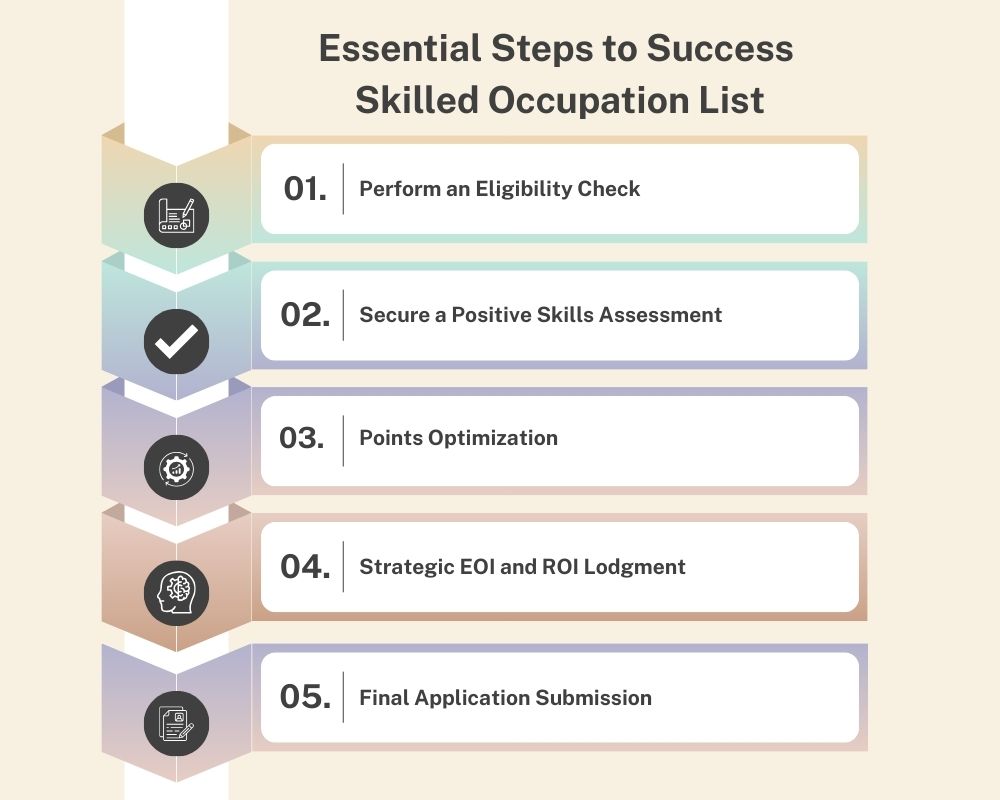
- Perform an Eligibility Check
You should use the list of eligible skilled occupations tools to make sure that you are eligible candidate and job is not mismatched.
- Secure a Positive Skills Assessment
You are mandatorily required to have a Positive outcome of the Skills Assessment.
- Points Optimization
Maximize your points that you can be granted by scoring and getting points through point granting section like English Proficiency and work experience.
- Strategic EOI and ROI Lodgment
Submit a high-quality EOI for each state you are genuinely willing to live in, ensuring all claims are backed by Decision-Ready documents.
- Final Application Submission
Make sure you have gathered required certifications like police certificates and health checks.
Frequently Asked Questions (FAQs) on Skilled Occupation List

The CSOL, which is Australia’s combined list of priority occupations drawn from various past lists, which will govern all skilled migration nominations for the 2024-2025 program year and thereafter.
State/territory occupation lists for state-sponsored visas (Subclass 190 and 491) complement the CSOL, reflecting local labour needs and possibly making nominations easier in those areas.
Yes, they will continue to apply between program years 2024 and 2025 until the CSOL becomes fully effective.
Western Australia is generally regarded as offering the lowest competition for mining, energy, and trade occupations.
The minimum is 65 points for EOI submission, competitive invitations require 90 points or more for competitive invitations.

Navigating the skilled migration rules of Australia, particularly during significant changes such as the CSOL introduction, requires professional guidance. BJAY Education and Visa Services will keep you updated in real-time with personalized assessment and professional advice to optimize your pathway so that your application fully meets the current requirements and holds the highest chance for success.
We here at BJAY provide a free, no-obligation consultation to discover the best migration pathway for your skills. Contact us now!